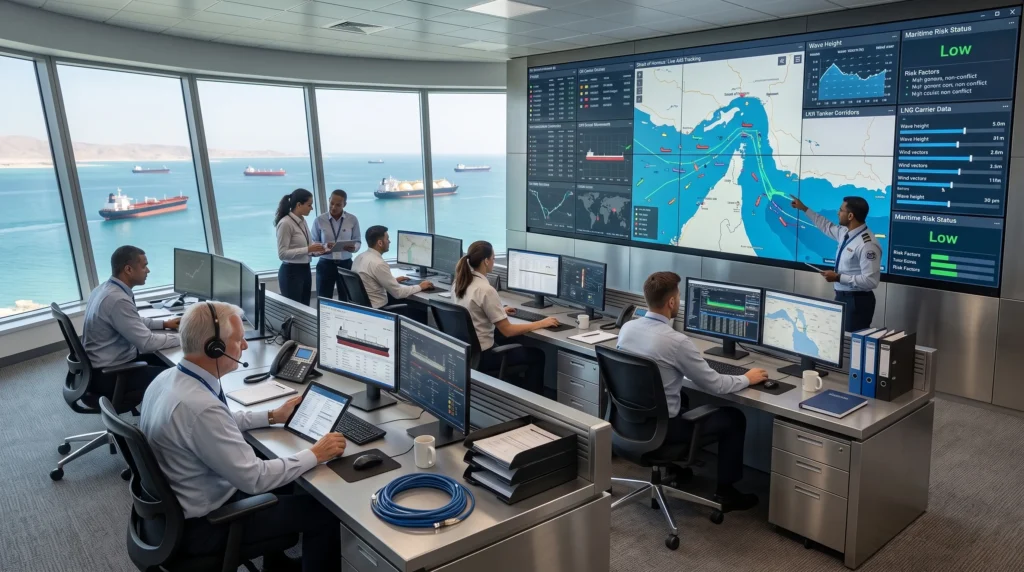
The Strait of Hormuz is once again at the center of international attention following a new escalation of tensions in the Middle East, testing the ability of energy logistics chains to maintain the flow of oil and liquefied natural gas (LNG). Although geopolitical uncertainty continues to raise risk perception, the continuity of maritime operations demonstrates the resilience of one of the most important trade routes for global energy supply.
Each episode of instability in the Persian Gulf triggers an immediate reaction in international markets due to the relevance of the Strait of Hormuz as a corridor through which a significant share of global hydrocarbon trade passes. However, the experience accumulated over recent years has led operators, shipping companies, and producers to develop mechanisms that make it possible to maintain exports even under scenarios of heightened regional tension.
This ability to adapt explains why fluctuations in international crude prices often respond not only to geopolitical events, but also to perceptions regarding the effective continuity of energy flows.
Strait of Hormuz sustains energy transport under risk conditions
The Strait of Hormuz is one of the main maritime corridors for exports of oil and liquefied natural gas from the Gulf. Through this route, the region’s major producers are connected with strategic markets in Asia, Europe, and other economies dependent on energy imports.
When geopolitical uncertainty increases, shipping companies, port operators, and energy firms activate additional protocols related to route planning, risk management, insurance procurement, and logistics coordination to reduce potential disruptions.
Although these procedures increase operating costs and may temporarily slow some operations, they also strengthen supply continuity and limit the immediate impact on the international market.
Logistics resilience limits the impact on the oil market
Recent developments show that the Gulf’s energy infrastructure now has greater capacity to respond to complex scenarios than it did just a decade ago. Maritime terminals, storage hubs, pipelines, loading facilities, and digital tracking systems make it possible to maintain a high level of operations even when navigation risks persist.
This logistics resilience reduces the likelihood of prolonged disruptions and helps moderate international price volatility. Markets no longer react solely to political or military events, but also to concrete indicators related to export volumes, vessel movements, and the continuity of port operations.
For refiners, traders, and energy infrastructure operators, the effective availability of cargoes is now an indicator as important as the evolution of the conflict itself.
Maritime security will remain a decisive factor for global supply
The situation in the Strait of Hormuz confirms that maritime security will continue to play a decisive role in the global energy balance. Each new episode of tension requires a review of transport, supply, and risk management strategies, especially for countries highly dependent on crude and LNG imports.
In this context, coordination among governments, shipping companies, energy operators, and international organizations will remain essential to preserve the stability of maritime trade and ensure the functioning of global supply chains.
Beyond daily fluctuations in the price of oil, the industry’s real challenge is to maintain the logistics reliability of strategic energy corridors. The Strait of Hormuz’s ability to continue channeling exports under uncertainty confirms that operational resilience has become one of the main pillars of international energy security.
Source: Reuters