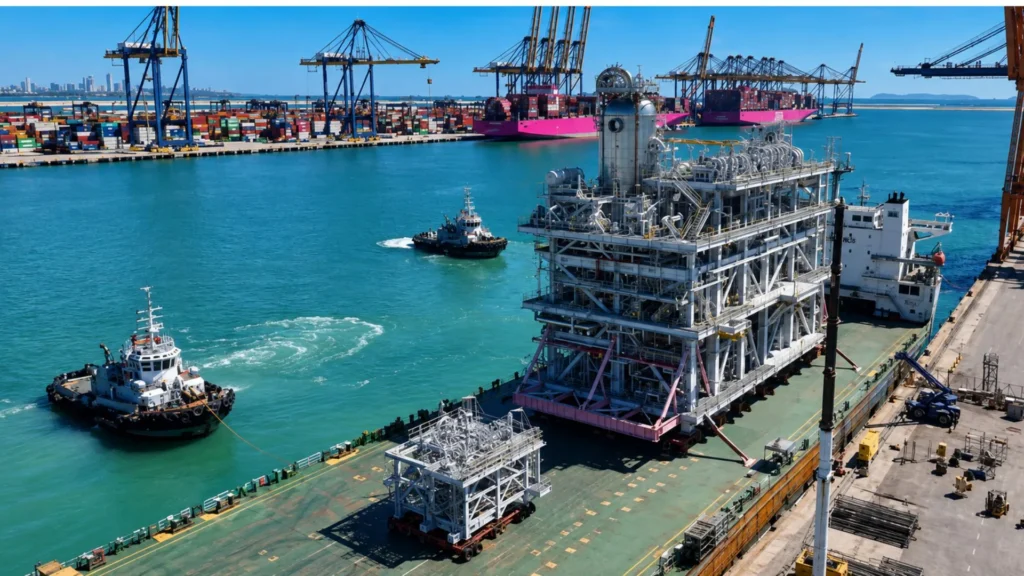
Woodside completed the delivery of the last module intended to modify Pluto LNG Train 1 in Western Australia. The structure, weighing approximately 4,500 tons, will allow the facility to be adapted to process gas from the Scarborough project.
The arrival of the module in Karratha marks the end of a four-year process that included planning, manufacturing, and transportation. With this progress, the gas project, valued at approximately US$12.5 million, remains on track to deliver its first LNG shipment during the fourth quarter of 2026.
Scarborough Project enters final phase to produce LNG
Work is now focused on installing, connecting and integrating the new module with Pluto Train 1, which must be ready to receive and process the gas extracted from the campo Scarborough.
The modifications to Pluto LNG are an essential part of the development. As of the end of the second quarter of 2026, Scarborough had reached approximately 98% completion and was maintaining its schedule to begin liquefied natural gas shipments before the end of the year.
The scale of the last module reflects the magnitude of the works; the structure weighs about 4,500 tons and reaches a height similar to that of a 10-story building, so its relocation required a highly complex logistical operation.
The module was manufactured over two years in Thailand
The process began with planning and design in London, subsequently, the structure was manufactured for approximately two years in Thailand before beginning its maritime transport to Western Australia.
The operation also required a detailed study of the land route to Pluto LNG, the teams had to evaluate bridges, drainage systems, services located above and below ground, and various foundations to ensure the safe passage of the structure.
Fiachra Gleeson, construction director, highlighted the coordinated work necessary to complete the transfer and noted that the arrival of the module was the result of the joint effort of the various participating teams.
The construction of the three integrated modules mobilized around 2,000 workers, in addition to the staff of Woodside and the contractor responsible for engineering, procurement, and construction management. In total, the structures incorporate thousands of tons of steel, piping, and industrial equipment. Before arriving in Western Australia, the final module traveled nearly 2,500 nautical miles.
Pluto LNG is preparing to receive gas from Scarborough
Woodside has also made progress on other components needed to bring Scarborough online, the floating production unit previously completed the connection of the underwater umbilicals and risers before starting the commissioning of its upper facilities.
The integration of this offshore infrastructure with Pluto LNG will allow the gas produced in Scarborough to be transported to the mainland, where part of those volumes will be processed and converted into LNG.
With the module now in its final position, the next activities will focus on completing the connections, integrating the systems, and carrying out the necessary tests on Pluto Train 1. The project schedule maintains the fourth quarter of 2026 as the target for the first LNG shipment.
Scarborough strengthens Australia’s gas infrastructure
Once operational, Scarborough will be intended to supply gas to both Western Australia and the Asia-Pacific markets. Woodside estimates that the project’s resources could generate an amount of energy equivalent to the consumption of more than 8.5 million homes for more than 30 years.
The installation of the last module thus represents one of the major large-scale tasks remaining before Pluto LNG Train 1 can begin processing gas from Scarborough. From now on, attention will focus on completing the integration and commissioning of the systems as Woodside moves towards the start of LNG shipments planned for the end of 2026.
Source: Offshore Energy
Photo: Woodside