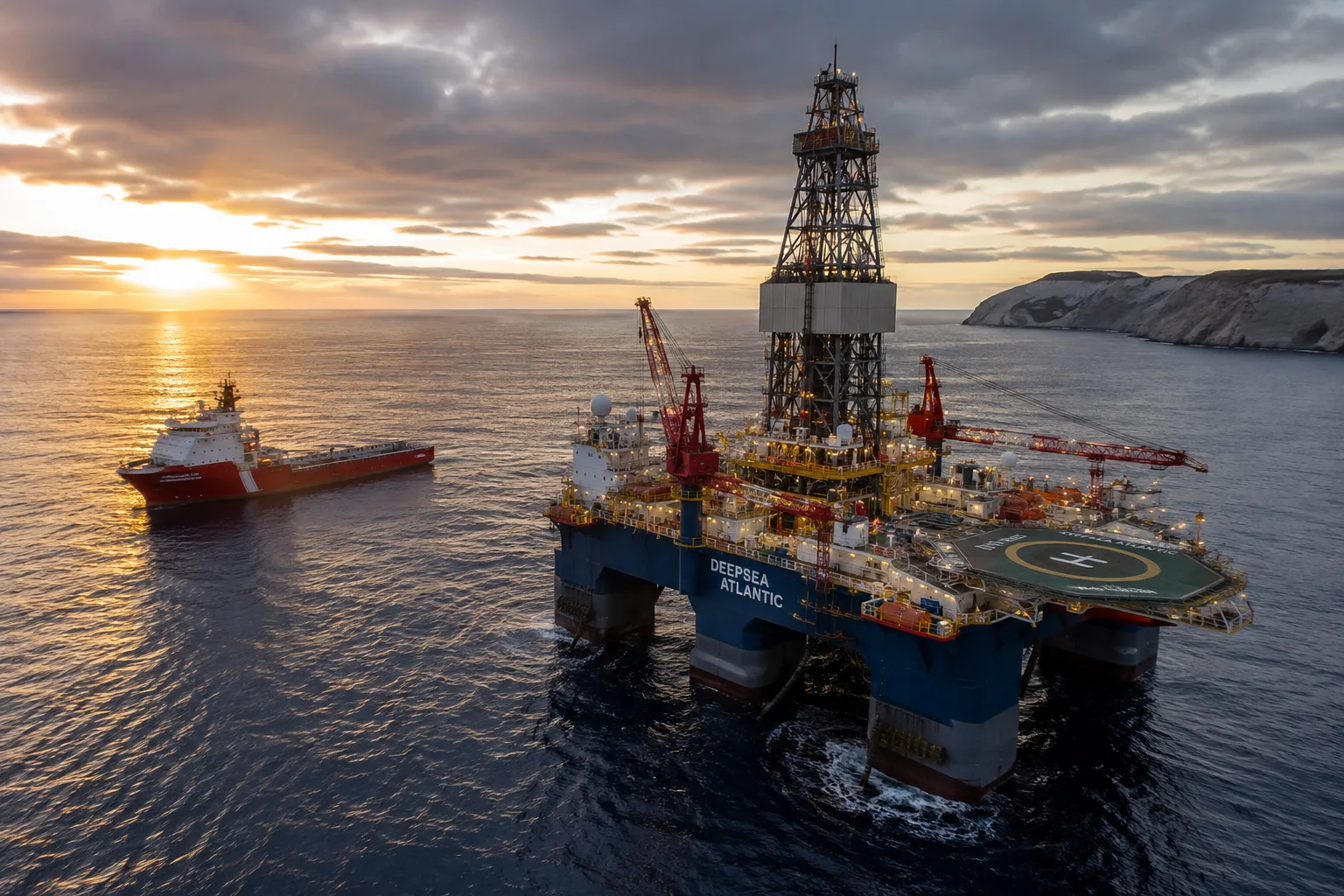
The Rosebank project has once again become a focal point in the United Kingdom’s energy sector following the return of the Deepsea Atlantic semisubmersible drilling rig to the field located west of the Shetland Islands. The unit resumed operations after being out of service for more than three months following an incident in April, when the Blowout Preventer (BOP) was accidentally dropped to the seabed during drilling activities.
Although the rig’s return marks an important step forward for the development of the Rosebank field, the companies involved are still working to recover the original drilling schedule while investigations into the causes of the incident and its operational implications continue. The event has also highlighted the critical importance of risk management in complex offshore operations, particularly for projects carried out in deepwater environments and under challenging operating conditions.
Rosebank project returns to the center of offshore activity
Rosebank is considered the United Kingdom’s largest undeveloped oil field and one of the most significant projects in the North Sea. Its first development phase includes the drilling of four production wells, three water injection wells, and two well abandonment operations. These activities are being carried out by the Deepsea Atlantic, a sixth-generation semisubmersible drilling rig operated by Odfjell Drilling under contract with Equinor.
The field’s development plays a strategic role in the future of the United Kingdom’s hydrocarbon production, not only because of its estimated recoverable resource volumes but also due to its potential contribution to the country’s energy supply over the coming decades.
BOP incident reshaped the operational schedule
On April 18, 2026, during BOP deployment operations, a failure in the lifting system caused the suspended load to be lost. As a result, the Blowout Preventer (BOP) and part of the riser fell to the seabed at an approximate depth of 1,100 meters. No injuries or signs of environmental pollution were reported; however, operations were immediately suspended to recover the equipment and assess the condition of the drilling rig.
The Deepsea Atlantic was subsequently moved to a shipyard in Bergen, Norway, where repair work, inspections, and equipment replacements were completed before the unit was cleared to return to the Rosebank field. At the same time, Odfjell Drilling launched an investigation in collaboration with equipment manufacturers and regulatory authorities to determine the root causes of the incident and implement corrective measures aimed at reducing the risk of similar events during future drilling campaigns.
Deepsea Atlantic’s return does not eliminate Rosebank project challenges
Although the drilling rig has returned to the operating area, several industry reports indicate that the incident could delay the Rosebank project’s development schedule. Current estimates now place the start of commercial production in 2027 rather than in the fourth quarter of 2026, as originally planned.
This revised timeline reflects not only the time required to repair the unit but also the need to repeat certain drilling activities and verify the proper performance of critical systems before operations can safely resume.
For a project of this scale, any change to the schedule results in logistical, financial, and contractual adjustments affecting both the operator and the specialized contractors involved in the field’s development.
Operational reliability remains a decisive factor
The incident at Rosebank serves as a reminder that well control systems remain among the most critical components of any offshore drilling campaign. The Blowout Preventer (BOP) represents the final safety barrier against a well control event, making its handling, maintenance, and installation highly controlled processes that require precise coordination among operators, contractors, and equipment manufacturers.
Beyond the immediate impact on the project schedule, incidents of this nature often lead to technical reviews, updates to operating procedures, and improvements in risk management programs. In an industry facing increasingly stringent safety and operational performance requirements, the ability to learn from such events is just as important as restoring production.
Rosebank project’s future will depend on execution
The return of the Deepsea Atlantic marks an important milestone in resuming field development, but the success of the Rosebank project will ultimately depend on the industry’s ability to restore drilling activities without compromising safety and operational reliability standards.
At a time when the United Kingdom is seeking to balance energy security with its transition toward a low-carbon economy, Rosebank will remain one of the offshore projects most closely watched by the industry. Its progress is expected to serve as a benchmark for future deepwater developments, where operational excellence and effective risk management will continue to be decisive factors in ensuring the technical and economic viability of major investments.
Sources: Upstream / Odfjell Drilling / Odfjell Drilling