Table of Contents
- Pemex oil leak was detected off Campeche
- Is there a risk of the oil reaching the coast?
- The incident comes months after another Pemex spill
- Mature offshore infrastructure requires greater integrity control
- What should be evaluated after a leak in an offshore pipeline?
- Subsea inspection becomes increasingly relevant for aging assets
- The leak also puts operational continuity to the test
- The new leak increases pressure on Pemex asset management
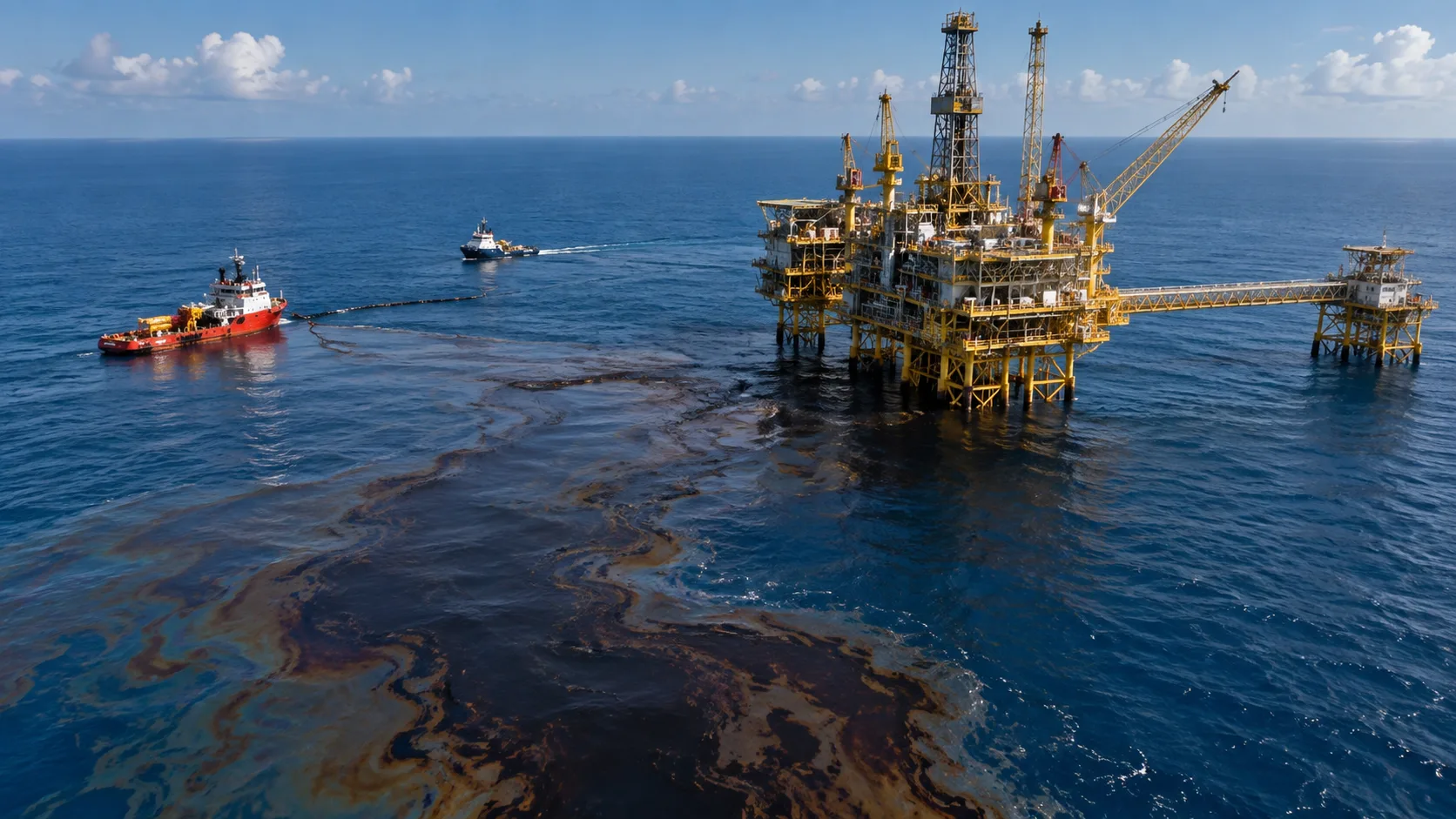
A new Pemex oil leak was detected in a pipeline associated with an offshore facility off Campeche, in the Gulf of Mexico. The oil company is working to contain the crude while authorities track the trajectory of the slick, which could move westward. For now, there is no official estimate of the volume spilled, and the oil is not expected to reach the coast.
The incident once again draws attention to the extensive Pemex offshore infrastructure in a region where some of its main producing fields operate. Many of these assets are mature and depend on complex systems of platforms, pipelines, and subsea equipment whose availability and integrity are essential to sustaining production.
Pemex oil leak was detected off Campeche
The leak was identified on Thursday morning in a pipeline linked to a Pemex facility in the waters of the Gulf of Mexico.
The Mexico Science Ministry reported that authorities are monitoring the movement of the slick and, under current conditions, estimate that it could move westward over the coming days without reaching the coastline.
So far, authorities have not disclosed an estimate of the volume of crude released. The absence of an initial figure currently limits any precise assessment of the environmental magnitude of the event. The visible surface extent of a slick does not necessarily make it possible to determine by itself how much hydrocarbon was discharged, due to factors such as thickness, dispersion, currents, wind, and product characteristics.
Therefore, during the initial stages of the response, trajectory monitoring and containment become priority actions while additional information is collected.
Is there a risk of the oil reaching the coast?
Based on the information currently available, Mexican authorities do not expect the slick to reach the coast. The forecast is based on the expected westward direction of movement, although the agency responsible for tracking the slick will continue monitoring it in case environmental conditions change.
In offshore operations, the evolution of a spill can be influenced by multiple variables. Wind can alter surface movement, while ocean currents affect the trajectory of the hydrocarbon. Waves can also contribute to dispersion and emulsification processes.
This means that the response does not depend solely on identifying the source of the leak. It also requires tracking how the slick changes over the following hours and days. From an operational perspective, the priority is to limit the discharge at the source and prevent the event from developing into a larger-scale problem.
The incident comes months after another Pemex spill
The new event follows another significant spill associated with Pemex that occurred during 2026. Reuters reported that a leak near the Abkatun field caused an earlier spill that ultimately affected areas of the Mexican Gulf of Mexico coast. To date, a complete assessment of the environmental damage caused by that event has not been published.
The short period between the two incidents adds relevance to the debate over the reliability of offshore systems. However, it would be premature to link both leaks to the same technical cause. Each incident requires a specific investigation to determine the failure mechanism, the operating conditions of the component, the condition of the material, and other factors that may have contributed to the event. Nevertheless, the recurrence of leaks increases attention on inspection and maintenance programs applied to offshore infrastructure that has been in service for decades.
Mature offshore infrastructure requires greater integrity control
Pemex maintains an extensive presence in the Gulf of Mexico, where some of its most important producing fields are located. Reuters also notes that numerous assets correspond to mature developments connected through extensive offshore infrastructure.
The maturity of an asset does not necessarily mean that an unsafe condition exists. It does mean, however, that cumulative degradation mechanisms must be controlled over extended periods. Internal and external corrosion, wall thickness loss, fatigue, mechanical damage, coating degradation, and environmental conditions can progressively affect pipelines and subsea components.
In this context, ILI inspection in non-piggable offshore pipelines can provide information on wall thickness loss and corrosion processes when pipeline configurations make the application of conventional methods difficult.
What should be evaluated after a leak in an offshore pipeline?
An active leak may first require controlling the discharge and stabilizing operating conditions. Subsequently, the technical investigation must establish where the loss of containment occurred and why. The analysis may consider indication geometry, wall thickness loss, the presence of localized corrosion, possible cracks, weld condition, and the effects of external loads.
In subsea systems, it is also important to inspect supports, crossings, contact areas, possible pipeline movement, and sections subjected to cyclic stresses. The protection and integrity of subsea pipelines can be supported by inspection and monitoring technologies such as ILI, ROV, and ultrasonic testing, together with integrity assessment methodologies aimed at identifying and characterizing deterioration before it compromises containment capability.
The actual cause of this specific leak has not yet been disclosed, so any damage mechanism should be considered solely as part of the technical context and not as a confirmed explanation of the event.
Subsea inspection becomes increasingly relevant for aging assets
Offshore facilities present an additional challenge: many of their critical components are located underwater and cannot be evaluated using conventional inspection methods. For this reason, integrity programs rely on technologies capable of examining pipelines, structures, and other components while they remain in service.
Remotely operated vehicles (ROVs) can perform visual inspections of subsea pipelines, structures, connections, supports, and contact areas. Depending on the component and the degradation mechanism being considered, these assessments can be complemented by techniques aimed at measuring thickness, detecting discontinuities, or characterizing anomalies.
Subsea inspection of equipment and facilities becomes particularly important for mature assets exposed to demanding marine conditions for years, as it makes it possible to document their condition and generate information for monitoring potential deterioration mechanisms.
When comparable historical records are available, results from different inspection campaigns can also be used to identify condition changes and degradation trends. This information provides a technical basis for prioritizing new assessments, maintenance interventions, or additional integrity analyses.
The leak also puts operational continuity to the test
A failure in an offshore pipeline does not create only an environmental concern. It can also affect production availability. Gulf of Mexico facilities operate as integrated systems. Wells depend on production lines, manifolds, platforms, and transfer systems to transport fluids to processing facilities.
When one of these components loses integrity, the operator may be required to isolate segments, reduce production, or perform repairs before normal conditions can be restored. This makes integrity management a variable directly related to operational reliability.
An effective strategy must balance inspection, maintenance, risk assessment, and intervention planning to reduce the probability of unexpected failures.
The new leak increases pressure on Pemex asset management
Important information about the incident is still unavailable. The total volume released, the exact duration of the leak, and the mechanism that caused the loss of containment are not publicly known. Subsequent investigations will be critical to understanding whether the event involved localized damage, progressive degradation, or another mechanism.
What this new event does show is the growing importance of managing offshore infrastructure that has accumulated decades of operation. For Pemex, sustaining production in the Gulf of Mexico will depend not only on keeping wells active, but also on ensuring that pipelines, platforms, and auxiliary systems can continue operating reliably.
The new Pemex oil leak therefore once again connects two challenges that cannot be analyzed separately: containing the immediate impact and preserving the integrity of an offshore network that is critical to Mexican oil production.
Source: Reuters