Table of Contents
- Patagonia data centers put Vaca Muerta on the digital map
- Why is Patagonia attractive for data centers?
- Multibillion-dollar projects increase the scale of the opportunity
- OpenAI had already put Argentina on the AI radar
- Argentina seeks to compete for artificial intelligence infrastructure
- Energy may be the advantage, but infrastructure will decide
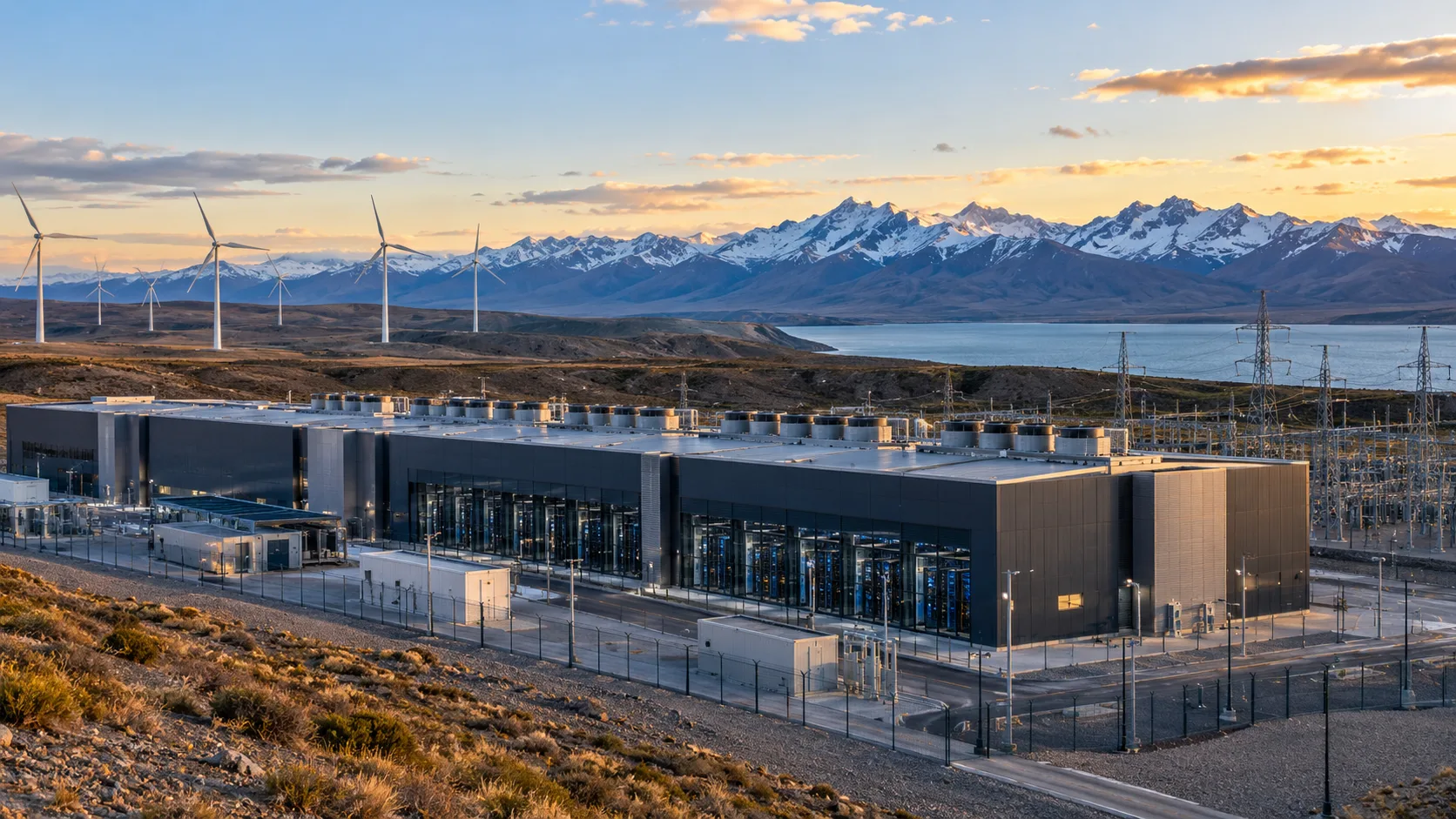
Patagonia data centers are beginning to emerge as a new source of energy demand for Argentina. Access to Vaca Muerta gas, hydroelectric, wind, and solar resources, together with the low temperatures of the country’s southern region, is attracting the interest of developers evaluating facilities with capacities of hundreds and even thousands of megawatts. However, transforming that potential into digital infrastructure will require significant investment in generation, transmission, and connectivity.
The global expansion of artificial intelligence is rapidly reshaping the relationship between the technology industry and the energy sector. Large data centers require enormous amounts of electricity on a continuous basis and, given this reality, access to abundant energy has become one of the main criteria for determining where new computing capacity should be installed.
Argentina could enter this international competition thanks to an unusual combination of resources. Patagonia offers access to natural gas, hydroelectric generation, some of the country’s best wind resources, solar potential, vast areas of land, and temperatures that can help reduce the energy requirements associated with server cooling.
This combination of conditions is putting provinces such as Neuquén and Chubut on the radar of international developers and investors.
Patagonia data centers put Vaca Muerta on the digital map
One of the projects that best reflects this convergence between energy and technology is located in Neuquén. Pampa Energía is evaluating the possibility of developing a data center near its Loma de la Lata thermal power plant, with demand potentially reaching 500 MW and access to energy associated with Vaca Muerta, one of the world’s largest shale formations. The company began studying the opportunity after receiving inquiries related to this type of facility in early 2026.
The potential size of the project illustrates the scale of this new energy challenge. Interested parties are reportedly considering starting with a pilot facility of approximately 20 to 40 MW before moving toward larger capacities. Pampa Energía estimates that the electrical infrastructure alone required to support 500 MW of demand could represent an investment of nearly US$900 million.
This makes data center development more than just an opportunity for the technology sector. A facility of this scale requires continuous energy availability, transmission capacity, redundancy, backup infrastructure, and adequate conditions to ensure operational continuity.
Vaca Muerta could therefore play a different role in Argentina’s energy transformation: in addition to supplying households, industries, power plants, and gas exports, its resources could help support new energy-intensive digital infrastructure. Vaca Muerta production already accounts for more than 50% of Argentina’s domestic oil and gas output, reflecting the structural importance the formation has acquired within the country’s energy system.
Why is Patagonia attractive for data centers?
Electricity availability is one of the main factors determining the location of large data processing facilities, but it is not the only one.
Neuquén combines access to natural gas from Vaca Muerta with hydroelectric generation and a cold climate that could reduce costs associated with equipment cooling. This combination represents a potential advantage for facilities that need to operate continuously while managing substantial thermal loads.
The possibility of integrating different generation sources also opens the door to hybrid energy configurations. Gas can provide firm generation, while hydropower, wind, and solar energy can increase the share of renewable sources within the supply mix.
However, the theoretical availability of resources does not automatically translate into usable energy for a data center.
Installing hundreds of megawatts requires the development of substations, power lines, transformation systems, redundancy, and connections capable of supplying large loads with high levels of reliability. This pressure on energy infrastructure for data centers is already generating multibillion-dollar investments in other markets. Electricity and connectivity are precisely among the main challenges Patagonia will need to overcome to turn current interest into operational projects.
Multibillion-dollar projects increase the scale of the opportunity
Interest is not limited to Neuquén. In Chubut, Polish company Green Capital is proposing a development whose first phase could reach 300 MW, with an estimated investment of US$3 billion. The proposal envisions a considerably larger expansion: it could eventually reach as much as 3,000 MW.
The project’s energy concept is also significant. The company is leasing approximately 1,298 km² south of Trelew to develop wind and solar facilities intended to power the project without relying on the national grid. However, the initiative still requires investors and plans to apply for access to an investment incentive regime in 2027.
Given its scale, an eventual capacity of 3 GW would substantially change the magnitude of energy demand associated with digital infrastructure in Argentina. But it also demonstrates why a distinction must be made between announced capacity, projects under development, and capacity that has actually been built. For now, many of these initiatives remain at an early stage.
OpenAI had already put Argentina on the AI radar
International interest in Argentina as a destination for digital infrastructure gained greater visibility following the announcement made in 2025 by OpenAI and local company Sur Energy.
The initiative envisions a data center powered by clean energy, a potential investment of up to US$25 billion, and capacity of up to 500 MW. At the same time, Argentine authorities have proposed developing a second fiber-optic cable landing station to improve connectivity in Patagonia.
The project should not yet be interpreted as a definitively secured facility. According to information reported by Reuters, Sur Energy was continuing to work with Neuquén to identify a location, while the definitive agreement with OpenAI remained pending.
The significance of the announcement, however, extends beyond a single company: it demonstrates how energy availability is becoming a direct factor in decisions regarding the expansion of global artificial intelligence infrastructure. This trend is also rapidly increasing data center electricity consumption, particularly as infrastructure dedicated to artificial intelligence continues to expand.
Argentina seeks to compete for artificial intelligence infrastructure
Argentina’s data centers are currently relatively small and concentrated primarily in Buenos Aires, while other South American countries are moving forward with larger-scale facilities. Chile has an Amazon mega-project under development, Google is building infrastructure in Uruguay, and Paraguay has also presented initiatives to expand its capacity.
Argentina is seeking to change that position by leveraging its energy resources and an investment environment that has evolved in recent years.
The Incentive Regime for Large Investments (RIGI), promoted under the government of Javier Milei, offers tax benefits and regulatory stability for large projects. These conditions have already attracted investment into sectors such as hydrocarbons and mining and could become another competitive factor for digital infrastructure.
Nevertheless, investors are also monitoring the country’s political and regulatory developments, including the presidential election scheduled for 2027 and potential new incentive schemes.
Energy may be the advantage, but infrastructure will decide
Argentina’s real challenge will be to transform its abundance of resources into available, reliable, and competitive energy exactly where data centers need it. Vaca Muerta provides an enormous natural gas resource base. Patagonia has large-scale hydroelectric and renewable resources. The climate offers cooling advantages, and vast areas of land are available to accommodate large facilities. But these projects also require power grids, fiber optics, redundancy, investment, and sufficient certainty to operate for decades.
For this reason, the arrival of data centers in Patagonia could create an unprecedented relationship between the expansion of artificial intelligence and Argentina’s energy development. If the projects currently under evaluation advance toward final investment decisions, AI growth could generate a new source of large-scale electricity demand in the country. In that scenario, Vaca Muerta would no longer be associated solely with oil and gas expansion, but could also become a potential energy platform for South America’s digital economy.
Source: Reuters