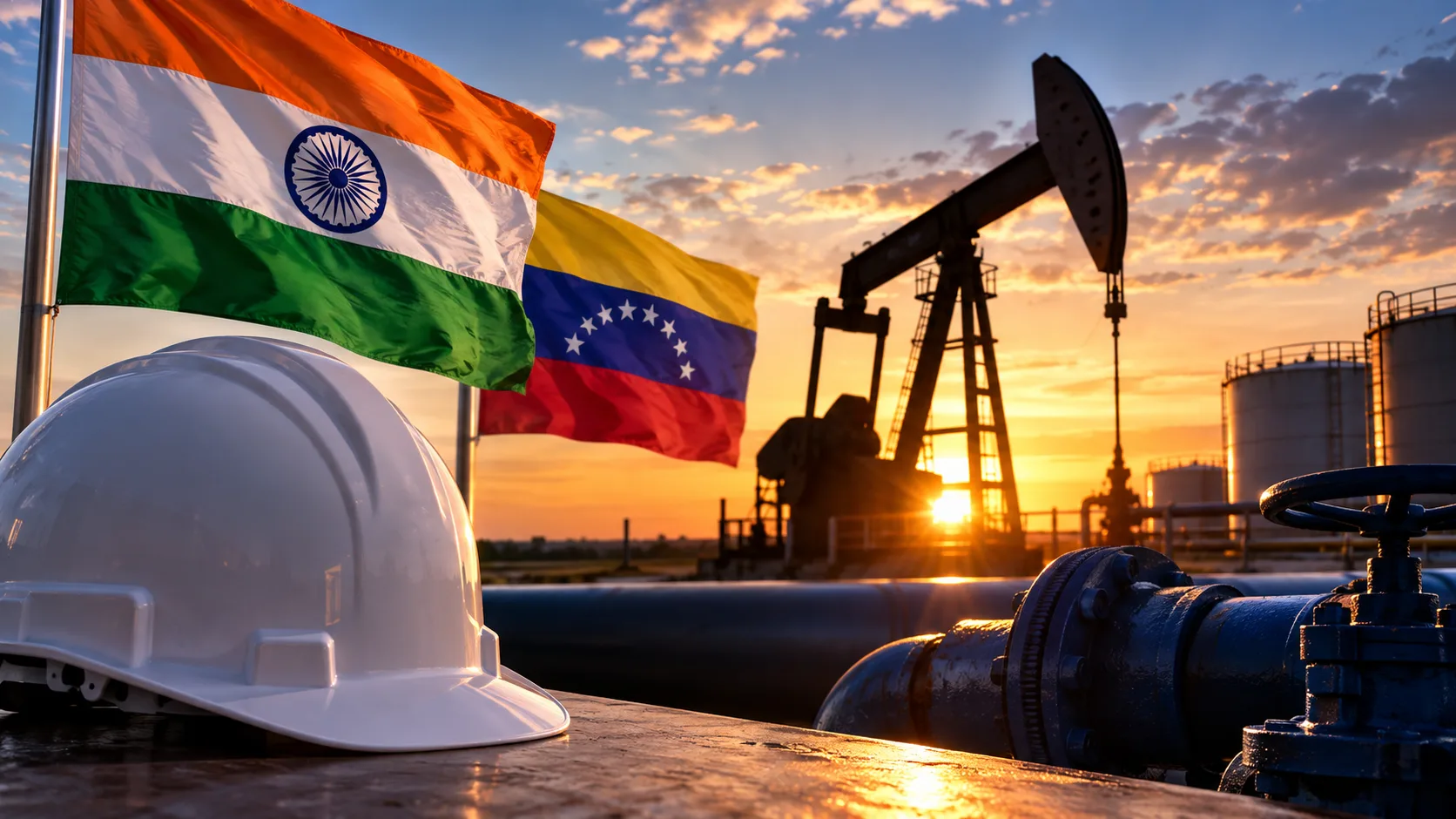
ONGC in Venezuela could enter a new phase of production recovery through the San Cristóbal oilfield, after its international subsidiary ONGC Videsh proposed an investment of nearly USD 200 million to increase the asset’s output. The project, jointly operated with PDVSA, currently produces around 4,000–5,000 barrels per day (bpd), well below the levels reached during its peak years.
The strategy aims to progressively rebuild that capacity and eventually approach 45,000–50,000 bpd once again. However, the target will depend on the finalization of the investment plan between the Indian company and PDVSA and the subsequent execution of the necessary interventions at the field. ONGC Videsh also holds a U.S. license authorizing operations, investments, and the commercialization of production associated with its Venezuelan assets.
San Cristóbal oilfield could multiply its current production
The gap between current output and historical capacity illustrates the scale of the challenge. San Cristóbal produces approximately 4,000–5,000 bpd, while it previously reached between 45,000 and 50,000 bpd. Recovering those levels would mean increasing current production by approximately tenfold.
This does not mean that 50,000 bpd can be immediately added to Venezuelan production. It is a recovery target that will require investment, asset interventions, and an operational strategy capable of reversing years of production decline.
In mature fields, increasing production can involve everything from well workovers and reactivation to the restoration of artificial lift systems, surface facilities, fluid handling systems, and associated infrastructure. The specific technical scope to be implemented at San Cristóbal has not yet been publicly disclosed.
The move coincides with a broader strategy to boost Venezuelan oil production through agreements with international companies, where the recovery of existing assets could provide production gains sooner than the full development of new fields.
ONGC in Venezuela prepares USD 200 million to recover San Cristóbal
The central element of the new plan is an estimated investment of approximately USD 200 million over the next 12 months. ONGC Videsh, the international arm of India’s state-owned Oil and Natural Gas Corporation, holds a 40% interest in San Cristóbal, while PDVSA retains the remaining 60%.
The financial structure currently under discussion is particularly significant. According to information published by ETEnergyWorld, ONGC would also cover PDVSA’s share of the investment and subsequently recover those funds through future production from the field.
If finalized, the mechanism would allow capital to be mobilized into the asset without relying exclusively on the Venezuelan company’s immediate investment capacity.
The structure also illustrates how the recovery of Venezuela’s oil industry could increasingly rely on arrangements in which international partners contribute capital, technology, and execution capabilities in exchange for mechanisms linked to future production.
U.S. license changes the outlook for ONGC
One of the factors enabling the strategy to move forward is the new framework under which ONGC can operate in Venezuela.
The Indian company confirmed in its corporate information that ONGC Videsh received a specific license from the U.S. Office of Foreign Assets Control (OFAC). The authorization allows it to continue operations, make investments, and commercialize production from its Venezuelan assets.
The authorization substantially changes the conditions under which the company had been managing its interests in the country. ONGC had reduced its activity for years due to restrictions and risks related to sanctions. The new license opens the door not only to recovering San Cristóbal, but also to evaluating other opportunities within Venezuela.
The strategy also coincides with other recent moves to modernize the sector. Inspenet reported on the digital transformation agreement between SLB and PDVSA, aimed at incorporating technology, artificial intelligence, and new capabilities to support the recovery of oil operations.
Carabobo represents another piece of ONGC’s strategy
India’s presence in Venezuela does not end with San Cristóbal. ONGC Videsh also holds an approximately 11% interest in Carabobo-1, where it shares interests with other international companies and PDVSA. However, available information indicates that there is not yet an investment plan comparable to the one proposed for San Cristóbal.
This difference makes the San Cristóbal oilfield a particularly relevant test case. If the investment succeeds in stabilizing existing assets and progressively increasing production, the model could provide insights into the feasibility of recovering other Venezuelan fields through international capital and repayment structures linked to barrels produced.
There is also an additional financial incentive for ONGC. The company is seeking to recover more than USD 500 million in dividends associated with its Venezuelan operations that have remained outstanding for years. Higher production would facilitate the generation of the cash flows needed to advance that process.
San Cristóbal could become a test case for oil recovery
The importance of the project extends beyond the approximately 45,000 additional bpd separating current production from the upper end of its historical capacity.
Venezuela is going through a period in which recovering production requires simultaneous action on wells, facilities, infrastructure, financing, and technology. In this scenario, rehabilitating existing assets can be strategically attractive because part of the infrastructure and geological knowledge of the field already exists.
The digital dimension is also being strengthened. Recent cooperation between international companies and PDVSA seeks to reorganize reservoir and production information, creating a foundation that could help improve intervention selection and investment prioritization. Inspenet recently analyzed how SLB and PDVSA are advancing the modernization of Venezuela’s oil data.
The recovery of San Cristóbal would provide an opportunity to observe how these different elements — international capital, regulatory authorization, asset rehabilitation, and cooperation with PDVSA — can converge on a specific field. The target of 45,000–50,000 barrels per day should, for now, be understood as a goal rather than committed production. The plan between ONGC and PDVSA will first need to be finalized and the corresponding investments executed.
Even so, moving from the current 4,000–5,000 bpd toward a significant share of historical capacity would represent a considerable change for the San Cristóbal oilfield. If the project moves forward successfully, the asset could become one of the most visible examples of a new phase in the recovery of Venezuelan oilfields through partnerships with international operators.
Sources: Oil Price | The Economic Times