SLB and PDVSA finalize agreement in Venezuela. The alliance officially took shape on June 10, 2026, when both companies signed a long-term Memorandum of Understanding (MoU) at Miraflores Palace, Caracas, with the aim of modernizing the country’s oil and gas industry through digital technology, artificial intelligence, and human capital development.
Agreement between SLB and PDVSA: Scope of the Cooperation Framework
The document was signed by Olivier Le Peuch, CEO of SLB, and Héctor Obregón, President of PDVSA, in an act led by Venezuela’s acting President, Delcy Rodríguez. The agreement covers exploration, field development, production, digital enablement, and workforce training. Additionally, it incorporates the mining sector under the framework of the new Mining Law approved in April 2026.
Le Peuch emphasized the depth of the historical link between the company and the country:
For nearly a century, SLB personnel in Venezuela have stayed the course—working alongside the country’s energy sector through every cycle, contributing expertise, technology, and a deep commitment to local capability.
SLB has maintained an uninterrupted presence in Venezuela for 97 years, a track record that executives highlighted as the basis for the negotiation.
Artificial Intelligence and Predictive Models
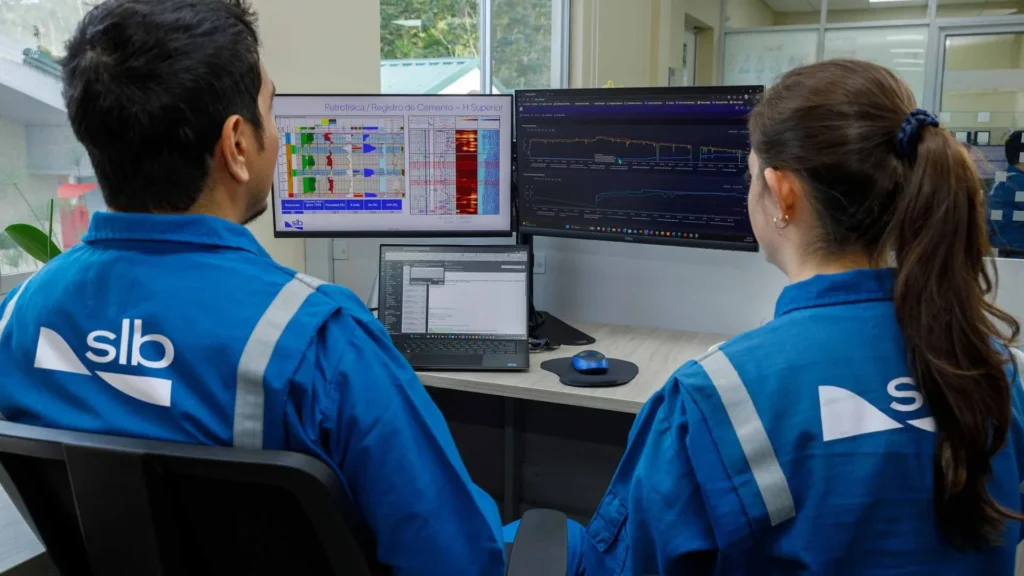
On the technological front, SLB will evaluate the implementation of connected data systems, predictive models, and AI-enabled workflows to accelerate operational decision-making in Venezuelan fields. The company will also explore opportunities in mature fields, heavy and extra-heavy crude reserves, and optimization of existing infrastructure. This digital agenda is part of a broader trend: the presence of major international operators in Venezuela seeking to reactivate fields with cutting-edge technology.
Rodríguez expressed the Venezuelan government’s expectations for the agreement:
I know that the new technologies you will bring to Venezuela will have a high impact on exploration and production.
The statement reflected the official interest in attracting technological investment as a lever to increase extraction volumes, which are well below the country’s historical maximums.
Human Capital and Institutions
The MoU stipulates that SLB will work with PDVSA and Venezuelan academic and institutional actors to expand local expertise and technical capacity in the sector. The objective is to build a foundation of competencies that sustains the long-term growth of the industry. President Obregón clarified that the signed document constitutes a “preparatory agreement” and anticipated that a definitive agreement with more specific commitments would be signed “soon.”
SLB’s move coincides with a period of greater commercial openness in the sector. India, for example, has made progress in direct purchases of Venezuelan crude, indicating growing interest from global players in Venezuelan oil despite international regulatory complexity.
Implications for Production
Venezuela holds the world’s largest proven oil reserves, estimated at over 300 billion barrels, but its production has drastically fallen since the 1990s due to lack of investment, exodus of technical talent, and international sanctions. The MoU with SLB precisely targets the technological and human capital bottlenecks that explain this gap between potential and reality. Le Peuch summarized it accurately:
Venezuela’s oil and gas sector has substantial resource potential, and realizing that potential will require technology, digital integration, and long-term talent development.
The agreement comes at a time when Venezuela’s regulatory framework is undergoing changes, including new mining legislation, which broadens the potential scope of collaboration beyond conventional hydrocarbons. The effectiveness of the agreement will ultimately depend on the speed with which the definitive agreements anticipated by Obregón are finalized.
Sources: SLB Newsroom | EFE Economía | BNamericas