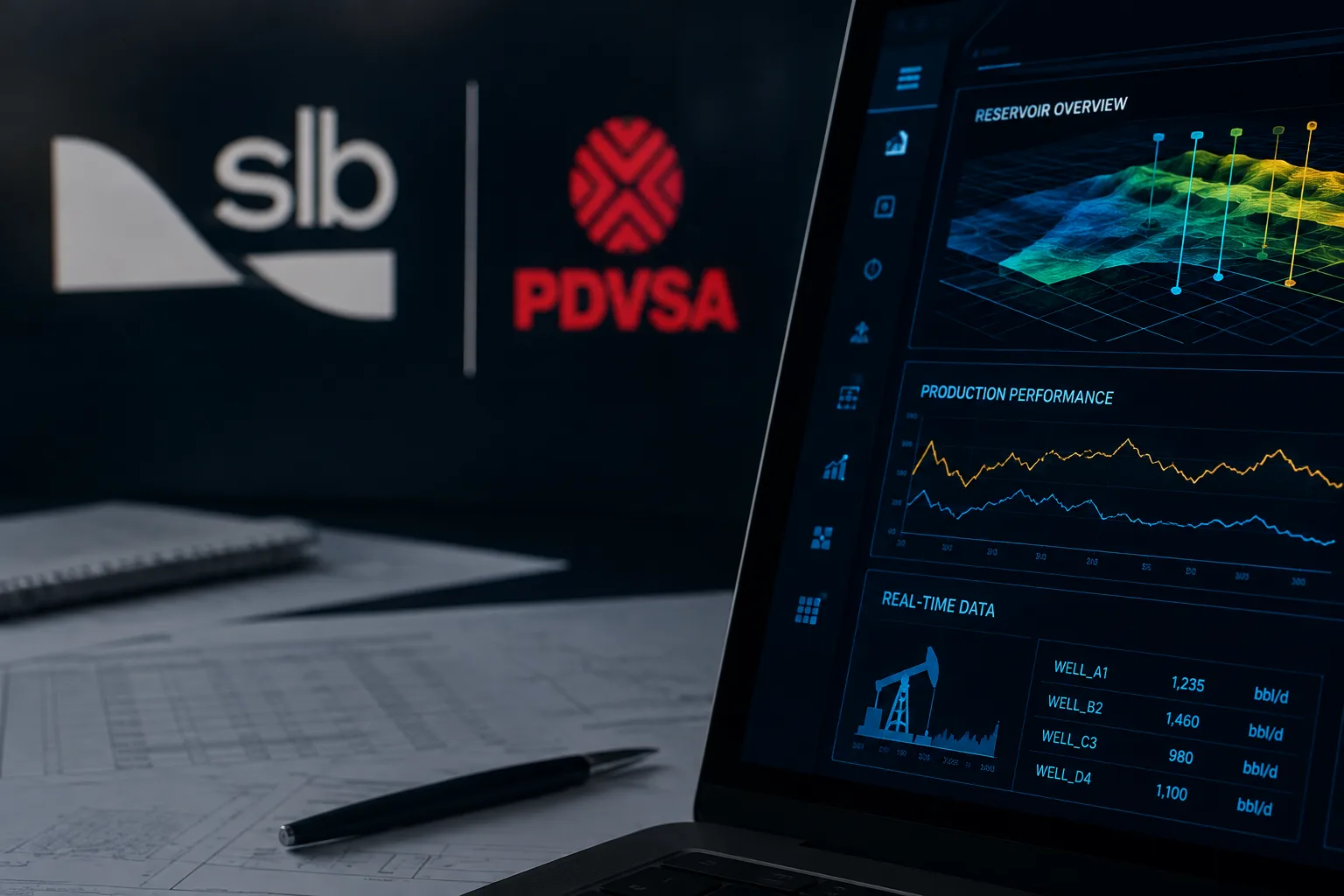
SLB and PDVSA are moving toward a deeper phase of technological transformation in Venezuela’s oil industry through an agreement that will enable the organization, modernization, and consolidation of critical information from the country’s reservoirs. The scope includes data related to reservoir characterization and real-time crude oil production, while opening the door to incorporating artificial intelligence and new digital tools into subsurface management and oil operations.
The move is particularly significant because Venezuela needs to rebuild part of its information infrastructure after years of limited technological upgrades and the problems caused by a cyberattack that affected systems used by PDVSA. Recovering this data could become a strategic component for evaluating fields, optimizing production, and providing more consistent technical information to companies interested in new oil projects.
SLB and PDVSA seek to rebuild oil data architecture
The value of the agreement does not lie solely in digitizing existing documents. The upstream industry depends on large volumes of information generated over decades of exploration, drilling, and production: well logs, seismic data, petrophysical properties, reservoir behavior, pressure, historical production, and operating conditions, among other variables.
Integrating this information makes it possible to build a more comprehensive view of each asset and reduce uncertainty when selecting interventions, identifying opportunities for additional recovery, or prioritizing new investments.
According to available information about the contract, SLB will be able to work on organizing and updating PDVSA’s databases, including information related to reservoir characterization and real-time oil production. Sources consulted by Reuters also indicate that technologies such as artificial intelligence could be incorporated to expand and modernize these systems.
The initiative deepens a relationship that had already shown important signs of progress. In June, Inspenet reported on the digital transformation agreement between SLB and PDVSA, aimed at incorporating digital technology, artificial intelligence, predictive models, and technical capability development into Venezuela’s oil industry.
Oilfield data takes on strategic value
In a mature oil province, SLB and PDVSA can turn reliable historical information into a strategic asset for reservoir evaluation and production optimization, making data management just as important as deploying new equipment.
Reservoir models need to integrate geological, geophysical, petrophysical, and production data to represent field behavior. When information is fragmented, outdated, or stored on incompatible platforms, uncertainty increases when estimating reserves, identifying undrained zones, or selecting candidate wells for intervention.
This challenge takes on an even greater dimension in Venezuela due to the scale and diversity of its oil assets. The country holds enormous accumulations of heavy and extra-heavy crude oil, as well as conventional fields that have been producing for decades. For SLB and PDVSA, recovering historical information and connecting it with current operational data could improve the ability to determine where capital and services should be concentrated.
Inspenet recently analyzed precisely how Venezuela is seeking to recover its oil production through agreements with SLB and Hunt. In this context, digitalization represents a complementary component to the physical recovery of wells, facilities, and infrastructure.
Artificial intelligence can turn data into decisions
Centralizing information is only the first stage. The next step is using it to improve technical decision-making. Artificial intelligence and predictive models can analyze large volumes of historical and operational information to identify patterns that are difficult to detect through conventional procedures. In upstream operations, this can support everything from subsurface interpretation to production optimization and intervention selection.
However, the capabilities of any model will depend directly on the quality of the data being used. Incomplete, inconsistent, or poorly traceable information can limit even the most advanced digital tools.
For SLB and PDVSA, rebuilding, classifying, and validating databases represents a fundamental stage before their full potential can be harnessed through AI.
PDVSA faces the challenge of recovering affected information
The modernization effort also comes after significant difficulties involving PDVSA’s IT systems. Sources cited in the original report indicate that a ransomware attack affected corporate applications and systems used to manage information. Although some functionality is being restored, certain data was reportedly damaged, while some information may even have to be reconstructed from physical documentation.
This makes the project considerably more complex than a conventional migration to new platforms. The challenge for SLB and PDVSA will be to combine historical information recovery, database standardization, new monitoring tools, and, progressively, an architecture capable of connecting subsurface information with production variables.
Data could become a gateway to new investment
There is also a commercial dimension. Venezuela stopped routinely publishing oil statistics more than a decade ago, while the limited availability of detailed information has made it more difficult to track production, refining, and exports, as well as to evaluate certain assets for potential investors.
The digital infrastructure being developed by SLB and PDVSA could facilitate technical field evaluations and provide a more consistent foundation for companies assessing investment opportunities.
This scenario coincides with a gradual recovery in activity. Inspenet recently reported that the , while international operators continue to evaluate opportunities in the country.
Nevertheless, important questions remain. SLB and PDVSA have not publicly disclosed the full duration of the contract, its final payment mechanism, or all details of its scope. It would therefore be premature to interpret the agreement as a general transfer of all Venezuelan oil industry information to SLB..
What the move does demonstrate is a significant shift: data is beginning to be treated as strategic infrastructure for rebuilding the oil industry. If the initiative succeeds in transforming decades of dispersed information into reliable and usable systems, SLB and PDVSA could establish a technological foundation capable of supporting reservoir, production, and investment decisions during the country’s next stage of energy development.