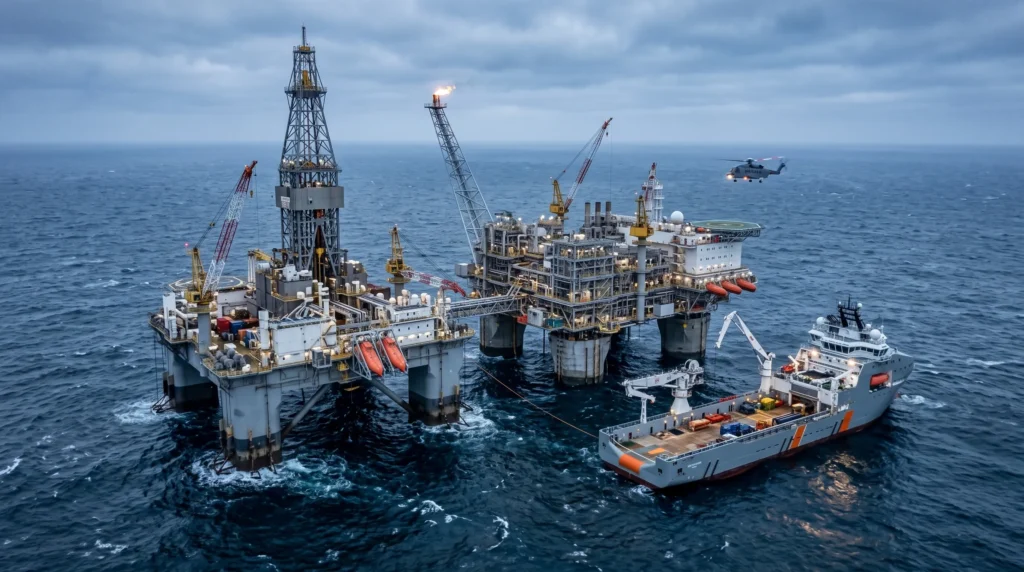
Offshore activity in Norway is once again in the spotlight of the European energy market following the escalation of a labor dispute that is beginning to affect drilling operations in the North Sea. Although oil and gas production remains stable, the partial halt of specialized services and the implementation of a lockout by companies raise concerns about the operational continuity of one of Europe’s main energy suppliers.
This development occurs at a time of heightened sensitivity for the international market, where any alteration in the offshore supply chain is closely monitored by operators, investors, and service companies. Beyond salary negotiations, the conflict tests the sector’s ability to maintain operational stability in a strategic region for European energy supply.
Offshore activity in Norway begins to show operational delays
The labor dispute originated after the failure of negotiations to renew the collective agreement for personnel dedicated to well services. In response to the strike initiated by workers, companies grouped under Offshore Norway announced the implementation of a lockout that broadens the scope of the conflict and could affect more than 1,200 employees in the sector.
The first consequences are already visible. Several drilling campaigns are experiencing delays, and at least two platforms have temporarily suspended their activities while companies reorganize resources to ensure the continuity of essential operations. Although hydrocarbon production has not significantly decreased, the slowdown in work is beginning to alter the planning of offshore projects.
For the industry, the continuity of drilling activities is key not only to sustain future production but also to ensure the availability of specialized services related to well intervention, maintenance, and subsea infrastructure.
Offshore suppliers face higher costs and uncertainty
The conflict also increases pressure on the supply chain that serves the Norwegian energy sector. Companies dedicated to drilling, logistics, subsea operations, and technical support must reorganize personnel and contracts while negotiations between unions and employers continue.
The lockout represents a mechanism contemplated within the Norwegian labor negotiation system, but its application implies higher costs for companies and a prolongation of operational uncertainty. Nevertheless, companies will maintain personnel assigned to critical functions to preserve the safety of facilities and the ability to respond to subsea emergencies.
The situation demonstrates the high dependence of the offshore sector on highly specialized personnel, whose availability is indispensable to maintain the pace of new well development and ensure operational continuity.
The North Sea maintains a strategic role for Europe
Norway continues to be one of the main suppliers of oil and gas to Europe, especially after the strengthening of its natural gas exports in recent years. In this context, any prolonged interruption in offshore activity can have effects that go beyond the labor sphere and extend to investment planning, the execution of drilling campaigns, and the future availability of production.
Although authorities consider that the immediate impact on energy supply remains limited, the evolution of the conflict will be crucial to avoid additional delays in strategic North Sea projects. For operators, contractors, and specialized service companies, the priority remains to preserve the operational continuity of a system that plays a fundamental role in European energy security.
The evolution of negotiations will be decisive for the pace of offshore operations in the coming weeks. Operators, contractors, and service providers will closely follow any agreement that allows for the full restoration of activity and avoids further delays in North Sea drilling projects.
Source: World Energy News / Reuters