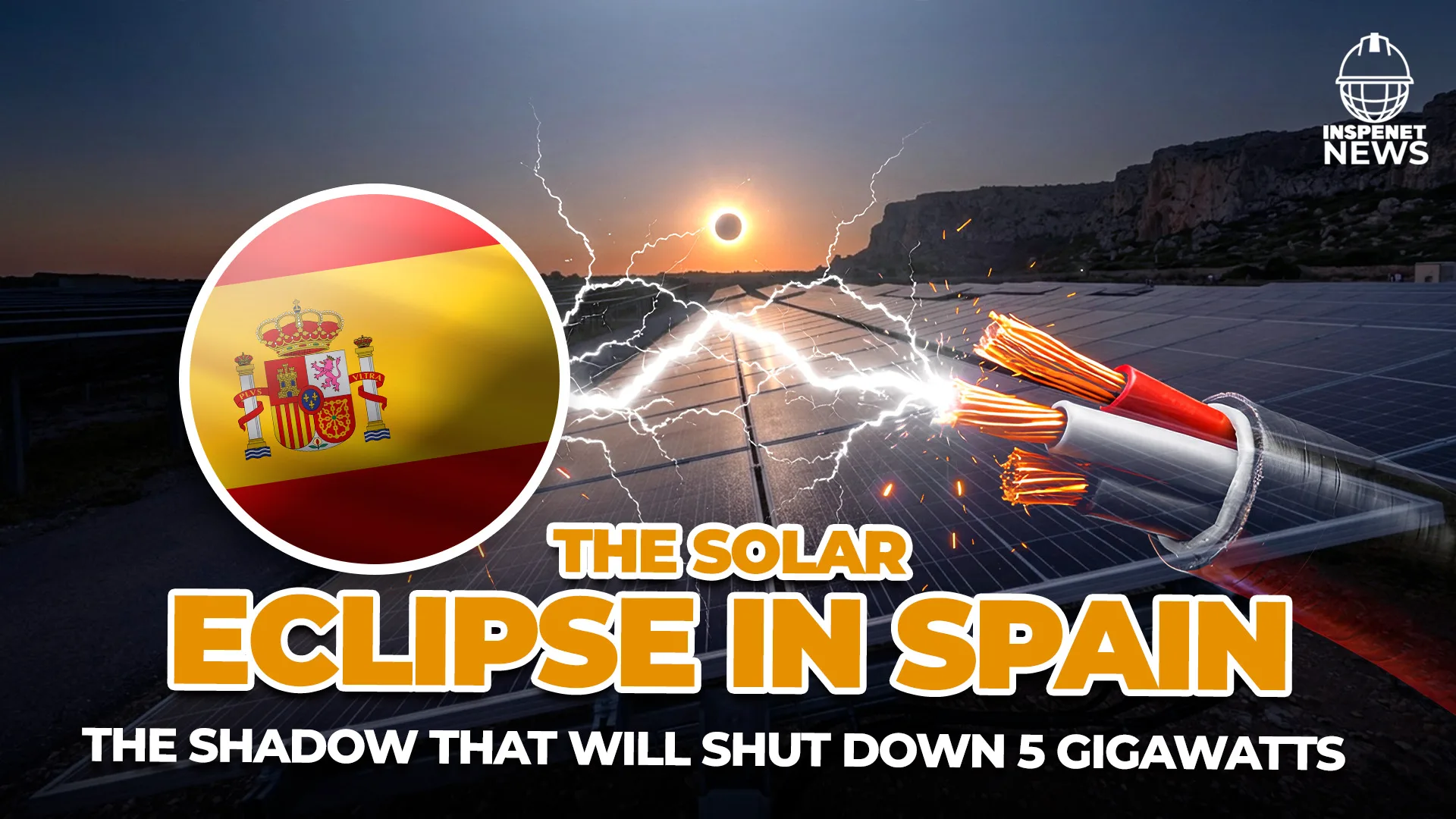
Solar eclipse will reduce 5 GW of photovoltaic energy in Spain
The solar eclipse of August 12 will have a direct effect on the photovoltaic energy of the Peninsula , Red Eléctrica predicts that the maximum solar production will decrease by around 5 gigawatts (GW) during the astronomical phenomenon.
Specifically, this reduction is equivalent to approximately 13% of the peak demand forecast for a typical Wednesday in August. Despite the magnitude of the drop, the electricity system operator does not expect the eclipse to cause problems in meeting electricity demand.
The effect will also be temporary; photovoltaic generation will recover its normal behavior as the darkening caused by the passage of the Moon in front of the Sun ends.
The eclipse will cause a temporary drop in photovoltaic energy
During the eclipse, the reduced amount of available solar radiation will directly affect photovoltaic installations. As a result, Red Eléctrica estimates that the maximum generation loss will be around 5 GW on the Iberian Peninsula.
However, the timing of the phenomenon will help reduce its impact on the electrical grid. The eclipse will occur during a period when photovoltaic energy generation is already naturally beginning to decline.
Therefore, the phenomenon will bring forward and accentuate this decrease in solar production; its effect will be concentrated during a limited period and will not coincide with the usual peak demand in August.
What do the 5 GW planned by Red Eléctrica represent?
The estimated reduction allows us to gauge the impact the eclipse will have on electricity generation. The projected 5 GW represents approximately 13% of the peak demand on a typical Wednesday in August.
However, this comparison does not mean that an amount of electricity equivalent to 13% of consumption will suddenly disappear. The estimate refers to the maximum reduction in solar production during the phenomenon.
Furthermore, this situation will occur while photovoltaic installations are already in a declining generation phase. This factor will allow the electrical grid to cope with the change under more favorable conditions.
The timing of the eclipse will limit its impact on the electrical grid
Another important factor will be the time of day the eclipse occurs. Photovoltaic generation follows a daily curve determined by the availability of sunlight. As the afternoon progresses, its contribution to the grid begins to decrease.
In this case, the darkness will accelerate that drop. However, Red Eléctrica estimates that the phenomenon will not coincide with the time of highest electricity demand of the day.
In this way, the system will not have to simultaneously cope with the maximum reduction in photovoltaic energy and the highest level of anticipated consumption. This time difference explains why the operator anticipates a reduced impact on demand coverage.
Cloud cover can modify the actual drop in solar production
On the other hand, the 5 GW figure is a forecast and the final result will depend on the weather conditions on August 12.
Cloud cover will have a direct influence. If the clouds are already reducing the radiation received by the facilities before the eclipse, the difference in generation caused specifically by the darkening could vary.
To study the scenario, Red Eléctrica has used its own mathematical model designed to analyze the effect of this type of astronomical phenomena on the electrical system.
The tool calculates obscuration curves for each geographic area and allows for estimating how electricity generation will evolve during the eclipse. This enables the operator to anticipate solar production patterns and prepare the system's operation.
In contrast, Red Eléctrica does not foresee a significant effect on photovoltaic production in the Balearic and Canary archipelagos.
Red Eléctrica will increase reserves and safety margins
Although forecasts do not indicate difficulties in meeting consumption, Red Eléctrica will implement preventive measures during the eclipse.
The planned actions include increasing reserves and safety margins typically used in system operation. Constant monitoring of the phenomenon's evolution and its impact on power generation will also be maintained.
The operator will also maintain close coordination with official bodies, national generation and distribution control centers, and European transmission system operators.
These measures will allow us to respond to possible differences between the expected solar production and the amount that is ultimately available during the eclipse.
Can the eclipse affect the electricity supply?
According to Red Eléctrica's forecasts, the reduction in photovoltaic energy should not prevent the system from meeting electricity demand.
The drop of approximately 5 GW will be significant for solar production. However, it will be short-lived, occurring when photovoltaic generation is already declining and will not coincide with the usual peak consumption.
In addition, the reinforcement of reserves and safety margins will give the operator greater capacity to manage possible deviations during the phenomenon.
Thus, the August 12 eclipse will represent an exceptional event for solar energy production on the Iberian Peninsula and an operational test for the electrical grid. Red Eléctrica will focus its efforts on anticipating the drop in generation, monitoring its evolution, and ensuring demand is met while photovoltaic energy experiences the period of lower production caused by the eclipse.
News of additional interest
Europe wants to store energy without depending on lithium.
Dutch startup Ore Energy raised $43 million to bring its iron-air batteries to an industrial scale. Its technology can store electricity for up to 100 hours and uses simple materials like iron, water, and oxygen. This would allow for the storage of solar and wind energy for several days for use during periods of low production.
The company will allocate the funds to its first automated factory in Europe and aims to reach a production of several GWh by 2028. Ore Energy has already agreed to sell 1 GWh of storage to the Dutch energy company Budget Thuis, with an initial delivery of 400 MWh planned for that year. It also tested its system with EDF in France and claims that its storage costs about one-tenth the price per unit of capacity compared to lithium-based alternatives.
South Africa explores green hydrogen with Envision
Envision Energy and Sasol will study the development of a green hydrogen system at the Sasolburg facility in South Africa. The project will analyze how to combine renewable energy, batteries, and electrolyzers to produce hydrogen competitively. It will also evaluate the use of this infrastructure to manufacture lower-emission fuels and chemicals, such as e-methanol and sustainable aviation fuel.
The study will leverage Envision's expertise in renewable energy, energy storage, and AI-powered energy management, along with Sasol's existing industrial infrastructure. The analysis is expected to conclude by the end of 2026, and its findings will inform future investments. The collaboration also gained visibility during a visit by the South African Minister of Electricity and Energy to Envision's hydrogen complex in China.
ICS expands its aerospace business with Modern Instrument
Industrial Control Solutions (ICS) has acquired the operations of Modern Instrument Company, a firm specializing in temperature calibration and validation for industrial and aerospace manufacturers. The transaction, which closed on July 31, allows ICS to add services such as thermal uniformity studies, accuracy testing, and audit documentation. Modern is ISO/IEC 17025 accredited and has been working with aerospace companies in Southern California for nearly four decades.
The purchase complements ICS' acquisition of Duro-Sense in October 2025. While Duro-Sense manufactures temperature sensors, Modern verifies and calibrates the equipment on which these sensors operate. ICS plans to hire more technicians, upgrade its systems, and increase coordination between the two companies to meet demand that Modern previously could not fulfill. The existing team will continue to provide services under the same scope of accreditation.
Globant changes the rules for hiring AI services
Globant has launched Glob.AI, a platform that allows companies to contract AI-based technology services and pay based on results or actual usage. Their offering revolves around AI Pods, digital teams comprised of AI agents that perform specialized tasks under human supervision. The company claims this model can be at least 30% more productive than the traditional approach that combines engineers with AI tools.
The platform also aims to streamline hiring processes that typically take months. Companies will be able to access online services to develop and implement software while maintaining control over the models used, their data, and token consumption. Globant assures that its clients' information will not be used to train external models. AI Pods are already being used by Fortune 500 companies, and the offering includes technologies from firms such as OpenAI, Anthropic, AWS, Google Cloud, Microsoft, SAP, and Salesforce.