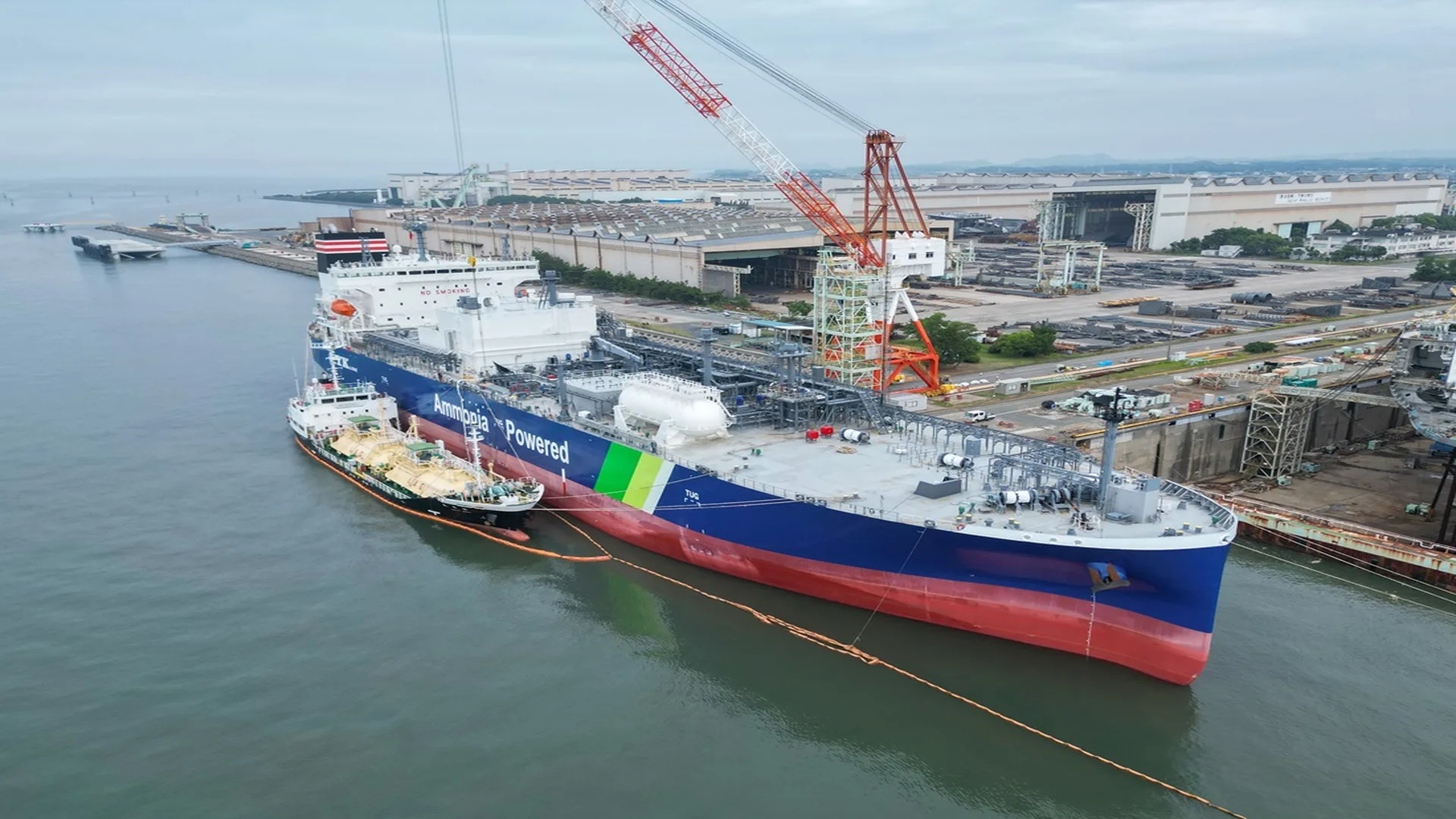
NYK Line completed, together with four Japanese companies, the first global operation of ammonia bunkering or by means of the método ship-to-ship (STS) intended to supply a vessel powered by this fuel. The transfer took place on September 17 at the Ariake shipyard of Japan Marine United, in Japan.
The operation involved the participation of NYK Line, Japan Marine United Corporation, Nihon Shipyard, Mitsubishi Gas Chemical y Kokuka Sangyo the objective was to prepare for the upcoming sea trials of a new medium-sized ammonia-powered gas carrier, known as AFMGC.
During the procedure, the ammonia was transferred from the Shoei Maru vessel to the AFMGC, which is in the final phase of construction and is scheduled for delivery in November 2026.
Ammonia bunkering using the ship-to-ship system
He STS method it allows fuel to be transferred directly from one vessel to another using hoses specially designed for this operation. In this case, the procedure allowed for the testing, under operational conditions, of a refueling method that will be necessary for future vessels using ammonia as marine fuel.
Before beginning the transfer, the participating companies reviewed work procedures and established specific safety measures. The operation concluded without incident and provided practical experience in handling ammonia during inter-vessel refueling.
This point is especially important due to the characteristics of the fuel, the combustion of ammonia does not produce direct emissions of carbon dioxide (CO₂), a characteristic that drives its study as an alternative to reduce emissions associated with international maritime transport.
However, its toxicity requires rigorous controls during storage, transfer, and use on board ships, therefore, developing safe and reliable procedures for ammonia bunkering is a necessary step toward its future commercial use.
The Shoei Maru supplied the ammonia fuel
The delivery was made by the Shoei Maru, owned by Kokuka Sangyo, the vessel has a gross tonnage of 998 tons, a length of 71.5 meters, and a beam of 12.5 meters. Currently, the ship primarily transports ammonia destined for the Mitsubishi Gas Chemical plant located in Niigata.
For the operation carried out in Ariake, the Shoei Maru acted as a supply vessel and transferred the fuel directly to the new AFMGC via the STS connection.
In this way, the companies were able to apply a maritime transfer operation to the specific context of ammonia as fuel and, at the same time, gain experience on the procedures necessary to carry out this type of supply.
The AFMGC is preparing for its sea trials
The receiving vessel is a medium-sized gas carrier designed to use ammonia as fuel, it is currently in the final stage of construction before its delivery, scheduled for November 2026.
The bunkering carried out in Ariake is part of the preparations for the AFMGC’s sea trials using ammonia, this next stage will allow for further evaluation of both its propulsion system and the operations related to fuel storage and handling on board.
The development of the AFMGC is part of a project supported by the Japan Green Innovation Fund and managed by the Organization for the Development of New Energies and Industrial Technologies (NEDO).
Japan promotes an ammonia supply chain
He Green Innovation Fund it has an endowment of 2 billon yen and was created to support projects related to Japan goal of achieving carbon neutrality by 2050.
The program can support initiatives for up to ten years, encompassing everything from research and development phases to demonstrations and eventual commercial implementation. NEDO focuses these resources on 14 priority areas linked to the country’s green growth strategy.
Within this context, the AFMGC project seeks to generate experience that contributes to the development of the infrastructure and procedures necessary to introduce ammonia as a fuel in maritime transport.
The STS operation carried out in Ariake also provides a practical reference for how a future supply chain for these types of vessels could function. The incorporation of ships capable of using ammonia must progress in tandem with the development of systems that allow them to be refueled safely and reliably.
Following the completion of the delivery, the AFMGC is now preparing for its sea trials ahead of its scheduled delivery in November. The experience gained during this operation will allow the participating companies to continue developing procedures to advance towards the commercial use of ammonia as a marine fuel.
Source and photo: NYK Line