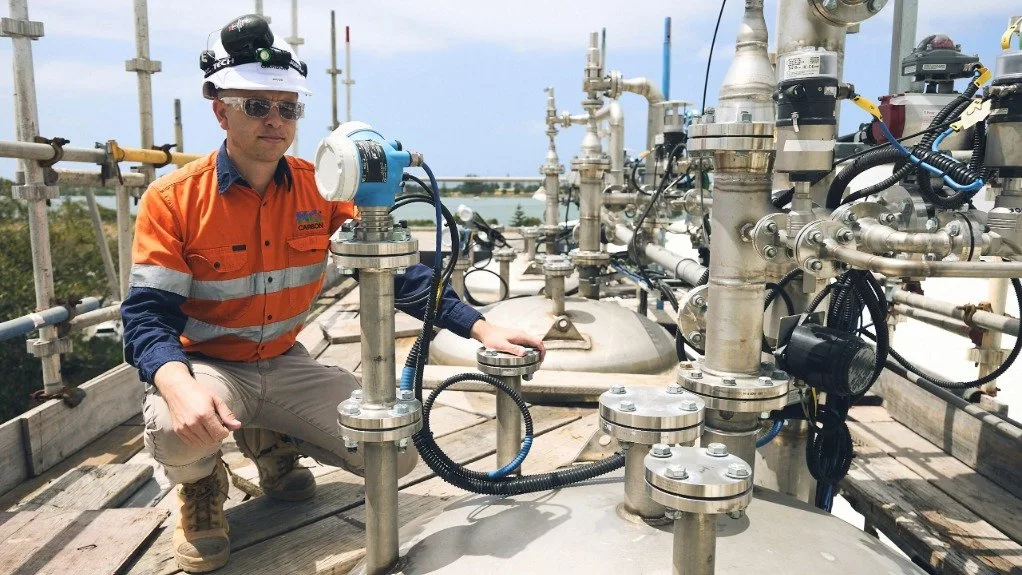
Australia has launched MCi Carbon, a new pilot carbon capture and utilization (CCU) plant that will convert industrial carbon dioxide emissions into raw materials for sectors such as construction, manufacturing, and the production of sustainable materials.
The facility, named Myrtle, was developed by MCi Carbon and will be located at Orica’s facilities on Kooragang Island, Newcastle. The project aims to demonstrate on an industrial scale how emissions can be captured directly at their source and converted into products with commercial value.
Conversion of CO₂ into industrial materials
The plant will capture carbon dioxide generated during ammonia production and transform it through a mineral carbonation process.
This system will enable the production of approximately 10,000 tonnes per year of mineral compounds, including magnesium carbonate, calcium carbonate, and amorphous silica—materials widely used in the manufacture of concrete, plasterboard, glass, and paper.
Furthermore, the facility will have the capacity to capture approximately 1,000 tonnes of CO₂ per year, contributing to the reduction of emissions associated with hard-to-abate industrial processes.
Mineral carbonation advances toward commercial applications
One of the most relevant aspects of the project is the validation of mineral carbonation under real operating conditions.
This technology utilizes natural chemical reactions to convert carbon dioxide into stable minerals, creating permanent products that can be incorporated into existing industrial chains.
In addition to reducing emissions, the process generates marketable materials, opening opportunities to develop new business models based on the circular carbon economy.
MCi Carbon: Supporting hard-to-abate sectors
Carbon capture and utilization technologies are gaining prominence as a complementary tool for achieving international climate goals.
Their application is particularly relevant in industries with processes that are complex to electrify or replace with renewable sources, such as cement, steel, chemical production, and heavy manufacturing.
In this context, projects like Myrtle demonstrate how carbon management can be integrated directly into industrial operations without affecting production continuity.
Public investment to accelerate climate technologies
The development of the plant received 14.5 million Australian dollars in funding through the Australian Government’s Carbon Capture Technologies Program.
The investment seeks to accelerate the adoption of solutions that reduce industrial emissions and foster the creation of value chains associated with low-carbon products. With the commencement of operations at Myrtle, Australia adds a new technological benchmark in the field of carbon utilization and advances in the demonstration of solutions capable of combining industrial competitiveness with emissions reduction.
Source: https://www.dcceew.gov.au/
Photo: MCi Carbon