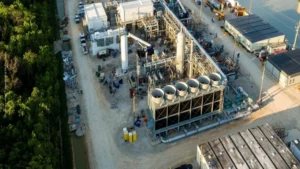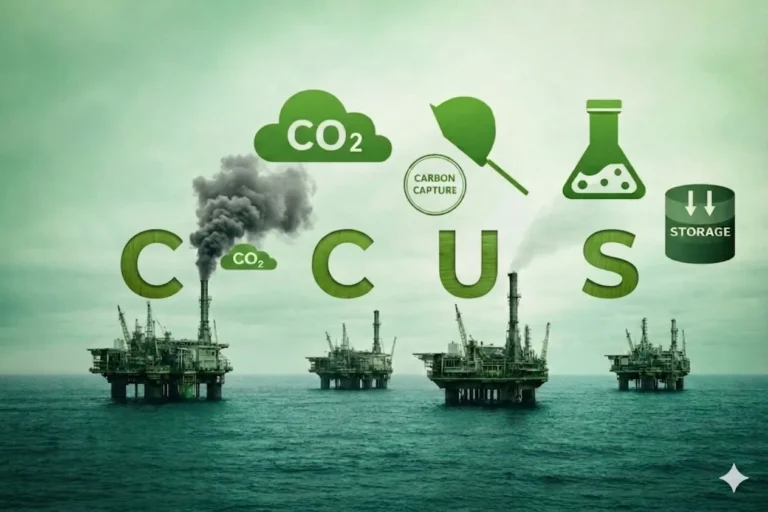
Offshore CCUS (Carbon Capture, Utilization, and Storage) is evolving from a conceptual promise into a concrete industrial framework within the energy transition. In a context where decarbonization goals demand scalable solutions, offshore carbon storage is emerging as one of the most significant pathways for reducing emissions without compromising the operational continuity of energy-intensive sectors.
The conversation is no longer only about capturing CO₂, but about how to integrate it into a complete chain that includes conditioning, transport, subsea injection, monitoring, and long-term verification. This is precisely the point where serious projects separate themselves from generic discourse: real feasibility depends on engineering, logistics, geoscience, asset integrity, and operational discipline.
For companies with global ambition and a long-term vision, such as Shell, interest in offshore CCUS is not limited to its environmental value. It also represents a strategic platform for developing decarbonization infrastructure with industrial logic, scalability potential, and the ability to integrate with other energy solutions.
What is offshore CCUS?
CCUS stands for Offshore Carbon Capture, Utilization, and Storage (CCUS), and in its offshore form, it relies on the marine environment’s capacity to provide large volumes of potential storage, typically located far from densely populated urban and industrial centers.
Its relevance is growing because many major emission sources will not disappear immediately. Refineries, petrochemical plants, gas processing facilities, cement plants, steel mills, and other heavy industries will continue operating for decades. In this context, offshore CCUS emerges as a practical tool to reduce residual emissions while advancing electrification, energy efficiency, low-carbon hydrogen, and the gradual substitution of fossil fuels.
The offshore approach also offers a structural advantage: the marine environment allows for large-scale geological storage, particularly in deep saline reservoirs or depleted fields whose historical experience in fluid handling provides a degree of technical confidence. However, the fact that CO₂ ends up beneath the seabed does not simplify the project; on the contrary, it requires a more sophisticated engineering chain, where every variable must be precisely controlled.
Below is a video from the CCSA (Carbon Capture & Storage Association): Driving the Deployment of CCUS to Achieve Net-Zero Emissions and Sustainable Growth on a Global Scale.
How offshore CO₂ storage works
To understand how offshore CO₂ storage works, it is useful to view the process as a sequence of interconnected stages. First, CO₂ is captured at the industrial source, then conditioned to remove water and impurities, compressed, transported to the offshore site, and finally injected into a geological formation suitable for permanent storage. Each of these phases has specific requirements and cannot be treated as a simple logistical step.
Conditioning is critical because CO₂ cannot be transported or injected in just any state. The presence of water, oxygen, hydrogen sulfide, or other impurities can lead to corrosion, unwanted phase formation, or compatibility issues with pipelines, valves, compressors, and surface equipment. Therefore, before discussing storage, the chain must ensure fluid quality and operational stability.
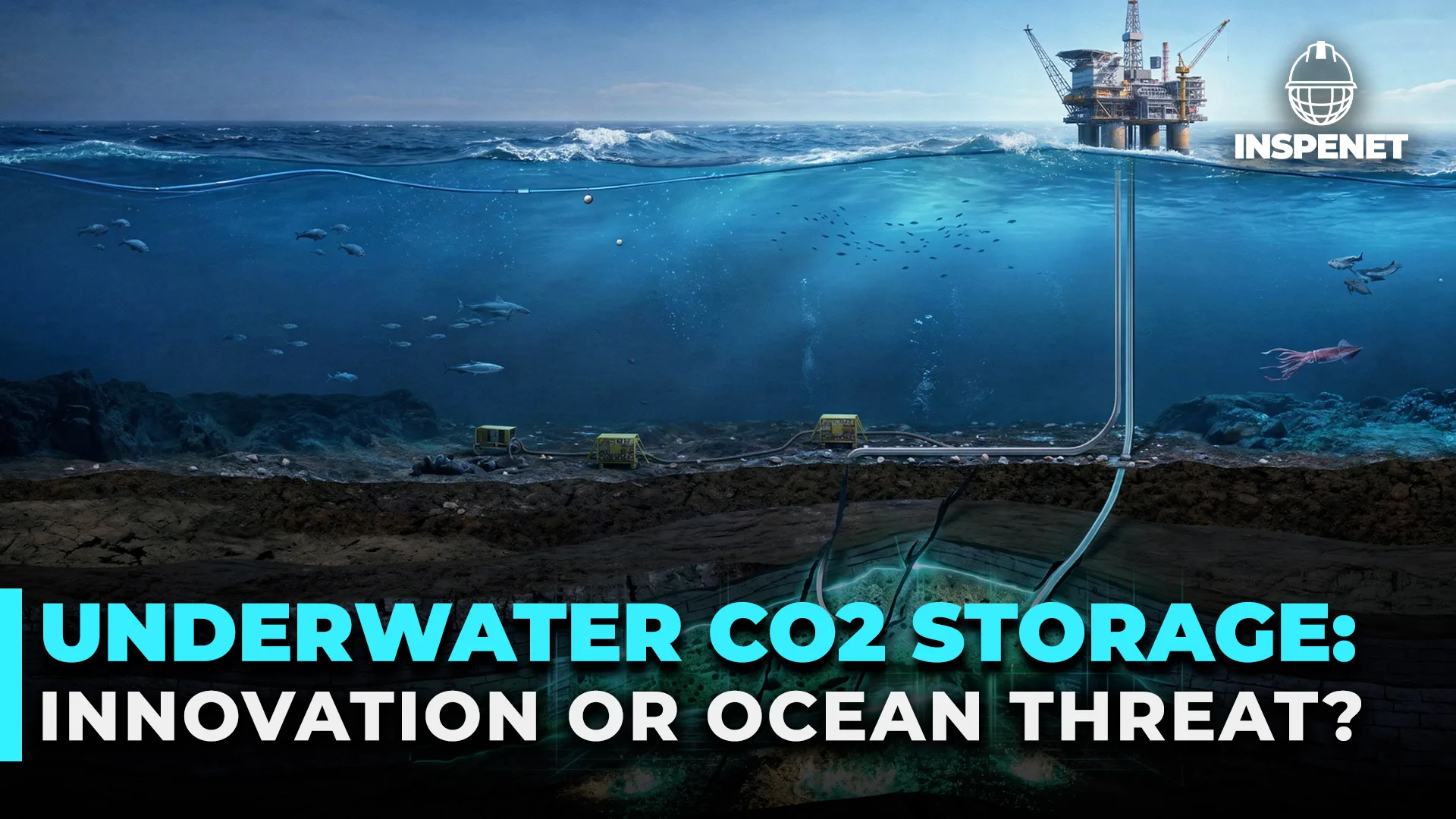
Once compressed, CO₂ can be transported via pipeline or by ship, depending on distance, volume, project maturity, and available infrastructure. Upon reaching the storage site, it enters wells designed for deep injection, where it is introduced into porous and permeable formations sealed by impermeable rock layers capable of containing the fluid over long periods.
The geological principle is relatively simple, but its implementation is not. CO₂ can be trapped through several mechanisms: structural trapping beneath a caprock, dissolution in saline water, residual trapping within rock pores, and, in the long term, mineralization. This combination of processes forms the basis of storage security but requires testing, modeling, and continuous monitoring to validate system behavior.
How is CO₂ transported to offshore sites?
One of the most common questions in this field is how CO₂ is transported to offshore sites. The answer depends on project scale and the distance between the emission source and the injection site. In general terms, there are three main approaches: pipeline transport, shipping, or hybrid solutions combining both.
Pipeline transport is typically preferred when handling large volumes of CO₂ continuously and when the distance to the storage site is reasonable. Its main advantage is efficiency for stable and long-term flows. However, building a CO₂ pipeline requires significant investment, complex permitting, and careful design to avoid pressure, corrosion, and operational safety issues.
Maritime transport becomes attractive when emission sources are dispersed, initial volumes are moderate, or land infrastructure does not justify a dedicated pipeline. In this case, CO₂ is conditioned and loaded onto specialized vessels for delivery to offshore terminals or hubs. This model can offer commercial flexibility and reduce entry barriers for projects that have not yet reached sufficient scale to justify fixed infrastructure.
Hybrid solutions are particularly interesting because they allow gradual transition. A project may begin with ship transport and later evolve toward pipelines as volumes increase and economies of scale improve. This adaptability is one of the strongest arguments in favor of modular offshore CCUS architectures.
Technical challenges in subsea storage
Although the marine environment offers large-scale opportunities, it also introduces complex challenges that must be addressed before a solution can be considered reliable, bankable, and operationally sustainable.
The first challenge is site selection. Not all geological formations are suitable for CO₂ storage. Reservoir rocks must have adequate porosity and permeability, along with a robust caprock to prevent vertical migration of the gas. In addition, it is essential to understand the geological history of the area, its mechanical behavior, and its response to pressure changes.
The second challenge is well integrity. An injection well must withstand pressure, temperature, and chemical exposure conditions for years or decades. Any failure in cementing, tubing, seals, or completion can compromise system safety. In offshore environments, where access is more costly and intervention more complex, design reliability becomes even more critical.
Another key issue is corrosion. CO₂, especially when mixed with water or impurities, can attack materials and affect both surface and subsurface equipment. Therefore, material selection, coatings, chemical barriers, and maintenance strategies are integral parts of the project. In practical terms, choosing the wrong material can turn a climate solution into an operational problem.
Monitoring is also a central challenge. To demonstrate that CO₂ remains safely stored, monitoring systems must combine seismic methods, pressure and temperature sensors, fluid analysis, and predictive modeling tools. Verification is not a communication accessory; it is a requirement for technical and regulatory legitimacy.
EOR in offshore CCUS: Climate–Economy link
EOR stands for Enhanced Oil Recovery and refers to the use of CO₂ to increase hydrocarbon extraction in mature reservoirs. In some contexts, this application has served as a commercial bridge for CO₂ capture and transport projects.
EOR can provide value by creating demand for captured CO₂ and helping finance transport and injection infrastructure. From a business perspective, this can accelerate the viability of systems that would otherwise have long return periods. It also allows leveraging existing expertise in fluid management, well operations, and reservoir integrity.
However, EOR does not define the entire logic of offshore CCUS. There are projects whose main objective is industrial decarbonization and permanent storage, not incremental oil production. In such cases, CO₂ use for EOR may be a transitional phase, an additional revenue stream, or a strategic component within a broader portfolio.
From a market development perspective, EOR can function as a kick-start mechanism, especially in regions where capture infrastructure is still emerging. However, in the long term, the value of offshore CCUS will depend on its ability to operate as independent decarbonization infrastructure, with or without the enhanced recovery component.
For a company like Shell, operating across multiple dimensions of the energy system, this balance between monetization and decarbonization is particularly relevant. The interest lies not only in storing CO₂ but in building chains that can be economically and operationally sustainable within a realistic energy transition.
Next, we examine how EOR in offshore CCUS projects serves as a commercial bridge, linking climate goals with industrial economic viability.
Opportunities of offshore CCUS in the energy sector
Beyond its environmental dimension, offshore CCUS opens concrete opportunities for the energy industry. The first is the creation of new critical infrastructure. Each project can mobilize subsea engineering, offshore construction, asset integrity, specialized transport, digital monitoring, and advanced geoscience capabilities—representing high-value industrial activity.
The second opportunity lies in cross-sector collaboration. Offshore CCUS can connect energy producers, gas operators, service companies, ports, shipyards, equipment manufacturers, research centers, and governments. This networked nature fosters the creation of more resilient industrial ecosystems with better scalability potential.
The third opportunity is strategic: enabling carbon-intensive assets to continue operating while reducing their climate footprint. In practice, this can help preserve competitiveness, jobs, and energy security during the transition period. It is not about immediate replacement, but about building a technically sound bridge between present and future.
There is also clear potential in digitalization and remote monitoring. Offshore storage tracking requires data platforms, advanced analytics, subsea sensors, and long-term verification systems. This drives the industry toward more integrated models of operation, diagnostics, and predictive maintenance.
Infrastructure for the next decade
Offshore CCUS is at a stage where the technology already exists, but large-scale deployment still depends on integration, permitting, financing, and scale. This makes it particularly attractive for companies seeking not superficial solutions but platforms capable of operating for decades with technical discipline and economic value.
CO₂ capture, transport, and offshore storage form a chain that demands excellence at every link. If one fails, the entire system loses credibility. If all operate in coordination, the result can be decisive infrastructure for industrial decarbonization.
Therefore, the future of offshore CCUS will not be defined solely by the amount of CO₂ stored, but by the quality of engineering, robustness of monitoring, reliability of wells, and the ability to create sustainable business models. That is the conversation that truly matters for the industry.
In an increasingly demanding market, companies leading this transition will need editorial and technical partners who understand their language, risks, and priorities. In this context, offshore CCUS is not just a topic to explain—it is an opportunity to demonstrate expertise, judgment, and long-term vision.
Conclusions
Offshore CCUS represents one of the most technically robust and scalable pathways for industrial decarbonization, particularly in sectors where emissions are difficult to eliminate in the short term. Its success depends not only on the capture of CO₂ but on the integration of a complete and reliable value chain that includes transport, injection, monitoring, and long-term containment.
The offshore environment offers significant storage potential, but it also demands higher levels of engineering precision, operational discipline, and asset integrity. Challenges such as corrosion, well integrity, and monitoring must be addressed with advanced technical solutions to ensure safe and permanent storage.
From a strategic perspective, offshore CCUS enables a balanced transition by allowing existing industrial assets to remain operational while reducing their carbon footprint. In this context, approaches such as EOR can serve as transitional mechanisms, although long-term value will depend on independent decarbonization infrastructure.
Ultimately, the viability of offshore CCUS will be defined by its ability to combine technical reliability, economic sustainability, and regulatory credibility, positioning it as a cornerstone of the global energy transition.
References
- Shell. (n.d.). Carbon capture and storage (CCS). Retrieved from https://www.shell.com
- Bott, T. R. (1995). Fouling of heat exchangers. Elsevier.
- Müller-Steinhagen, H. (2011). Heat exchanger fouling: Mitigation and cleaning technologies. IChemE.
- Kakac, S., Liu, H., & Pramuanjaroenkij, A. (2012). Heat exchangers: Selection, rating, and thermal design. CRC Press.
- Wang, L. K., Hung, Y. T., & Shammas, N. K. (2009). Handbook of environmental engineering. Humana Press.