NEURA Robotics has announced a strategic alliance with Amazon Web Services to accelerate the development of so-called physical AI, an emerging field that seeks to provide robots with advanced cognitive capabilities in real-world environments.
Unlike generative AI, which is powered by massive volumes of digital data, robotics faces a structural limitation: the scarcity of real-world physical data. This gap limits the ability of robots to learn, adapt, and operate reliably outside of controlled environments.
The collaboration directly addresses this challenge by creating an infrastructure that connects simulation, real-world data, and continuous learning, establishing a technological foundation to scale robotic intelligence beyond the laboratory.
Cloud infrastructure redefines robotic training
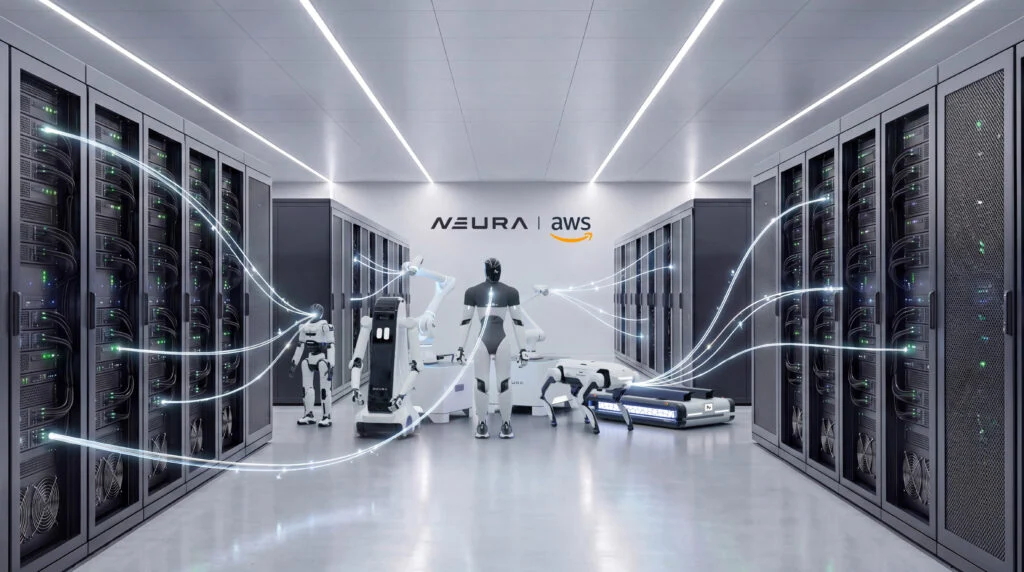
At the core of this alliance is the integration of the Neuraverse platform within the AWS cloud, enabling distributed training of physical AI models, real-time processing, and intelligence sharing across robot fleets.
The use of tools such as Amazon SageMaker significantly accelerates training cycles by combining data from real sensors with high-fidelity simulations. This hybrid approach reduces development times and improves model robustness.
From a technical perspective, the cloud acts as a scalability enabler, allowing multiple robots to share learning in real time. This transforms the traditional paradigm of isolated robots into connected and evolving systems.
Simulation and reality converge in continuous learning
A determining factor of the agreement is the integration of NEURA Gym, an environment designed for robotic training under controlled conditions with advanced simulation capabilities. Here, robots practice complex tasks before facing real-world scenarios.
This approach responds to a key principle in modern engineering: iterative validation between simulation and operation. By combining both worlds, the risk of field failure is reduced and technological maturity is accelerated.
Furthermore, the ability to feed models with real data from operations allows for a continuous improvement cycle, where every interaction in the physical world contributes to the global learning of the system.
Industrial application accelerates global adoption
The collaboration transcends the technological sphere by incorporating validation in real-world environments, particularly in Amazon logistics centers, which are considered among the most advanced in the world for automation.
These environments provide an essential volume of operational data, allowing robotic systems to be tested and optimized under conditions of high demand, variability, and complexity. This significantly accelerates the transition from prototypes to commercial deployments.
In strategic terms, the alliance positions NEURA within a global ecosystem that integrates robotics, cloud computing, and artificial intelligence. The goal is clear: to enable millions of cognitive robots by 2030, consolidating a new standard in industrial automation.
Source: https://ir.nauticusrobotics.com/
Photo: Shutterstock