Guided Wave Testing: from CUI detection to autonomy
The history of Guided Ultrasonics Limited (GUL) is closely linked to the development of Guided Wave Testing (GWT) . The company was founded in 1999 by members of the research team at the Department of Mechanical Engineering at Imperial College London, the institution where the foundations of this technology for pipeline inspection and monitoring were developed.
guided wave inspection and monitoring solutions , supplying technologies for industries such as oil and gas, refining, chemical processing, transport infrastructure and power generation.
During an interview conducted by Inspenet, Keith Bine, Global Sales & Service Director of GUL, explained how the technology evolved from a tool designed to detect corrosion under insulation (CUI) to become a comprehensive platform for continuous asset monitoring.
The initial challenge: inspecting corrosion under insulation
In the late 1980s and early 1990s, corrosion under insulation represented one of the biggest challenges for the industry. Conventional techniques required removing large amounts of insulation to inspect relatively small segments of pipe.
According to Bine, the initial goal of the research at Imperial College was to develop a methodology capable of surveying long distances from a single access point. However, at that time the physical phenomena associated with guided waves were not yet fully understood.
After years of doctoral and postdoctoral research, the researchers managed to understand fundamental aspects such as:
- The different modes of propagation.
- The effects of dispersion.
- Sensitivity to different damage mechanisms.
- The generation of interpretable signals for industrial inspection.
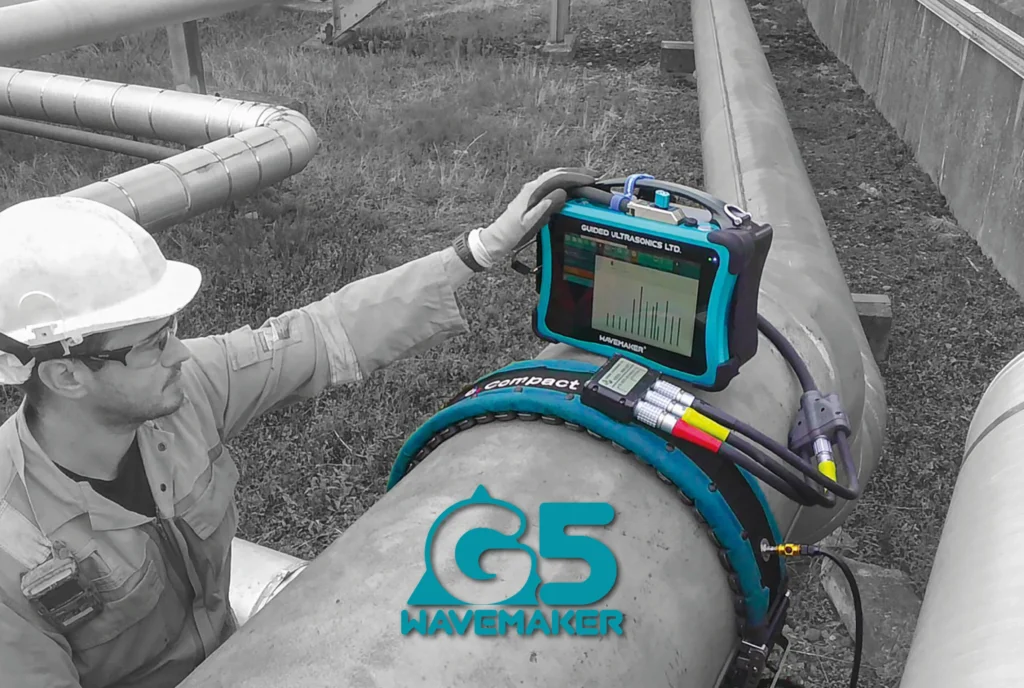
This knowledge made it possible to develop GUL's first commercial system in 1999: the Wavemaker SE16 .
The turning point: bringing technology to the field
For Keith Bine, the real change occurred when the technology left the laboratories and began to be used in real operating conditions.
Companies such as Shell, BP, Exxon, Chevron, and Saudi Aramco were among the first organizations to bet on the potential of guided waves for pipeline inspection .
The field experience allowed for the identification of new needs and applications that could not be fully replicated in academic settings. Each inspection generated valuable information that was subsequently used to improve equipment, procedures, and analysis algorithms.
This process of continuous improvement has characterized GUL's evolution for more than two decades.
From conventional screening to new industrial applications
One of the most important advantages of Guided Wave Testing is its ability to inspect large lengths of pipe from a single location.
The technology works by using a ring of transducers that generates guided waves along the length of the pipe. When there is a loss of cross-section caused by corrosion, erosion, or another defect, some of the energy is reflected back to the point of origin, allowing the location and severity of the damage to be identified.
Although initially developed to detect CUI, new applications quickly began to emerge:
Underwater inspection
GUL developed specific solutions for underwater pipelines installed on the seabed, allowing inspections by divers and remotely operated vehicles (ROVs).
Railway inspection
Following a railway accident in the UK, Network Rail promoted the development of the G-Scan system to detect defects in rails and railway crossings.
High-temperature inspection
In collaboration with Chevron, GUL developed transducer rings capable of operating in pipelines up to 350°C, allowing inspections without the need to stop the operation of the assets.
The evolution towards continuous monitoring
One of the most important developments in recent years has been the transition from periodic inspections to permanent monitoring systems.
Based on the needs of operators facing high access costs (such as scaffolding, excavation, or offshore work), GUL developed permanent sensors capable of remaining installed for years.
This technology gave rise to the gPIMS (Guided Wave Permanent Inspection Monitoring System) , which allows for repetitive inspections without the need to reinstall sensors or move inspection equipment.
Currently, some systems installed more than a decade ago continue to provide reliable information on the condition of the monitored pipes.
QSR: when screening needs quantification
Although Guided Wave Testing is extremely efficient at detecting anomalies, operators also needed to know precisely how much material remained in a damaged area.
QSR (Quantitative Short Range Scanning) technology .
This system uses high-frequency guided waves to generate quantitative measurements of remaining thickness in hard-to-reach areas, such as pipe supports or partially covered areas.
The results obtained by QSR have been independently validated, showing a strong correlation with reference measurements obtained by laser scanning.
Subsequently, the company introduced the QSR Axial system , expanding inspection capabilities to areas such as wall penetrations, clamps, and other complex configurations.
From remote monitoring to autonomous monitoring
The next stage of evolution was the incorporation of permanent electronics connected directly to the sensors.
Instead of an inspector periodically visiting the facility to collect data, modern systems continuously collect information and transmit it through digital platforms.
A prime example is the implementation carried out for Chevron in Australia, where autonomous systems monitor critical lines associated with carbon capture projects.
These systems allow:
- Continuous data collection.
- Real-time remote access.
- Integration with industrial historians.
- Automated processing.
- Ongoing evaluation of corrosion rates.
Artificial intelligence and predictive integrity management
During the interview, Bine emphasized that the future of Guided Wave Testing is closely linked to the digital transformation of integrity management.
Current platforms generate large volumes of information that can be combined with other operational data sources to build more robust predictive models.
According to the executive, technologies such as artificial intelligence will allow the correlation of multiple operational variables with the degradation mechanisms observed in the assets, generating more valuable information for decision-making.
In this context, continuous monitoring using guided waves is emerging as a strategic tool for data-driven integrity programs.
GUL and its vision for the future
Currently, GUL maintains its vision to continue leading the development of innovative inspection and monitoring systems based on guided wave technologies, transforming data into useful knowledge for the integrity management of industrial assets.
With headquarters in the UK, the US and Malaysia, the company continues to invest in research and development to expand its capabilities for inspection, monitoring and predictive analysis of critical assets around the world.
The evolution of Guided Wave Testing reflects how a technology born in academia can transform into an essential tool for global industry. What began as a solution for detecting corrosion under insulation has become a complete ecosystem for inspection, continuous monitoring, and predictive analytics.
The track record of Guided Ultrasonics Limited demonstrates that sustained innovation, collaboration with industrial operators, and the incorporation of digital technologies are key factors for the future of asset integrity and non-destructive testing.