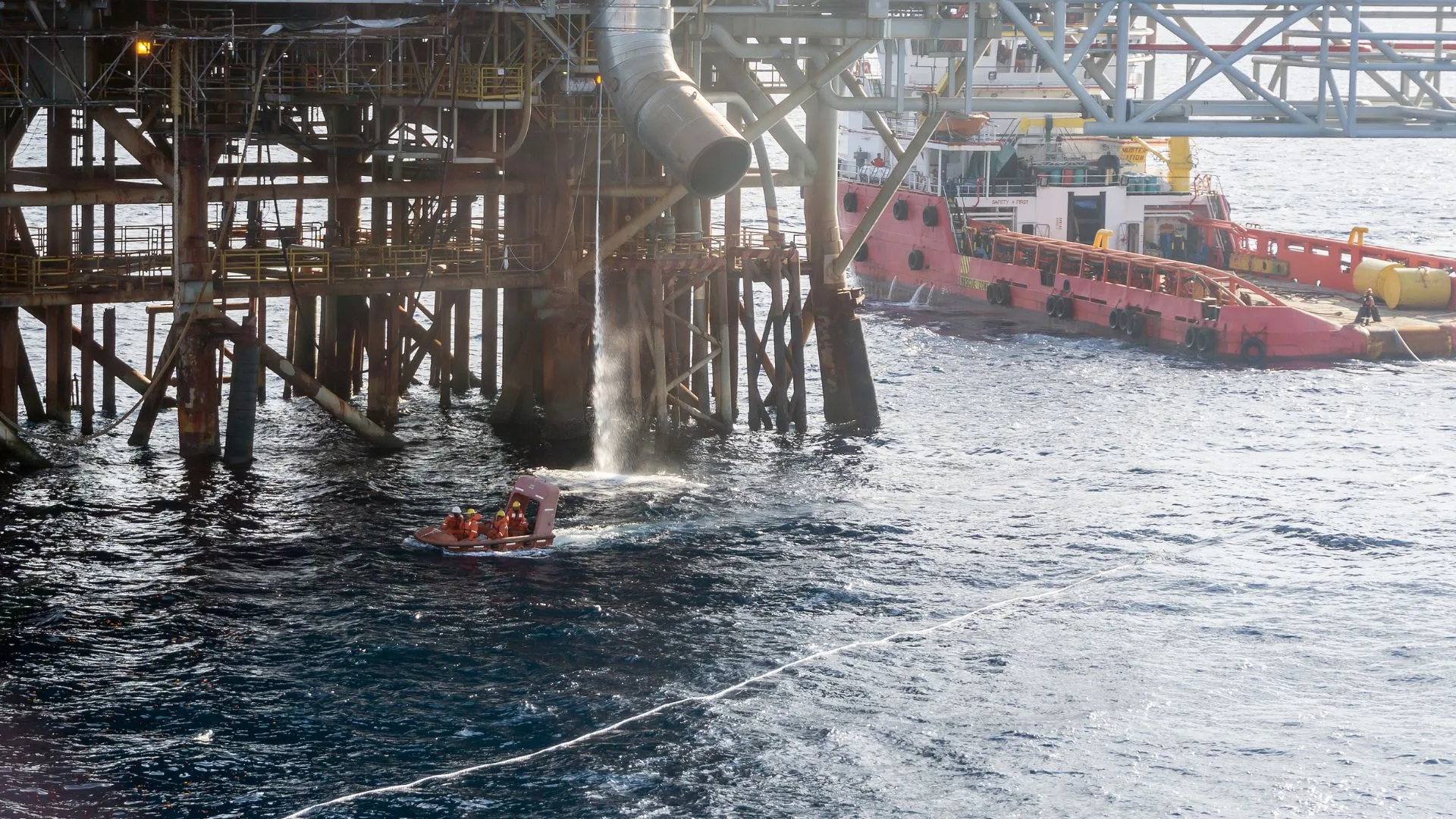
Monopile lowering is gaining relevance as one of the most demanding load cases for jack-up vessels used to install offshore wind farms. A study conducted by GustoMSC indicates that this phase, corresponding to lowering the foundation into the water, can generate structural stresses greater than those traditionally considered under extreme survival conditions.
Monopile lowering gains relevance in monopiles
In recent years, the offshore wind industry has steadily increased the size of foundations to support higher-capacity wind turbines; today it is common to find monopiles with diameters between 10 and 12 meters and weights reaching 2,500 tonnes. This evolution improves the structures’ ability to support more powerful turbines. However, it also increases the complexity of installation operations and the demands on the equipment used offshore.
Initial immersion concentrates the highest loads
The study analyzed the behavior of a monopile during its lowering from a jack-up vessel in an approximate water depth of 40 meters. The results show that the most demanding moment occurs when the monopile passes through the first meters below the water surface. At that point, wave–structure interaction phenomena appear that significantly increase the dynamic loads transmitted to the vessel’s guiding system. According to the research, the interval between 10 and 15 meters of immersion represents the most critical condition for the structure.
Loads higher than expected under extreme conditions
One of the most relevant findings of the analysis is that the bending moments recorded in the lower guide can exceed by up to 20% the loads associated with the 50-year return-period survival scenario. Likewise, the study highlights that wave direction has a significant influence on the magnitude of the structural demands. This behavior confirms that installation operations require specific assessments and cannot be analyzed solely using traditional design criteria.
Implications for offshore wind development
The results point to the need to incorporate the load case associated with monopile lowering into the engineering processes for new jack-up vessels and into offshore installation procedures. As the industry continues to develop higher-power wind turbines and larger foundations, manufacturers and contractors will need to adapt their methodologies to ensure safer and more efficient operations. Integrating these scenarios from the earliest design stages will help reduce operational risks and optimize the performance of offshore wind energy projects.
Source: Offshore-energy
Photo: Shutterstock


