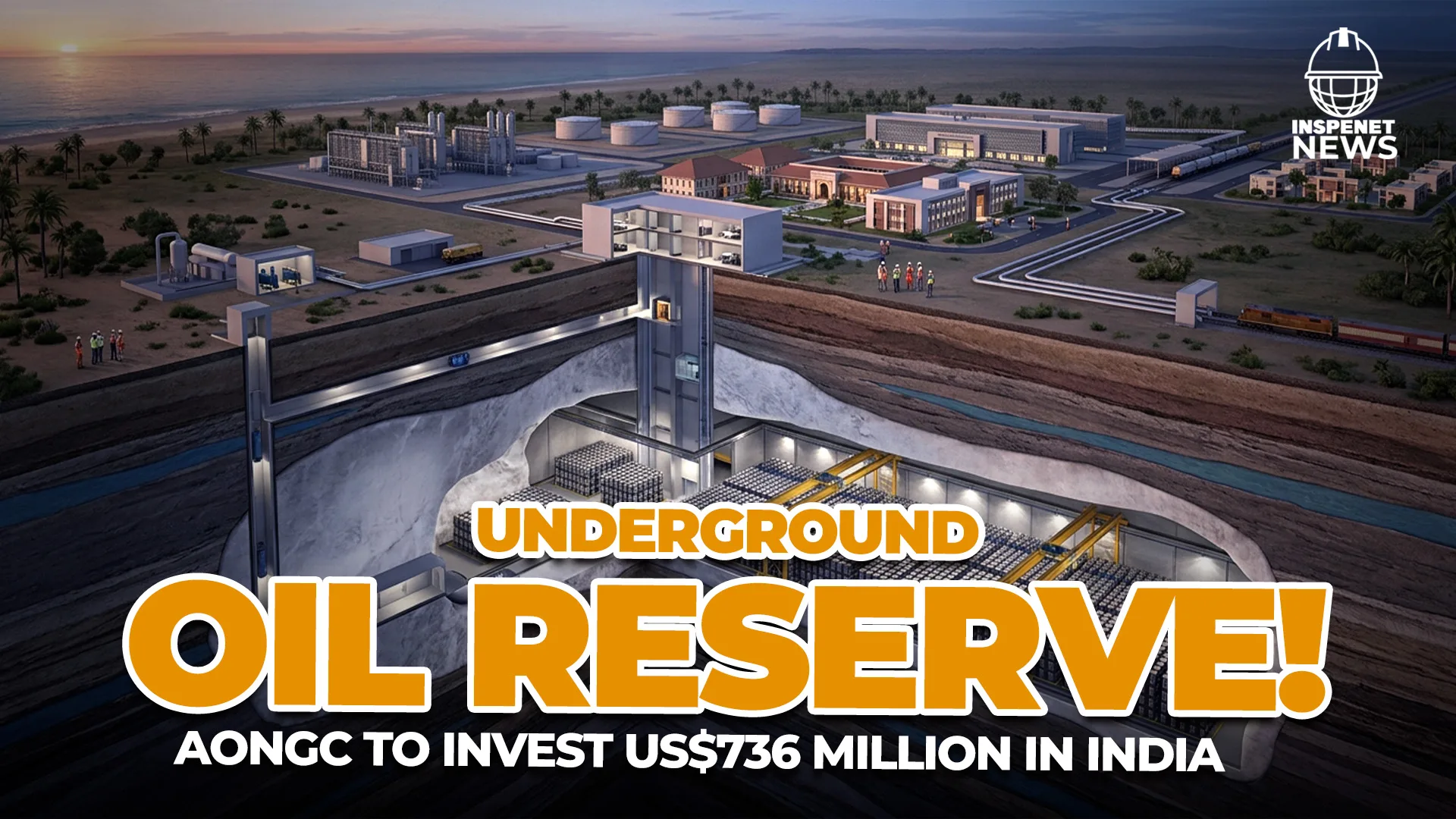
ONGC will invest US$736 million in India’s oil reserves
Oil and Natural Gas Corp. (ONGC) plans to invest 70 billion rupees, equivalent to about US$736 million, in the development of new oil reserves in southern India.
The state-owned oil company will build underground facilities with the capacity to store approximately 13 million barrels of crude oil. ONGC Chairman Arun Kumar Singh indicated that the land needed for the project has already been acquired and that construction will begin soon.
oil storage capacity to respond to potential supply disruptions. The initiative will also support the Indian government's efforts to increase its emergency energy reserves .
India seeks to protect itself from problems in crude oil supply
Moreover, the expansion comes after the war in the Middle East exposed India's vulnerability to disruptions in international supply .
India relies heavily on oil imports to meet its demand; therefore, a disruption in international flows could increase pressure on the country's supply and raise its exposure to changes in energy markets.
In this scenario, having more oil reserves provides additional leeway to cope with periods when imports are delayed or disrupted.
India has 39 million barrels of oil in storage
India currently has around 39 million barrels of crude oil in strategic storage. That amount is roughly equivalent to one week of oil imports.
Therefore, the 13 million barrels projected by ONGC represent a significant increase compared to the current strategic volume. Comparing both figures, the new facility would have a capacity equivalent to approximately one-third of those 39 million barrels.
However, India's capacity remains small compared to China's; the Asian country maintains around 1.2 billion barrels in commercial and strategic reserves.
The difference shows the scale of the challenge India faces as it tries to increase its protection against potential problems in international crude oil markets.
ONGC is evaluating operating oil and gas operations from Dubai or Singapore
Meanwhile, ONGC is also looking to increase its control over its international operations; the company is in talks with foreign firms to establish an operations desk outside of India.
The project would be dedicated to the trading of crude oil, refined fuels and natural gas . With this structure, ONGC seeks to gain greater control over purchases and sales, as well as better manage its exposure to price fluctuations.
According to Singh, Dubai and Singapore are the two locations the company is considering to set up this operation.
ONGC aims to market 50 million tons per year
Furthermore, ONGC's business plans are on a considerable scale; the company intends to manage around 50 million tons of crude oil , petroleum products, and gas annually through this platform.
Thus, the two initiatives showcase different facets of ONGC's strategy. The project in India will increase available physical storage capacity in the face of supply problems, while the international initiative will allow for direct involvement in operations related to the purchase and sale of energy resources.
For India, the increase in reserves is especially important due to its dependence on oil imports. The additional 13 million barrels will provide greater responsiveness to external disruptions, although the gap with China's accumulated reserves will remain significant.
News of additional interest
Norway wants to sell energy without paying the full cost
Norway maintains its intention to explore for oil and gas in the Barents Sea despite the European Union's support for halting new drilling in the Arctic. Oslo also rejects the idea of becoming Europe's major "green battery." However, the country remains closely tied to the European market: it supplies nearly 30% of the gas consumed by the EU and the UK and earns significant revenue from its energy exports.
The relationship also extends to electricity. Norway produced around 162 TWh in 2025 and consumed 139.2 TWh, while exporting approximately 34 TWh and importing 11.5 TWh. Its hydroelectric reservoirs store around 85 TWh, allowing it to conserve water when external electricity is cheap and generate more when prices rise. The problem is that this interconnectedness can also increase the rates Norwegian consumers pay when Europe experiences periods of high energy costs.
Eagle LNG attracts capital amid US space boom
Datacentrex will invest $30 million in Eagle LNG Partners and acquire a 10.5% stake in the US company. Eagle LNG has been producing liquefied natural gas since 2017 and also supplies liquid methane with specifications for space propulsion. The deal comes as the United States seeks to significantly increase the number of launches this decade and as demand for rocket fuel grows.
Eagle LNG also serves the shipping, utilities, and industrial sectors. Its portfolio includes long-term supply contracts with an average duration of approximately 15 years. Since 2018, it has completed more than 700 LNG bunkering operations without incident. Datacentrex's investment will be complemented by an additional $10 million from a subsidiary of The Energy & Minerals Group, Eagle LNG's current majority backer.
Marine robots will monitor a British power link
XOCEAN will deploy two unmanned surface vehicles to inspect approximately 127 kilometers of the Western HVDC Link, a 2,200 MW submarine power line between Scotland and England. The X-05 and X-29 vehicles will begin operations on September 10th on the section between the south of the Isle of Man and the cable's arrival at Wirral. The work is expected to last between two and four weeks, depending on weather conditions.
The vehicles will use multibeam echosounders and side-scan sonar systems to study the cable and the seabed. The inspection will allow researchers to check the depth at which the infrastructure is buried, identify any seabed movements, and assess the condition of elements such as rock protection, concrete mats, and cable crossings.
Valeura anticipates Wassana's return
Valeura Energy will accelerate the reactivation of the Wassana oil field in the Gulf of Thailand and now expects to begin production in early Q2 2027, nearly two months ahead of schedule. The company plans to install its new central processing platform starting in October 2026 and begin drilling operations in November with the Shelf Enterprise rig.
The project remains on schedule, although accelerating construction will increase projected spending for 2026. Valeura adjusted its annual investment range to between $220 million and $235 million, compared to the previously estimated $195-$215 million. The new facility will have a maximum production capacity of approximately 7,500 barrels per day, and the early start could contribute an additional 430,000 barrels during 2027.