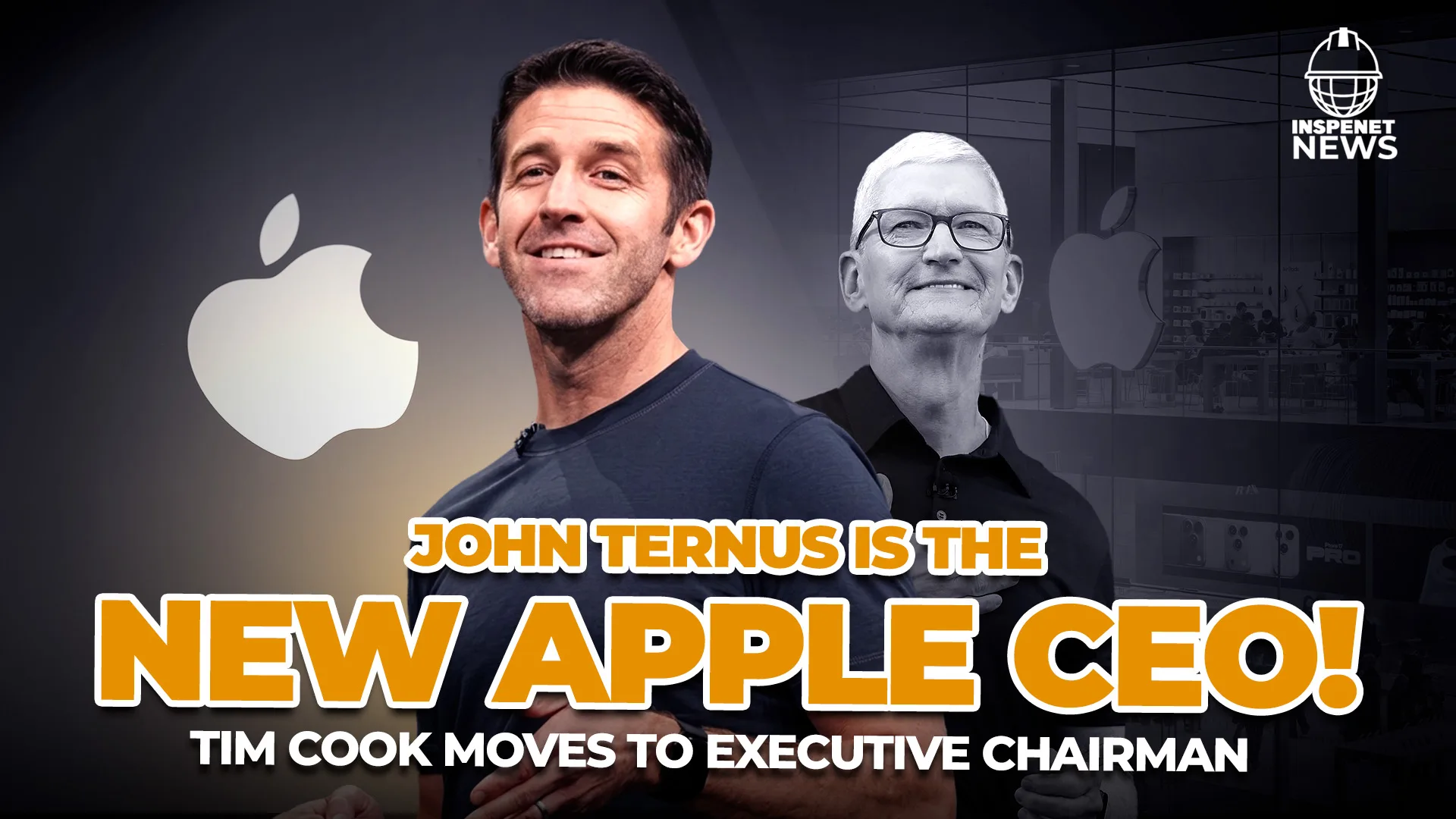
John Ternus takes over as Apple CEO with AI as the biggest challenge
When Tim Cook took the reins of Apple in 2011, he inherited a company valued at around $350 billion. Fifteen years later, he leaves the Apple CEO position with the company valued at over $4.5 trillion and John Ternus tasked with leading its next phase.
Furthermore, the change comes at a different time than Cook found himself in. Apple boasts a massive user base, a services business that generates recurring revenue, and a solid position in hardware. However, the company faces increasing pressure to demonstrate that it can also compete at the highest level in artificial intelligence .
John Ternus takes over from Tim Cook as Apple CEO
Since September 1, John Ternus has held the position of CEO of Apple , while Tim Cook has become executive chairman and will maintain his connection with the company after 15 years at the helm of its operations.
Thus, Apple is once again entrusting its leadership to an executive who has been with the company for years. Ternus joined the company in 2001 and spent much of his career in hardware, eventually becoming senior vice president of Hardware Engineering .
During that time, he participated in the development of some of Apple's main product lines, including iPhone, iPad, Mac, Apple Watch, and AirPods . His technical expertise will be especially relevant now that hardware, proprietary chips, software, and artificial intelligence are becoming increasingly interconnected.
Tim Cook leaves behind a much larger Apple than the one he inherited.
On the other hand, the figures allow us to understand the scale of the transformation that has taken place during Tim Cook's tenure. Apple's annual sales were around $108 billion when he began his time as CEO. In fiscal year 2025, they reached $416 billion .
Profits also grew strongly, with Apple closing that fiscal year with $112 billion, more than four times the level recorded at the beginning of Cook's tenure.
Furthermore, growth did not depend solely on selling more iPhones; Cook developed a model capable of generating revenue throughout the user's relationship with the company's ecosystem.
That strategy made services one of the pillars of the business. Subscriptions, storage, apps, and other services allowed Apple to leverage an installed base of over 2.5 billion active devices.
The services reduce Apple's dependence on the iPhone.
Meanwhile, the growth of services reduced some of Apple's reliance on regular sales of new devices. This division is worth over $100 billion and has grown faster than its traditional hardware business in recent years.
The ecosystem also expanded with new devices; Apple Watch and AirPods strengthened the relationship between users and the company's products. The wearables division generated approximately $35 billion in revenue during fiscal year 2025.
Thus, Ternus receives a company with multiple revenue streams and an extensive customer base; this strength gives it room to define Apple's next stage, although it also raises expectations about its results.
Artificial intelligence puts John Ternus to the test
However, Apple's size contrasts sharply with the doubts surrounding its position in artificial intelligence. While other major tech companies accelerated the development and deployment of generative models, Apple has followed a more cautious strategy.
The problems and delays related to Siri have increased that pressure; Apple needs to demonstrate that it can integrate artificial intelligence features capable of bringing noticeable improvements to the devices that millions of people use daily.
For Ternus, this situation presents a particularly important test; their expertise comes from hardware, but the company's next stage will increasingly depend on the integration between processors, devices, operating systems, and AI models.
In this scenario, Apple has a significant advantage: it controls much of the hardware and software of its products. It also develops its own chips and has a vast number of active devices from which it can distribute new features.
The challenge will be to transform those capabilities into artificial intelligence experiences that allow the company to close the gap with its main competitors.
China and India add another challenge for Apple's new CEO
Meanwhile, Ternus will also have to manage a supply chain exposed to US-China relations. A significant portion of Apple's products remain tied to Chinese manufacturing capacity, making any trade or political tensions a relevant factor for its operations.
Faced with this situation, the company has progressively expanded its production in other markets. India occupies an increasingly important position within this diversification process.
This area directly connects with one of Tim Cook's greatest strengths. Before becoming Apple's CEO, he had gained influence within the company thanks to his mastery of operations and the supply chain.
Tim Cook will remain linked to Apple
Despite the change of CEO, Cook is not leaving the company; from his position as executive chairman, he will continue to participate in certain matters and will be able to contribute his experience in Apple's institutional relations.
His continued leadership also provides continuity during Ternus's initial stages. The new CEO will have to manage a massive business while defining his own priorities and responding to technological changes that may alter how users interact with their devices.
Ultimately, this will be the comparison that defines this new phase. Cook inherited an Apple that had to prove it could thrive after Steve Jobs and ended up multiplying its revenue, profits, and valuation. Ternus inherits a much larger and wealthier company, but with one lingering question: can he translate all that strength into a competitive response to the advance of artificial intelligence.
News of additional interest
BP puts Meg O'Neill under more pressure
BP has appointed Ian Tyler as its permanent chairman following several changes to its board of directors over the past year. Tyler, who had been serving as interim chairman, brings experience from companies such as BAE Systems, Anglo American, and Balfour Beatty. His arrival is expected to bring internal stability as the oil company, valued at approximately $115 billion, accelerates asset sales, seeks to reduce debt, and refocuses resources on its oil and gas business.
The new chairman will be tasked with overseeing and questioning management's decisions, but execution will fall primarily to CEO Meg O'Neill. BP is looking to cut billions of dollars in structural costs and simplify its portfolio. Tyler's record at the helm of Balfour Beatty also raises concerns: during his eight years as CEO, total shareholder returns were 13%, well below the 80% return posted by the FTSE 100 during that period.
The US plans to double Venezuela's oil production
US Energy Secretary Chris Wright stated that Venezuela's oil production could more than double in the coming years thanks to new investments. The country currently produces between 1.1 and 1.2 million barrels per day, a far cry from the more than 3 million barrels per day recorded in the late 1990s. Companies such as Chevron, Eni, ONGC, GeoPark, and GE Vernova are expected to sign agreements related to energy projects in Venezuela.
The move comes as Washington expands its involvement in Venezuela's oil sector. The United States has also agreed to long-term access to a fifth of the country's proven reserves. As part of this strategy, North American Blue Energy Partners would receive 100-year rights to 17 fields with an estimated 65 billion barrels of oil. The agreement has raised concerns among some companies because it was negotiated without a competitive process and has also drawn attention from China due to its interests in Venezuela.
Gangs challenge the security of Chilean copper
Copper thefts from trains are on the rise in the Atacama Desert, and gangs are employing increasingly sophisticated methods to circumvent security measures. Antofagasta recorded 86 thefts in 2025 and another 34 in the first four months of 2026. In that latter period, 169 tons were stolen, equivalent to 71% of the total volume stolen the previous year.
The criminals go so far as to jump from trucks onto moving train cars to throw 80-kilogram copper sheets to other members of the group. They also use hooks to remove cargo from stopped trains and have managed to attack units protected by cages. The stolen material ends up in illegal scrap yards, where it can be melted down to erase its identification and subsequently shipped abroad as scrap metal. Antofagasta warns that these actions also endanger railway workers.
Oil prices fall despite tensions in Hormuz
Oil prices retreated after reaching more than a month highs as the market assessed the risk of further disruptions in the Middle East. Brent crude fell to $94.22 a barrel and WTI to $89.51, after touching $97.04 and $92.29 respectively during the day. The decline gained momentum after news that more than 17 million barrels managed to cross the Strait of Hormuz on Monday, a sign that some supply is still reaching the market.
Concern remains due to the renewed exchange of attacks between the United States and Iran. Two oil tankers were immobilized after striking mines while attempting to cross the Strait of Hormuz, a route that carried approximately one-fifth of the world's oil and LNG before the conflict. Ship-to-ship transfers have allowed some exports to continue in recent weeks, although these operations remain vulnerable to further military action.