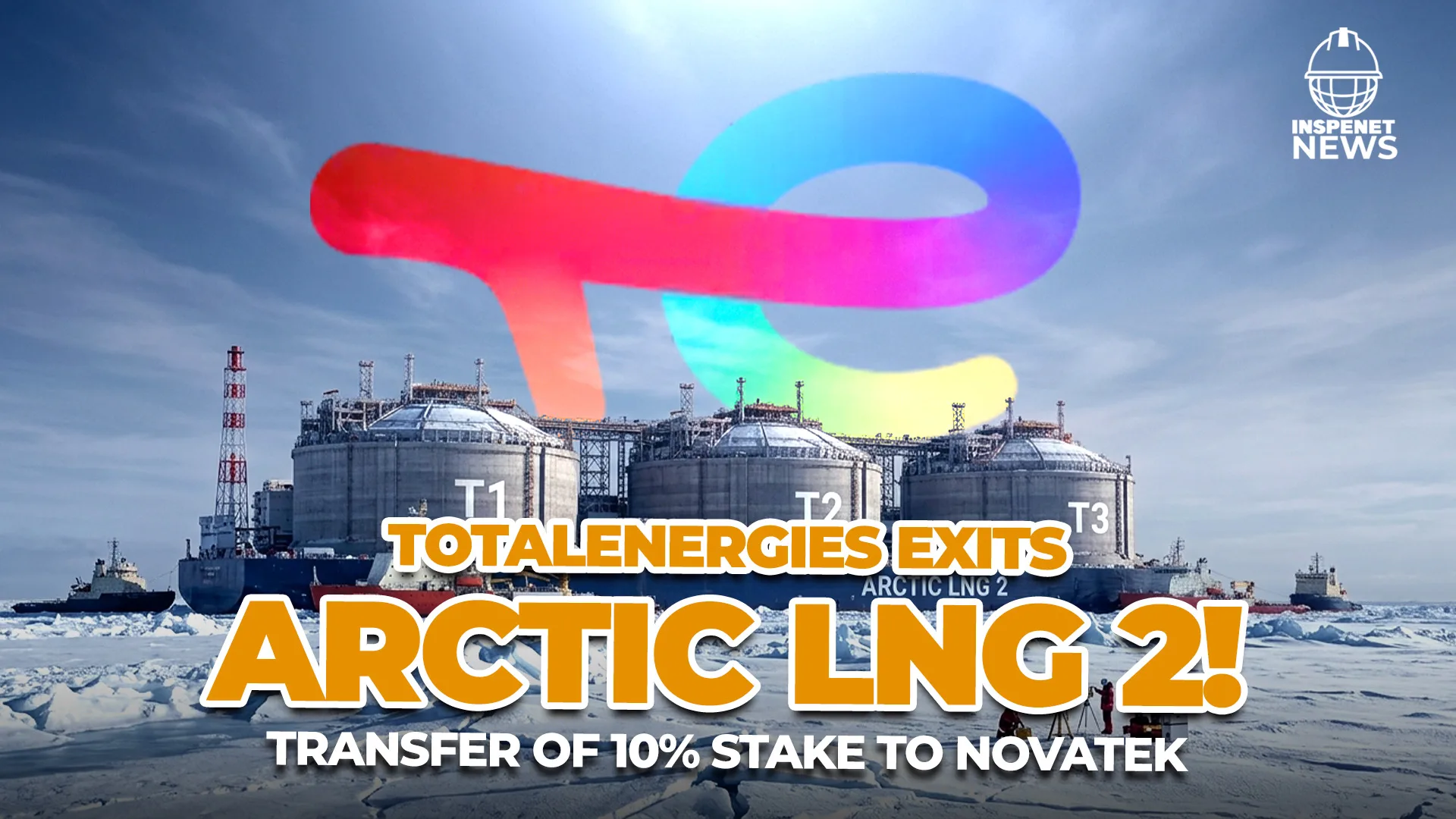
TotalEnergies completes its exit from Arctic LNG 2 after transferring its 10%
TotalEnergies has completed the transfer of its 10% stake in Arctic LNG 2 to NordLine, a subsidiary of Novatek. With the closing of the transaction, the French company is no longer a shareholder in this LNG project in Russia.
Furthermore, the transaction leaves one financial front open; TotalEnergies retains the right to receive approximately US$1.3 billion corresponding to its share of the loans granted by shareholders to Arctic LNG 2. However, any future repayment will be subject to applicable penalties.
TotalEnergies ceases to be a shareholder of Arctic LNG 2
Specifically, TotalEnergies confirmed on August 27, 2026, that it had completed the transfer of its entire direct stake in Arctic LNG 2. The stake represented 10% of the project's capital.
In this way, the shares pass into the hands of NordLine , a company linked to Novatek, the operation ends the presence of TotalEnergies as a direct shareholder of Arctic LNG 2.
The move had already been anticipated during the presentation of the results for the second quarter of 2026. Therefore, the August announcement confirms the execution of a transaction that the French energy company had previously communicated.
TotalEnergies holds rights to US$1.3 billion
On the other hand, leaving the shareholding does not mean closing all economic ties related to the LNG project.
TotalEnergies retains the right to be reimbursed by Arctic LNG 2 for the loans it provided as a shareholder. The company estimates that amount at approximately US$1.3 billion .
Thus, the transfer separates two distinct components of TotalEnergies' relationship with the project. On the one hand, the energy company no longer owns 10% of Arctic LNG 2. On the other, it retains an economic right related to the money previously loaned.
This difference is relevant to understanding the scope of the operation; the shareholding has already been transferred, while the recovery of the loans could occur later.
The penalties affect the possibility of a refund.
In turn, the collection of the US$1.3 billion is not guaranteed for a specific date; TotalEnergies indicates that the reimbursement could be executed in the future as long as applicable sanctions allow it.
This condition leaves some financial exposure after the transfer of the shares . The company has a right of reimbursement, although its exercise will depend on the restrictions in place when the payment can be made.
Sanctions have had a significant impact on Arctic LNG 2, the Russian liquefied natural gas project , which was subjected to US restrictions in 2023, a scenario that complicated its development and its relations with foreign companies.
Arctic LNG 2's release began before August
Previously, TotalEnergies had taken various measures related to its position in Arctic LNG 2. In 2022, the company recorded a US$4.1 billion impairment linked to the project.
Later, the energy company declared force majeure in relation to Arctic LNG 2, the scenario continued to evolve with the sanctions and talks aimed at resolving the future of its participation.
In July 2026, TotalEnergies' president and CEO, Patrick Pouyanné , confirmed that the company was preparing to withdraw from the project. By then, Russian authorities had authorized the transfer.
Finally, the operation announced on August 27th completed that process, NordLine received 10% and TotalEnergies ceased to be listed as a direct shareholder.
Arctic LNG 2 is a liquefied natural gas project in Russia
As for the asset, Arctic LNG 2 was conceived as a large-scale LNG project, its design includes three liquefaction units with a capacity of 6.6 million tons per year each.
Overall, the planned capacity reaches 19.8 million tons of liquefied natural gas per year.
Novatek maintains a central position within the project. Now, the transfer to NordLine reinforces the Russian group's connection to the shareholding that previously belonged to TotalEnergies.
What does the transfer mean for TotalEnergies?
Finally, the transaction establishes a clear separation between ownership of the project and outstanding financial obligations.
TotalEnergies no longer holds a direct 10% stake in Arctic LNG 2. Consequently, it ceases to be a shareholder in the LNG project after the transfer to NordLine is completed.
However, the eventual reimbursement of approximately US$1.3 billion remains to be resolved. The possibility of recovering those funds will depend on the applicable sanctions at the time the payment can be made.
Thus, the transfer closes TotalEnergies ' shareholding in Arctic LNG 2 while leaving a financial matter related to the loans provided to the project pending.
News of additional interest
The U.S. allocates $171.5 million to geothermal energy
The U.S. Department of Energy announced up to $171.5 million to develop geothermal field tests and explore new resources capable of generating electricity. The projects will operate at depths and temperatures suitable for large-scale installations. They will also allow for testing technologies under real-world conditions and provide a better understanding of subsurface behavior.
The first round will offer up to 28 grants ranging from $4 million to $25 million each. Part of the funding will support drilling to study and confirm potential hydrothermal reservoirs and other geothermal resources. The call for proposals could remain open for 72 months, with reviews of applications every 12 months as long as funds are available and Congressional budgetary support exists.
Roman takes off to look at the universe on a grand scale
NASA launched the Nancy Grace Roman Space Telescope from Florida aboard a SpaceX Falcon Heavy rocket. The observatory, valued at approximately $4 billion, will travel to the L2 Lagrange point, about 1.6 million kilometers from Earth. Its initial mission will last five years and will study phenomena such as dark energy, dark matter, and gravity. It will also search for planets located outside the solar system.
Roman has an unusual history: it was originally designed for a U.S. spy satellite program that was ultimately canceled and was delivered to NASA in 2012. Now it will leverage observational capabilities similar in sensitivity and sharpness to Hubble, but will be able to study much larger areas of the sky quickly. The team will spend about 90 days preparing its instruments before beginning scientific operations.
CSOVs are scarce and their rates exceed €60,000
The market for CSOV vessels, used to support work on offshore wind farms, is ending the summer with limited availability and spot rates exceeding €60,000 per day. Nine new vessels have been commissioned since May, and the market quickly absorbed them. Four already had long-term contracts, and the other five secured work upon delivery. Delays in several wind projects have also extended contracts that were due to end in August, pushing some availability into October.
Europe is bearing much of the pressure. Delays at Dogger Bank led SSE to order three additional vessels, while Polish projects such as Baltyk II, Baltyk III, and Baltica 2 already have four vessels under contract. The situation is different in Asia-Pacific, where Taiwan is losing business and projects in Japan, Vietnam, and South Korea face uncertainty. This could redirect some vessels to Europe or to oil, gas, and accommodation projects.
Virtual reality prepares staff before going to sea
API WorkSafe Offshore Orientation uses virtual reality to familiarize workers with the risks of an offshore installation before they physically arrive. Participants can explore interactive scenarios involving confined spaces, hot work, and work at height. The system allows them to learn about controls, operate equipment, and follow procedures in the same order they would need to apply during a real operation.
The training progresses from a guided stage to an independent assessment. During the practice, an error sends the worker back to the previous step to repeat the procedure instead of ending the exercise. WorkSafe also offers instructor-led training, both in-person and virtual, as well as online courses that individuals can complete at their own pace. This allows new workers to arrive at the facility with greater familiarity with the tasks and risks they will encounter.