Table of Contents
- Are spark gaps tough enough to stand up to ac faults on pipelines?
- Isolation joints require over-voltage protection
- Common solutions for isolation joint protection
- What happens when AC faults reach a spark gap?
- Lightning vs. AC faults: why energy matters
- What fault current testing reveals
- Dairyland devices are built to handle AC faults
- References
- Frequently Asked Questions (FAQs)
Are spark gaps tough enough to stand up to ac faults on pipelines?
Both isolating spark gaps and DC decouplers are commonly used for over-voltage protection on pipeline isolation joints and storage tanks where cathodic protection systems are applied. Though spark gap devices are often applied because of their relatively low cost, they are not designed for many over-voltage conditions that commonly occur on pipelines. Without fully understanding their limitations, pipeline operators may unwittingly put the mechanical integrity of their assets and operating personnel at risk from electrical events such as AC faults and lightning.
Isolation joints require over-voltage protection
If an isolation joint is exposed to electrical disturbances that cause differential voltages beyond the isolator’s withstand voltage, an arc can form across or through the isolation material. This arc can short out the joint and cause permanent damage to the isolation material and/or the joint itself. Figure 1, shows damage to the flange face of an unprotected isolation joint resulting from an AC fault on the pipeline.
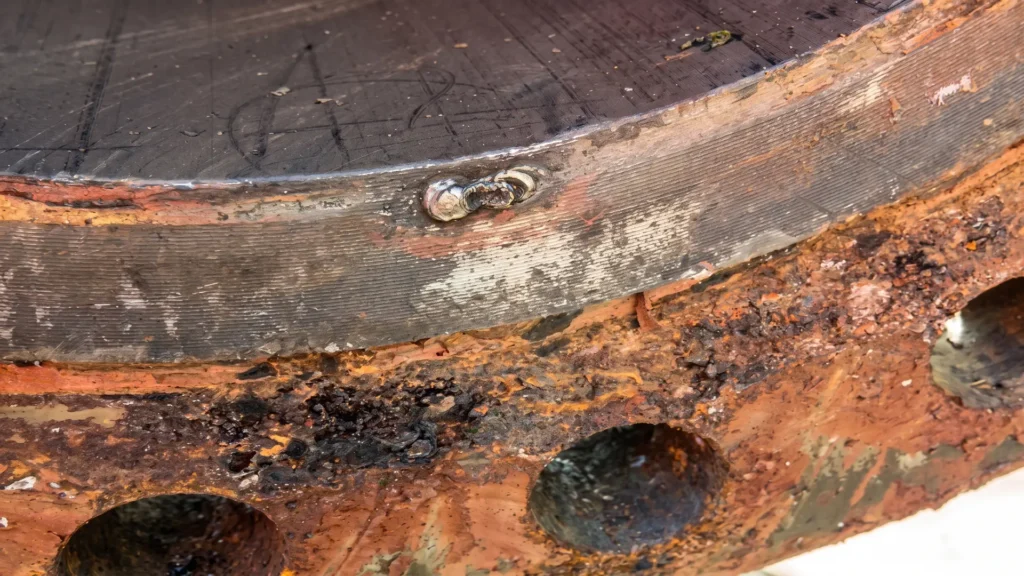
The high energy from the fault not only burned through the isolating gasket, but also literally welded the two flange faces together. Since the isolation joint was shorted, the cathodic protection (CP) system was compromised, and the affected pipeline was left without adequate protection until the short was identified and remedied. In this case, the entire bolted flange connection had to be replaced at considerable expense. Due to the obvious safety risks, especially in hazardous locations, and the potential for costly pipeline damage, effective over-voltage protection is essential for isolation joints. The differential voltage across the joint must remain well below the isolator’s withstand voltage during lightning and AC fault events.
Common solutions for isolation joint protection
When properly protected, excess voltage across the isolation joint is limited by providing an alternate, lower-impedance path for current to flow around the joint during over-voltage conditions. To maintain proper isolation for cathodic protection, the protective device must not conduct direct current (DC) under normal operating conditions. Both solid-state protection devices and isolating spark gap devices are commonly used to protect isolation joints from such electrical disturbances. Spark gaps are relatively low cost and effective for lightning protection. However, one of their key limitations is that typical AC fault current ratings are well below the fault levels commonly observed on pipelines.
What happens when AC faults reach a spark gap?
As a rough approximation, AC fault currents of 10 kArms or greater can be expected to flow through an isolation joint protective device on pipelines located near HVAC lines. For specific applications, numerical modeling tools should be used to provide precise predictions of fault current along the pipeline and determine the appropriate ratings required for protective devices.
Any device used on isolation joints for over-voltage protection should be properly rated to safely operate following exposure to such AC fault levels. If the device is under-designed for AC fault current, it can eventually fail in a closed state. In this condition, the device becomes a permanent short circuit and defeats the purpose of the isolator. It can also fail in an open state, where the device no longer conducts current during a fault or lightning event and is therefore unable to provide proper protection. Both failure modes are undesirable. However, failure in an open state is particularly problematic because it presents a potential safety hazard from over-voltage and/or arcing and exposes the joint to possible permanent damage.
To better understand the relationship between electrical isolation, cathodic protection, and corrosion control, as well as protection against alternating current and lightning effects addressed by NACE SP0177-2026, watch the technical interview on Inspenet TV with specialists from Dairyland Electrical Industries during the AMPP conference in March 2026, focused on electrical decoupling and its role in corrosion protection systems.

Lightning vs. AC faults: why energy matters
Spark gap devices are effective for protection against lightning and low-level fault currents. However, the total energy from an AC fault is orders of magnitude greater than that from a typical lightning event, for which spark gaps are primarily designed. This is because an AC fault can last much longer and therefore presents much higher total energy than lightning.
Spark gaps are not designed or rated to endure the high energy level associated with common AC faults, with typical ratings of only 500 Arms for 200 ms. During conduction, the arc formed between the internal gapped electrodes can degrade the electrodes and, over time, result in either a failed-open or failed-shorted device. When the device fails open, the electrodes can burn back, increasing the air gap between them and raising the spark-over voltage required for conduction during successive faults or lightning events. In other fail-open scenarios, terminal components can break apart or the entire assembly can simply fall apart. In either case, the result is a permanent failed-open condition. When the device fails shorted, high-energy dissipation overheats and deforms the internal components, resulting in a permanent short.
What fault current testing reveals
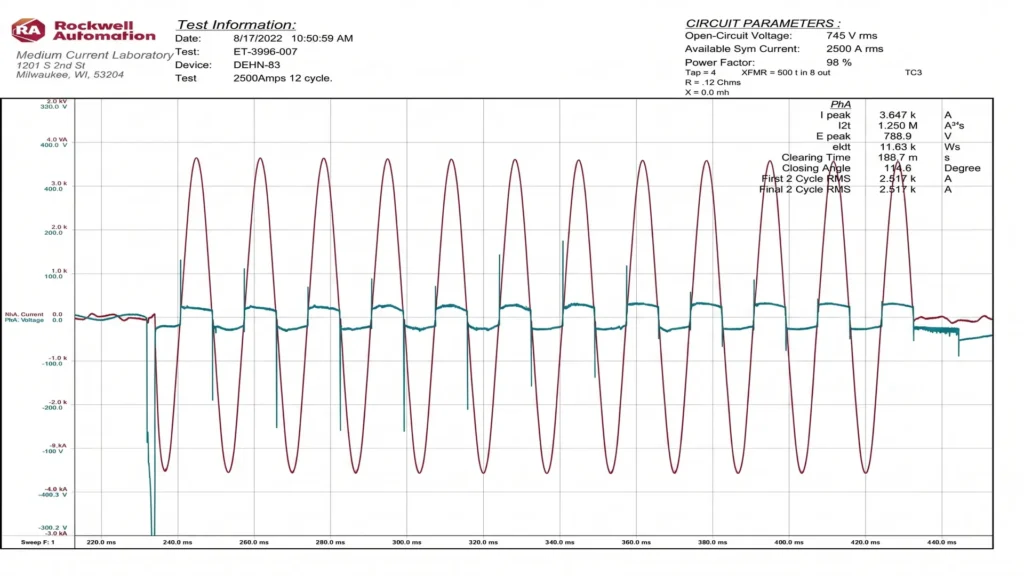
Figures 2–5 illustrate an example of a spark gap that failed open during fault current testing. Figure 2 shows an oscillograph of a new spark gap under an initial fault current test at 2500 Arms / 745 Vrms at 60 Hz for 200 ms. Once the voltage across the unit (blue trace) exceeds the spark-over voltage (-784 V in this test), the device goes into conduction and passes current (red trace).
Successive tests were performed on this sample, with time between tests to allow for cooling. Upon the sixth test at 2500 Arms, the device had failed open, as shown in Figure 3. Although the voltage across the device (blue trace) reached 1043 Vpk, well above the spark-over voltage, no current (red trace) passed through the unit.
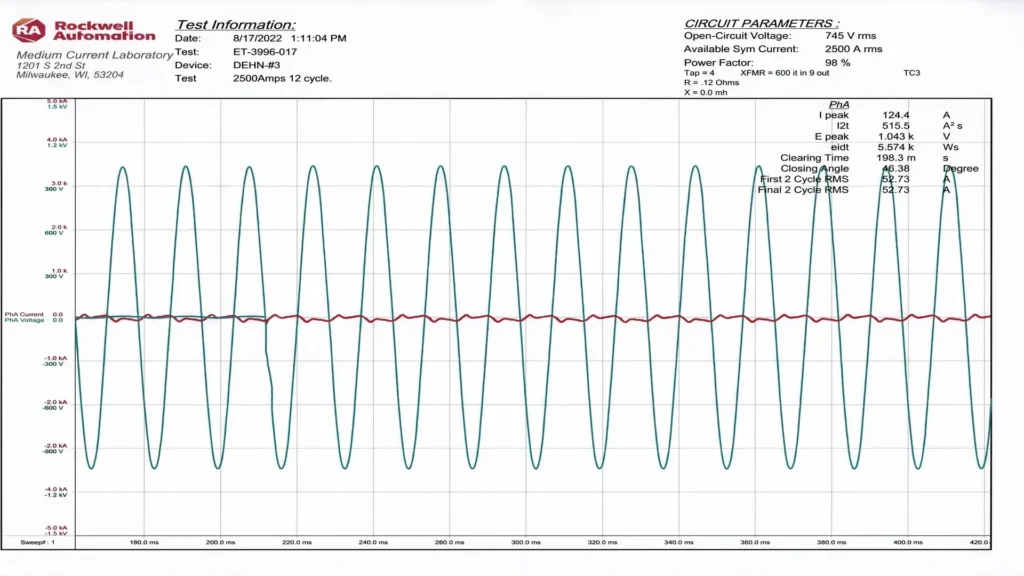
Figure 4 shows the internals of this failed spark gap test sample, while Figure 5 shows the internals of a similar sample before testing. As shown in Figure 4, the electrode appears to have lost material, increasing the gap size.
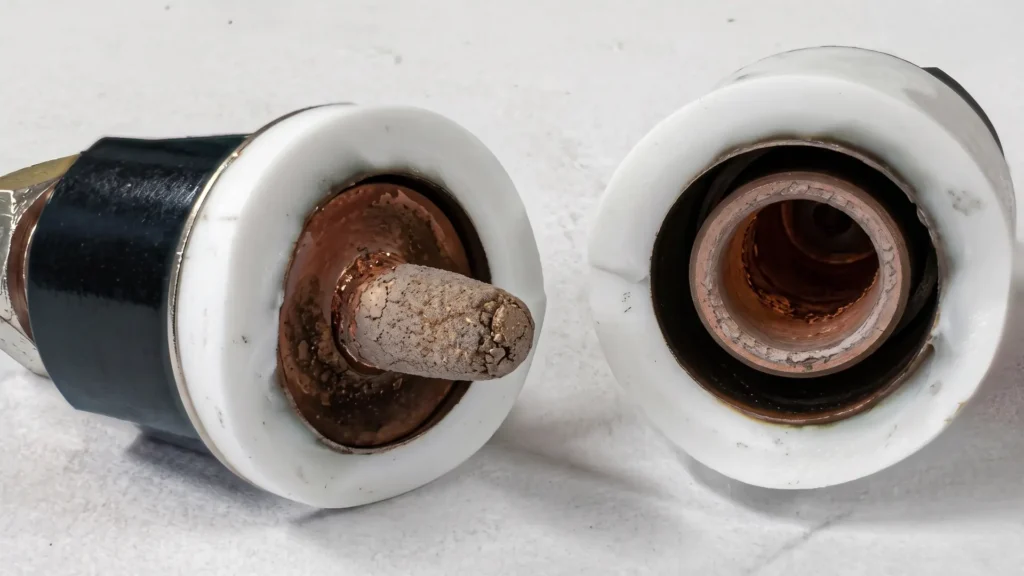
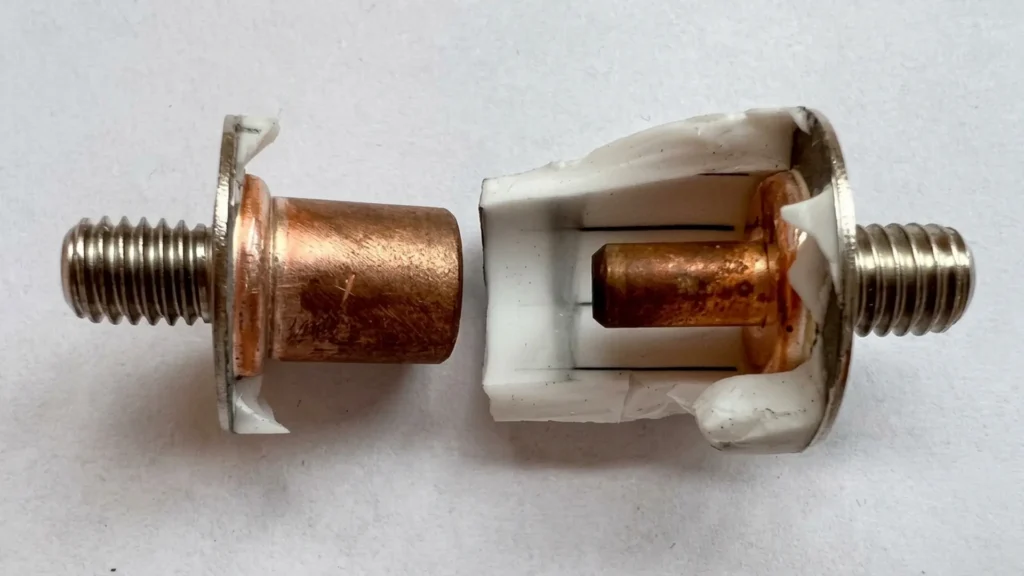
To be fair, this unit was tested far above its published AC current rating. However, the failure mode observed reveals inherent weaknesses associated with the basic technology of a spark gap when exposed to fault current levels common to pipelines. Like this tested sample, spark gaps can often fail in an open state, leaving the isolation joint, storage tank, or other application points exposed to potential arcing until it is replaced. And by failing open, this dangerous condition is not easily detected in the field using a basic resistance check.
Dairyland devices are built to handle AC faults
Unlike spark gaps, Dairyland decouplers and over-voltage protectors are designed and manufactured to protect isolation joints and pipelines against high-energy AC faults commonly encountered in these installations. Popular Dairyland devices are rated and certified to 3.7 kArms at 0.6 s and are available with ratings up to 15 kArms at 0.6 s. Dairyland devices also help protect personnel from over-voltage conditions and have clamping voltages far below those of spark gaps. Unlike spark gap devices, Dairyland solid-state devices have shown to be so reliable that they have no need for periodic testing or replacement. This reliability can result in lower operating and maintenance costs while supporting the long-term protection of pipeline assets.
Need to Upgrade Your Pipeline Protection?
Explore Dairyland’s range of DC decouplers and overvoltage protection devices, or contact Dairyland Electrical Industries through Inspenet Corporate to learn about the solutions available for your application.
References
- Dairyland Electrical Industries. Over-Voltage Protection: The Critical Differences Between Spark Gaps and DC Decouplers. Original technical article and primary source for this publication.
- Dairyland Electrical Industries. Technical documentation and product specifications for DC decouplers and over-voltage protection devices.
- AMPP — Association for Materials Protection and Performance. NACE SP0177-2026: Mitigation of Alternating Current and Lightning Effects on Metallic Structures and Corrosion Control Systems.
- Inspenet TV. Electrical Decoupling and Corrosion Control. Technical interview with Dairyland Electrical Industries specialists at AMPP 2026.
Frequently Asked Questions (FAQs)
What Is the Difference Between a Spark Gap and a DC Decoupler?
Both technologies can provide over-voltage protection while maintaining DC isolation under normal operating conditions. Spark gaps use gapped electrodes that conduct after reaching their spark-over voltage. Solid-state DC decouplers are designed to conduct AC fault and lightning current within their specified ratings while maintaining the required DC isolation.
Why Can AC Faults Damage Spark Gap Devices?
An AC fault can expose a protective device to significantly greater total energy than a typical lightning event because the fault may persist for much longer. When a spark gap conducts, an arc forms between its internal electrodes. Exposure to high-energy fault currents can degrade these electrodes and eventually contribute to a failed-open or failed-shorted condition.
What Happens When a Spark Gap Fails Open?
In a failed-open condition, the device can no longer provide a conductive path during an AC fault or lightning event.
This can leave the isolation joint without effective protection, increasing the potential for arcing, equipment damage, and safety risks. The condition may also be difficult to identify through a basic field resistance check.
How Do You Select the Right DC Decoupler for a Pipeline?
Selection should be based on the electrical conditions and protection requirements of the specific pipeline application rather than on a single universal rating. Expected fault current and duration, lightning exposure, clamping requirements, cathodic protection requirements, and installation conditions should be considered. For specific applications, numerical modeling can help determine expected fault-current levels and the appropriate device rating.
Can AC Interference Affect Cathodic Protection and Pipeline Corrosion?
Yes. AC power systems can interact with metallic pipelines and their corrosion control systems, making AC interference an important consideration when designing and operating cathodic protection and protection systems. NACE SP0177 addresses practices for mitigating alternating-current and lightning effects on metallic structures and corrosion control systems, including structures influenced by overhead AC power transmission systems.