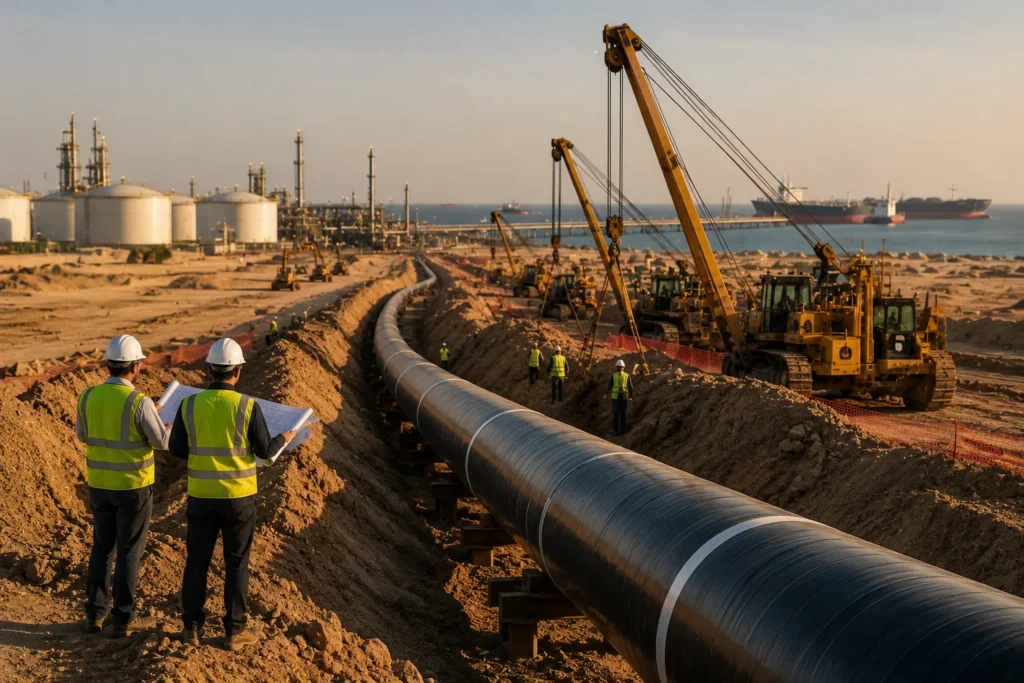
The Kuwait pipeline tender enters a new phase after Kuwait Petroleum Corporation (KPC) requested pre-qualified companies to form consortia before submitting their formal bids. The measure reorganizes the bidding process and seeks to strengthen technical and financial capacity to develop a strategic oil infrastructure project aimed at expanding the country’s crude oil transportation network.
The Kuwait Petroleum pipeline is part of a broader program to modernize and expand hydrocarbon transportation infrastructure in Kuwait, a country that seeks to increase its crude oil production and export capacity for the coming years within the framework of KPC and Kuwait Oil Company (KOC) strategic objectives.
Kuwait Pipeline Tender Reorganizes Contracting Process
According to sources consulted by Reuters, KPC notified pre-qualified applicants that submitting bids under a consortium scheme is now a requirement of the process. This decision implies that companies that had individually advanced in their project evaluation must now partner with other industry players—whether engineering contractors, pipeline construction companies, or equipment suppliers—to meet the technical and financial conditions required by the client.
The strategy of requiring consortia in large-scale energy infrastructure projects is a common practice in the Persian Gulf. EPC (engineering, procurement, and construction) contracts for pipelines in this region typically involve high investment figures, long execution periods, and demanding technical standards that a single company can hardly address competitively without strategic alliances.
The project will strengthen Kuwait’s oil infrastructure
Kuwait holds a significant position within OPEC and has declared a strategic objective to increase its crude oil production capacity from the current 2.7 million barrels per day (mbd) to 4 mbd in the long term. To achieve this goal, it is not enough to drill additional wells: it is essential to have the transportation infrastructure that allows moving the volumes produced from the northern and southern fields of the country to the export ports.
The pipeline subject to this tender would precisely address that need: to create or expand transportation capacity between production points and export terminals, ensuring the operational continuity of crude oil flows in case of saturation of the existing network or as redundancy in the event of scheduled maintenance.
Kuwait Oil Company (KOC), KPC’s subsidiary responsible for exploration and production, has been intensifying its drilling programs in the Greater Burgan fields—one of the largest in the world—and in areas shared with Saudi Arabia. The development of new transportation facilities and asset integrity is a necessary condition to sustain this productive expansion.
The EPC market reinforces competition in the midstream segment
The Persian Gulf midstream segment has seen a significant flow of EPC contracts in the last 18 months, driven by investment programs from Saudi Arabia (Aramco), the United Arab Emirates (ADNOC), and Qatar (QatarEnergy). Kuwait, with a historically more conservative award pace, is accelerating its project portfolio to avoid falling behind its neighbors in terms of export capacity.
The consortium requirement could attract large international contractors who, individually, might not have met the pre-qualification thresholds established by KPC. Companies such as Técnicas Reunidas, Samsung E&A, Saipem, or China Petroleum Pipeline Engineering (CPPE) typically participate in these regional tenders, often associated with local firms familiar with Kuwaiti regulations and the operational peculiarities of the environment.
For players in the operational reliability and pipeline engineering sector, the contract awarded in Kuwait represents an important benchmark for the regional project pipeline expected in the second half of 2026 and 2027.
Next Steps in the Bidding Process
KPC has not published a revised official timeline for bid submission following the consortium requirement. However, industry sources estimate that the reorganization could extend the original bidding period by four to eight weeks, the time needed for applicants to finalize their alliance agreements, update technical and financial qualification documents, and adjust their technical proposals to the project conditions.
The process will be closely followed by the engineering and construction markets in the region, given that an award in Kuwait tends to generate a ripple effect on other projects in KPC’s portfolio that are in earlier stages of development. The transparency of the process and payment terms—historically a concern for contractors who have worked with Kuwaiti government clients—will also be determining factors for the level of competition generated by the tender.
Kuwait maintains proven oil reserves estimated at around 102 billion barrels, which guarantees decades of production with current technology. Investment in transportation and export infrastructure is, in this context, a long-term priority that transcends crude oil price cycles.
Sources: Pipeline & Gas Journal / Kuwait Petroleum Corporation | Kuwait Oil Company (KOC)