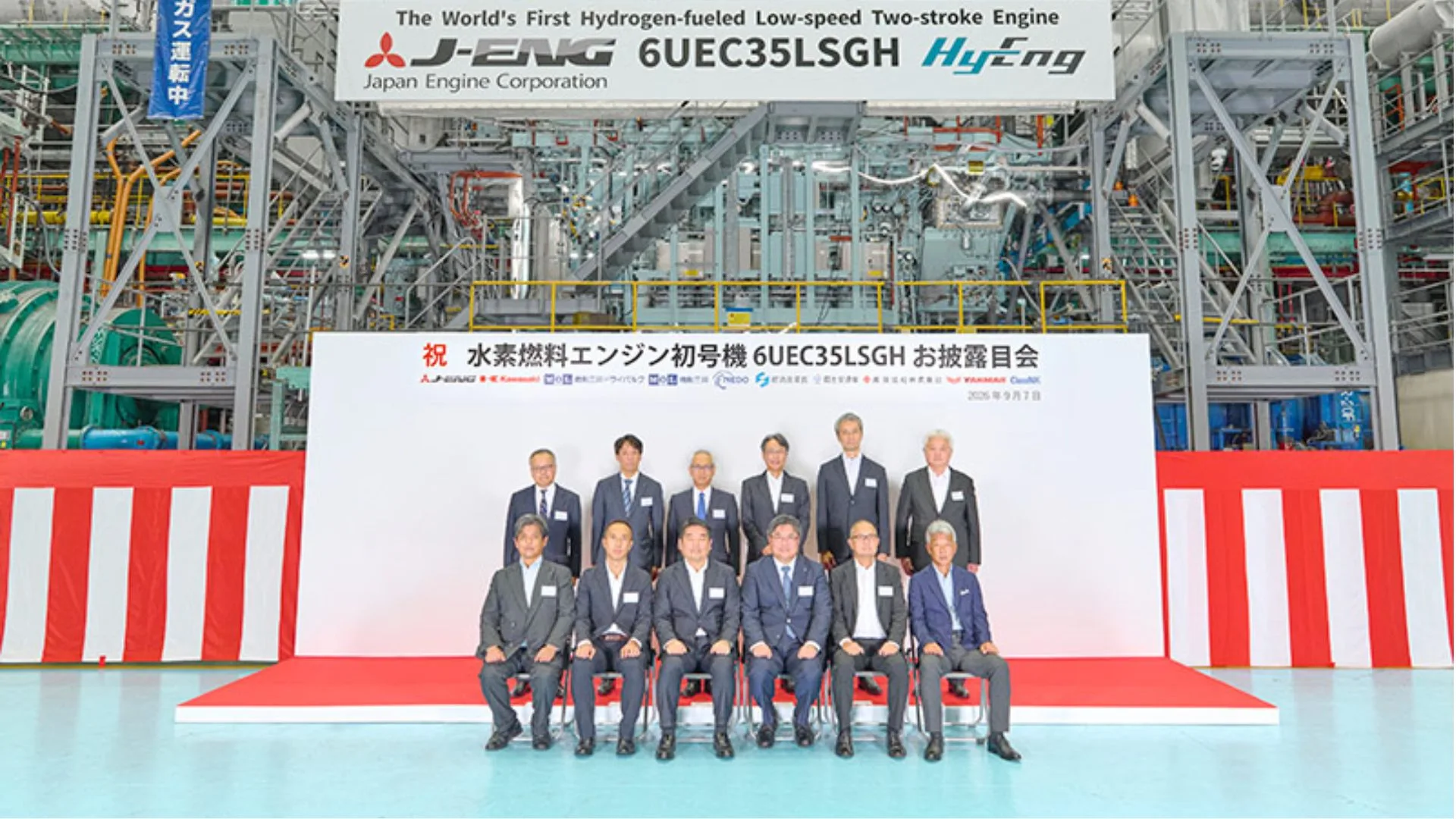
Japan Engine Corporation completed land-based trials of the 6UEC35LSGH, a two-stroke, low-speed marine engine designed to operate on hydrogen in large commercial vessels. The company presents it as the first of its kind developed globally for this class of vessel.
During factory trials, the unit achieved a hydrogen co-combustion rate of at least 95%. According to results disclosed by Japan Engine and its project partners, this performance enabled a reduction in greenhouse gas emissions of more than 95% compared to a conventional engine running on heavy fuel oil.
The development is part of the hydrogen marine engine and marine hydrogen supply system project, driven under NEDO’s Green Innovation Fund.
Hydrogen engine with high-pressure direct injection
One of the core elements of the 6UEC35LSGH is its high-pressure direct injection system, designed to introduce hydrogen directly into the cylinder.
This system aims to maintain stable combustion and control fuel delivery with greater precision. For large-scale maritime application, this point is especially relevant due to the physical and handling characteristics of hydrogen.
The engine also incorporates specific safety measures. These include a reinforced structure designed to prevent leaks and double-walled piping in the hydrogen supply lines.
Type approval trials were conducted in the presence of ClassNK, an entity that will also participate in safety evaluations during the various stages of engine and vessel development.
Installation planned on a 17,500 DWT vessel
The next phase of the project includes installation of the engine on a 17,500 DWT multipurpose vessel to be built by Onomichi Dockyard for Mitsui O.S.K. Lines and MOL Drybulk.
Installation is scheduled for January 2027. Following that process, the vessel will conduct sea trials before the start of the onboard demonstration phase.
Operational trials are scheduled to begin in April 2028. During this stage, the project will evaluate the engine’s performance, durability, and stability under real navigation conditions.
Kawasaki to supply hydrogen system
Kawasaki Heavy Industries will develop and manufacture the marine hydrogen fuel supply system, known as MHFS.
This system will be responsible for storing and delivering fuel to the engine. Kawasaki will also develop bunkering equipment to supply liquefied hydrogen to vessels, a necessary component for taking this technology from the experimental phase toward broader maritime operation.
Yanmar Power Solutions is participating alongside Japan Engine and Kawasaki in the development of engines and associated systems.
Blue Harmony to bring technology to real-world trials
The engine is part of the Blue Harmony project, which aims to advance toward commercial operation of hydrogen-powered vessels.
The onboard demonstration will verify how the system responds outside the factory environment and under real operating conditions. This includes engine behavior, fuel supply, and overall system safety during extended navigation periods.
Japan Engine has also worked with other alternative fuels. In August 2025, the company completed a two-stroke, low-speed marine engine running on ammonia.
With the 6UEC35LSGH, the project extends that development line toward hydrogen and advances to a phase in which technical performance must be demonstrated directly on a large commercial vessel.
Source and photo: MOL