Table of Contents
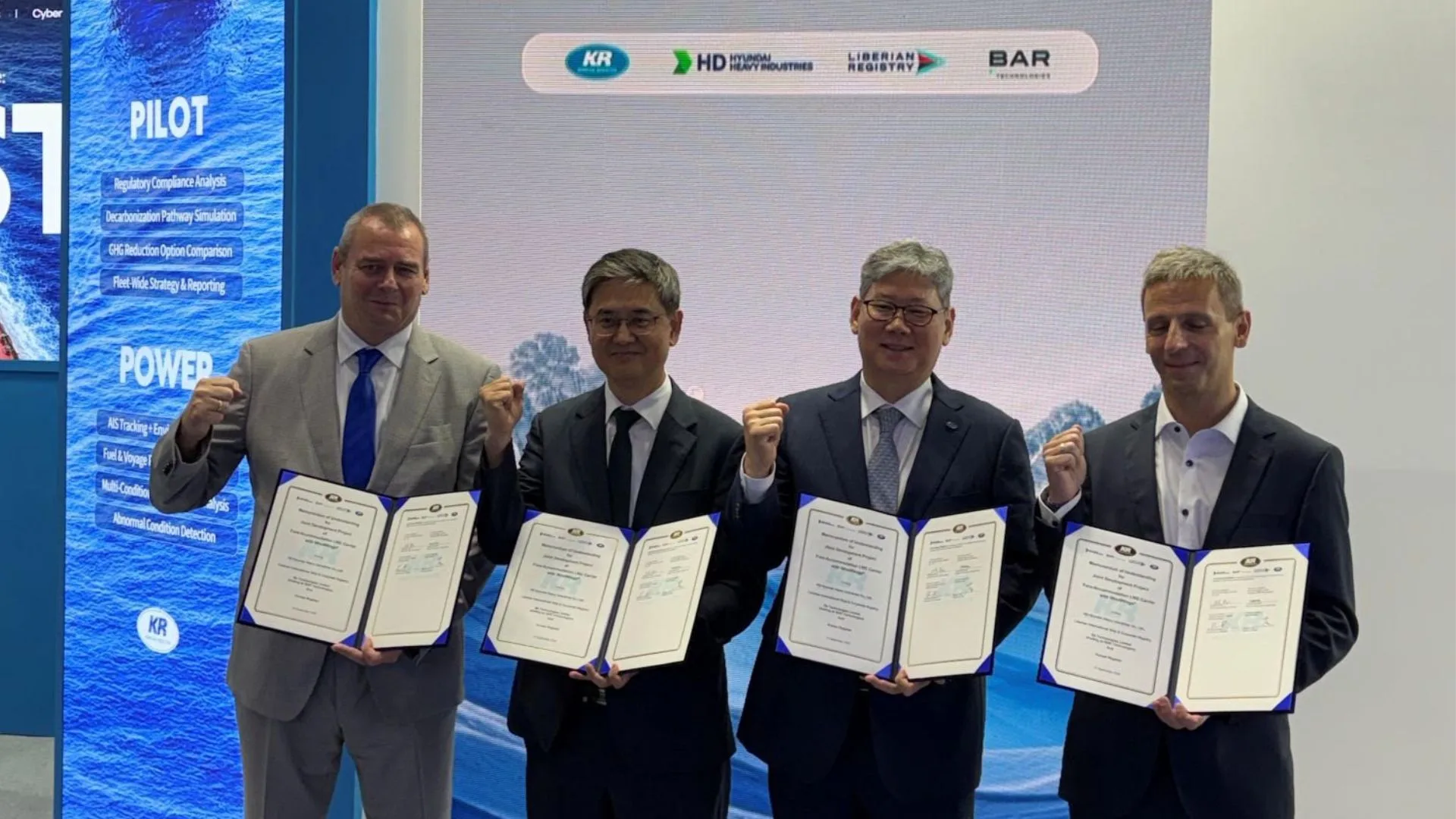
At the international Gastech 2026 exhibition held in Bangkok, classification society Korean Register, shipbuilder HD Hyundai Heavy Industries (HD HHI), British firm BAR Technologies, and the Liberian International Ship and Corporate Registry (LISCR) have formalized a collaboration agreement. Under a Memorandum of Understanding (MoU), the parties will jointly develop the technical adaptation of a 174,000-cubic-meter wind-assisted LNG carrier equipped with WindWings propulsion.
Integration of Rigid Sails on the Wind-Assisted LNG Carrier
The vessel’s engineering positions the crew accommodation superstructure at the bow. This design frees operational space on the upper deck to install large-scale rigid sails without interfering with the vessel’s operational maneuvers.
Regarding assigned responsibilities, HD Hyundai Heavy Industries will lead the basic design and structural review of the vessel. Additionally, BAR Technologies will provide technical data on equipment layout, structural behavior, navigation concepts, and fuel-saving calculations.
Likewise, WindWings technology harnesses wind force to provide auxiliary thrust to the vessel. Consequently, the system minimizes the required load on the main engine, reduces greenhouse gas emissions, and optimizes overall energy efficiency during commercial voyages.
Concurrently, Korean Register and the Liberian Registry will assess the technical feasibility and safety of the installation based on applicable rules and international maritime regulations. For this reason, the process will evaluate the issuance of Approval in Principle to validate the future commercialization of this naval architecture in next-generation LNG carriers.
For their part, executive representatives of the involved entities emphasized that implementing the system will extend decarbonization solutions to the global gas fleet. Finally, preliminary analyses of ten bulk carriers and tankers equipped with this mechanism report approximate global savings of one hundred tons of carbon dioxide per day.
Source and photo: Image Line