Table of Contents
- How does flywheel energy storage work?
- Why are flywheels regaining industrial interest?
- Qnetic validates a 200 kWh system for critical applications
- Data centers, microgrids, and industry drive demand
- Advantages of flywheels over other storage technologies
- Can flywheel energy storage compete with lithium batteries?
- Flywheel energy storage and its potential for the energy transition
Flywheel Energy Storage (FES) is beginning to position itself as a new-generation solution for high-power energy storage. The evolution of mechanical storage systems and investments aimed at verifying their operation under real conditions reflect the industry’s growing interest in technologies capable of reinforcing grid stability and supporting critical applications such as data centers, industrial complexes, microgrids, and renewable integration projects.
How does flywheel energy storage work?
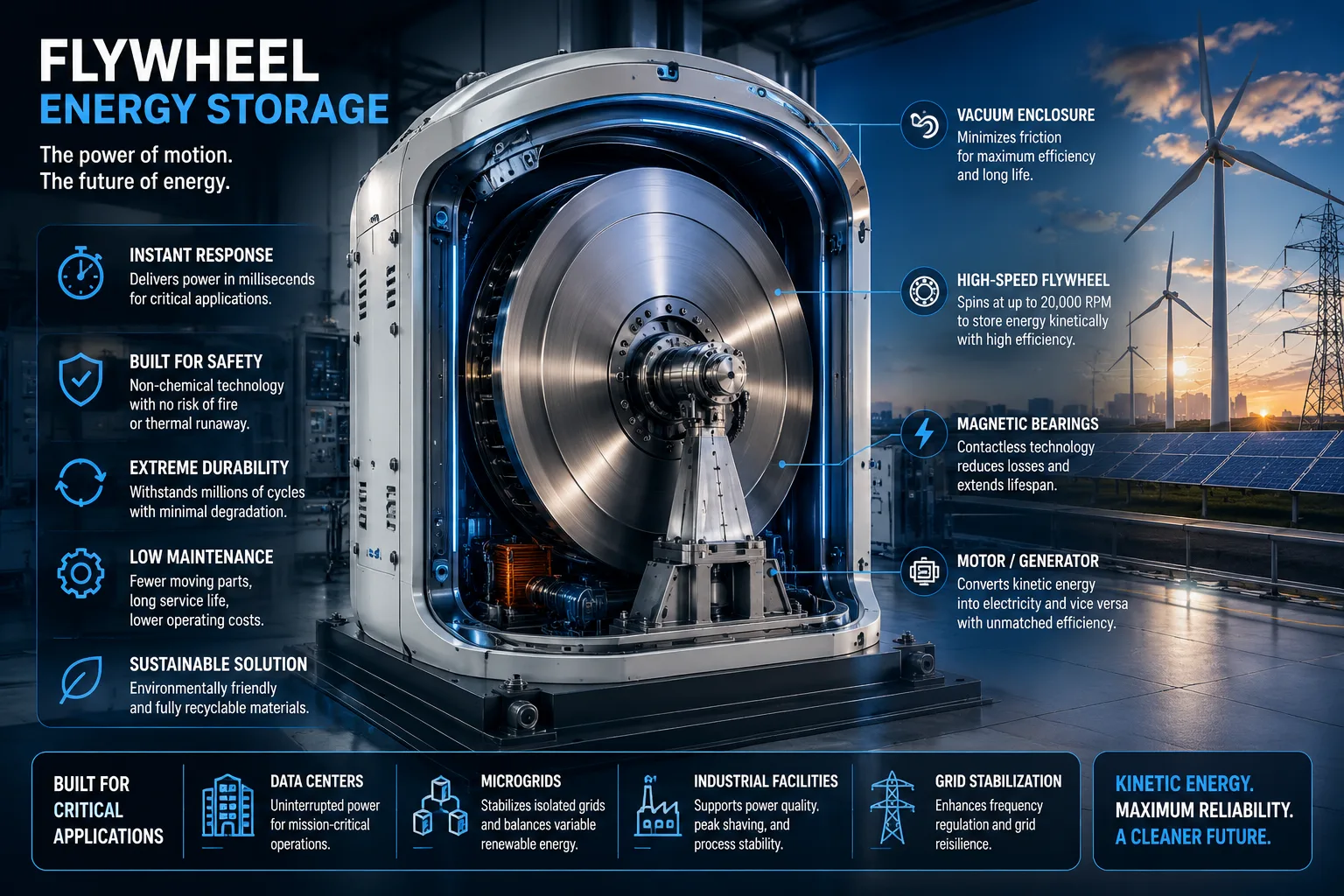
Unlike conventional batteries, which store energy through chemical reactions, Flywheel Energy Storage systems use kinetic energy. The principle is simple: a high-mass rotor spins at extremely high speeds within a vacuum chamber, where the absence of friction reduces energy losses to virtually zero.
When there is a surplus of electrical generation, a motor accelerates the flywheel, transforming that energy into rotational motion. Subsequently, when the grid or facility requires power, the system operates in reverse, using the flywheel’s rotation to drive a generator that returns electricity with virtually instantaneous response times.
This mechanism makes FES an especially suitable solution for stabilizing electrical grids, absorbing load variations, and providing power during transient events without relying on electrochemical processes.
Why are flywheels regaining industrial interest?
For decades, flywheel storage systems were limited by available materials, manufacturing costs, and electronic control capabilities. However, the evolution of composite materials, magnetic bearings, power electronics, and digital monitoring systems has allowed many of these limitations to be overcome.
At the same time, the increasing penetration of renewable sources has heightened the need for technologies capable of responding quickly to the generation fluctuations inherent in solar and wind energy.
In this context, flywheels have regained prominence as a solution capable of supplying power immediately, supporting millions of operating cycles, and maintaining stable performance over long service periods.
Qnetic validates a 200 kWh system for critical applications
The American company Qnetic represents one of the most recent examples of the commercial momentum this technology is experiencing. The company is developing a 200 kWh flywheel energy storage system, designed for applications where operational reliability and rapid response are determining factors.
As part of this process, the company is also building a specialized facility to validate the system’s behavior under real-scale operating conditions. This type of infrastructure allows for the evaluation of aspects related to safety, mechanical performance, rotor stability, and system reliability before its commercial deployment.
Beyond the specific project, the initiative demonstrates that the sector is beginning to invest in facilities capable of certifying mechanical storage technologies for highly demanding industrial applications.
Data centers, microgrids, and industry drive demand
The expansion of artificial intelligence, the growth of data centers, and the modernization of electrical grids are increasing the demand for solutions capable of responding immediately to load variations.
In these scenarios, Flywheel Energy Storage offers significant advantages as a support system for critical infrastructure, providing stability during brief interruptions, compensating for frequency variations, and offering instant backup while other generation sources come online.
In addition to data centers, this technology is attracting interest in industrial microgrids, manufacturing plants, mining facilities, hospitals, airports, and other infrastructures where even interruptions of a few seconds can represent significant operational losses.
It is also beginning to be evaluated as a complement to solar and wind farms, where it can absorb generation surpluses and contribute to stabilizing energy delivery to the electrical grid.
Advantages of flywheels over other storage technologies
Although lithium-ion batteries continue to dominate the energy storage market, flywheel systems present characteristics that make them particularly competitive in certain applications.
Their main advantages include high instantaneous power, rapid charge and discharge capability, absence of significant chemical degradation, and a service life that can extend over millions of operating cycles.
As a mechanical system, it also does not present risks associated with thermal runaway, a phenomenon responsible for some fires recorded in electrochemical battery systems.
Likewise, the reduction of consumable components decreases maintenance requirements and can improve the total cost of ownership in projects designed to operate for several decades.
However, flywheels do not seek to completely replace batteries. Their main strength lies in applications requiring high power for relatively short intervals, while other technologies remain more suitable for prolonged energy storage.
Can flywheel energy storage compete with lithium batteries?
More than direct competition, many specialists consider that both technologies can play complementary roles within the same energy system.
Lithium-ion batteries continue to offer advantages for storing large amounts of energy for several hours, while flywheels excel in their response speed, resistance to continuous cycling, and ability to stabilize the grid almost in real-time.
This complementarity opens new possibilities for designing hybrid architectures capable of leveraging the strengths of both solutions, improving both the efficiency and resilience of electrical infrastructures.
Flywheel energy storage and its potential for the energy transition
The growth of renewable energies demands storage technologies capable of responding to an increasingly dynamic and decentralized electrical system. In this scenario, Flywheel Energy Storage emerges as an alternative with the capacity to strengthen grid stability, improve the integration of renewable sources, and increase the reliability of critical infrastructures.
Technological advancements and investments aimed at validating higher-capacity systems reflect that this solution is moving beyond the experimental stage towards larger-scale commercial applications. If this trend continues, flywheels could become a strategic component within the portfolio of technologies that will support the transition towards more flexible, resilient, and sustainable energy systems.
Source: Interesting Engineering