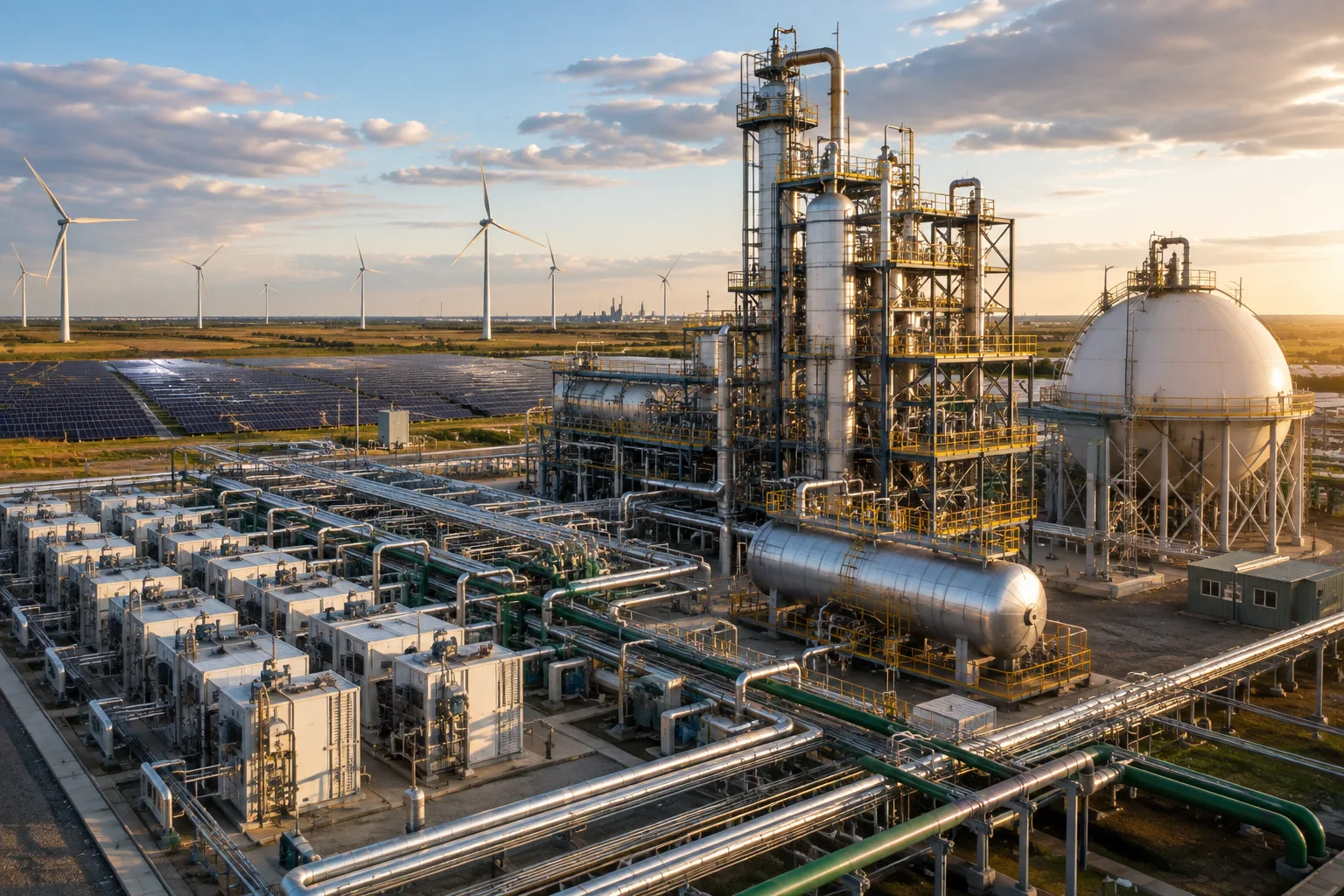
Green ammonia in Texas has taken another technological step forward with the agreement between Topsoe and First Ammonia for the planned facility in Victoria. The plant will incorporate dynamic synthesis technology capable of adjusting production between 10% and 100% within 30 minutes, providing the flexibility needed to respond to fluctuations in the renewable electricity used to produce green hydrogen.
Topsoe will supply its ammonia synthesis technology for the project, while First Ammonia moves toward financial close, expected by the end of 2026. The current schedule targets the start of commercial operations in 2029, although the development must still complete financial and execution milestones before reaching that objective.
The significance of the agreement extends beyond supplying technology to produce NH₃. One of the challenges of integrating renewable generation with continuous industrial processes is managing variability in available electricity. Topsoe’s solution is specifically intended to provide the ammonia synthesis loop with the operational flexibility required to accommodate these fluctuations without compromising process safety and reliability.
Green ammonia in Texas will incorporate Topsoe’s dynamic synthesis technology
The selected technology is specifically designed for green ammonia plants and enables rapid adjustments to process load. According to Topsoe, the system can increase production from 10% to 100%, or reduce it by a similar proportion, in approximately 30 minutes.
This capability is particularly relevant because the project will use green hydrogen produced through electrolysis powered by rhttps://inspenet.com/en/articles/hydrogen-green-green-technology/enewable electricity.
In a conventional ammonia plant, operations generally favor relatively stable conditions. When hydrogen comes from electrolysis linked to variable renewable energy sources, the availability of the energy input can change more frequently. This dynamic introduces new requirements for the equipment and systems involved in the subsequent synthesis process.
Topsoe’s solution is designed to enable the ammonia synthesis loop to adapt to these changes while maintaining safe, efficient, and reliable operation. Flexibility therefore becomes an inherent process design feature rather than merely an operational response to deviations.
The agreement places this capability at the technological core of the future Victoria plant.
Flexibility connects renewable electricity, hydrogen, and ammonia
The project highlights an important characteristic of the Power-to-Ammonia value chain. Green ammonia does not depend solely on having an electrolyzer capable of producing hydrogen without using fossil fuels as feedstock.
It also requires downstream stages capable of operating with a supply influenced by the behavior of renewable electricity generation.
Dynamic synthesis seeks to reduce this disconnect between the two processes. An operating range between 10% and 100% provides considerable flexibility to adjust ammonia production in response to changes in hydrogen availability.
This capability could become increasingly important as green hydrogen and green ammonia projects scale up. The integration of power generation, electrolysis, storage, and synthesis will largely determine the ability of these facilities to operate with adequate levels of availability and efficiency.
However, technological flexibility does not eliminate the project’s other challenges. The cost of renewable electricity, electrolyzer performance, infrastructure availability, financing, and the evolution of demand for low-emissions ammonia will continue to influence its commercial viability.
First Ammonia targets start of operations in 2029
The facility will be located in Victoria, Texas, and is designed to supply both the U.S. market and international markets.
First Ammonia expects to reach financial close during 2026 and begin commercial operations in 2029. These milestones remain future targets and will depend on the project’s financial, contractual, and construction progress.
The initiative is part of broader efforts to develop new ammonia production pathways using hydrogen generated through electrolysis and renewable electricity, in contrast to conventional processes that typically obtain hydrogen from fossil-based feedstocks.
The resulting ammonia can retain its traditional uses as an industrial feedstock and fertilizer input, while its potential use as a hydrogen carrier and low-emissions fuel in certain sectors is also being explored.
The location in Texas adds another strategic component. The state has a significant concentration of energy infrastructure, petrochemical activity, logistics networks, and expanding renewable power generation, factors that have attracted various projects related to hydrogen and its derivatives.
Topsoe remains involved in the project with a new technology scope
Topsoe’s current involvement should be distinguished from an earlier stage in the relationship between the two companies. First Ammonia had previously selected Topsoe’s SOEC (Solid Oxide Electrolyzer Cell) technology to produce hydrogen for its green ammonia projects. However, in March 2026, Topsoe announced that the supply agreements related to 100 MW of SOEC electrolyzers would not be extended after certain contractual milestones were not met.
The agreement announced now specifically covers dynamic ammonia synthesis technology. Therefore, it does not represent a reactivation of those electrolyzer contracts.
This distinction provides a clearer perspective on the latest development: Topsoe remains involved in the Victoria project, but its currently confirmed role focuses on a different stage of the technology chain.
For First Ammonia, the challenge will be to move this integration from the design stage into a commercial facility. For Topsoe, the project represents an opportunity to deploy its dynamic technology in an environment where flexibility could become an essential requirement for connecting renewable electricity, hydrogen, and industrial NH₃ production.
If the schedule remains on track, 2029 will be the point at which this approach will have to demonstrate its commercial performance. Until then, the financial close expected in 2026 will be one of the next critical milestones for moving the green ammonia project in Texas toward its execution phase.
Source: Hydrocarbon Processing