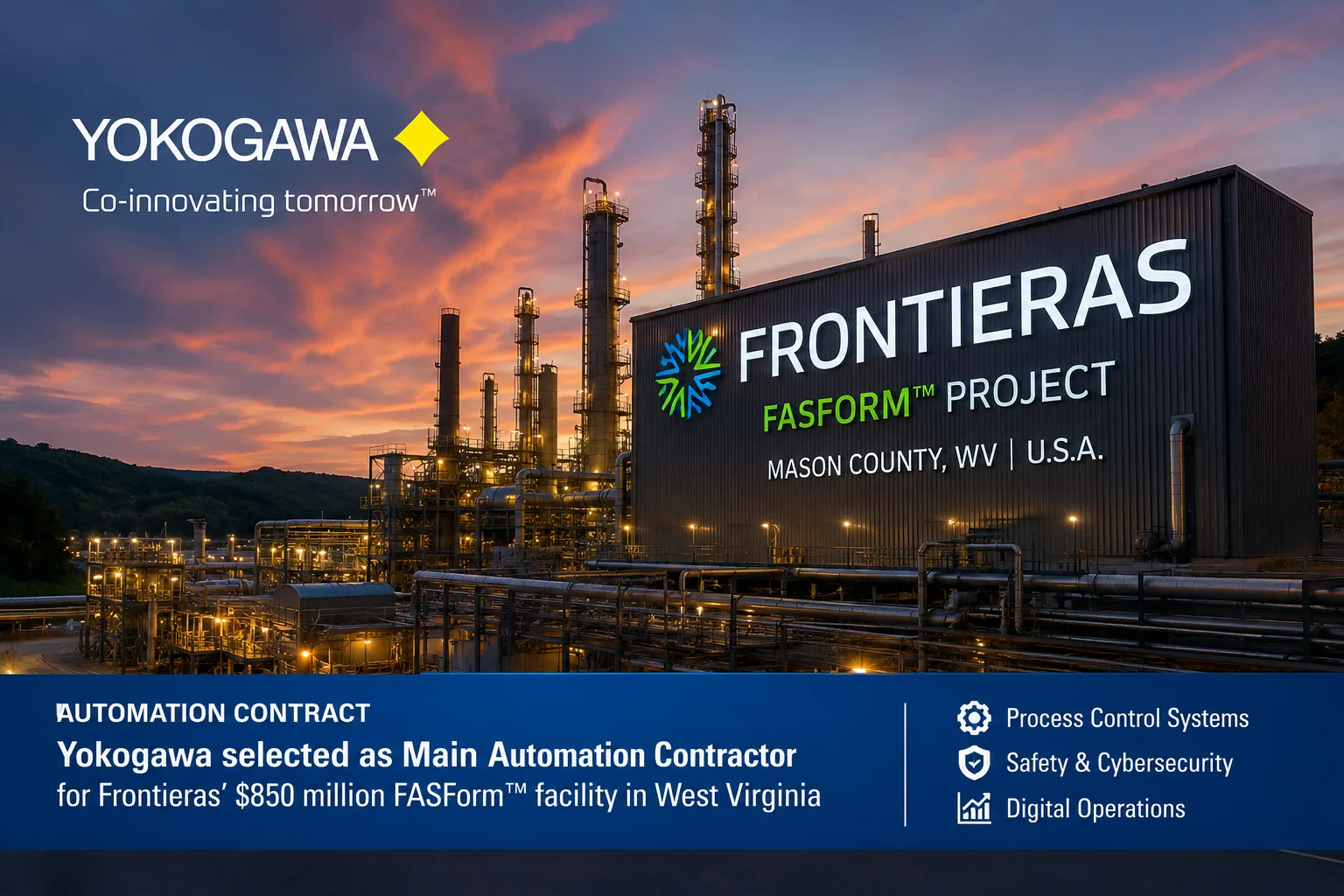
FASForm plant automation will place Yokogawa among the key technology players in the US$850 million project being developed by Frontieras North America in Mason County, West Virginia. The company was selected as the facility’s Main Automation Contractor (MAC), a role that will encompass everything from control and safety systems to industrial cybersecurity and the digital platforms used during operations.
The scope is significant because it extends beyond the supply of a distributed control system. Yokogawa will participate in the automation architecture from FEED engineering through commissioning and startup, integrating the different technology layers required to operate a facility that Frontieras envisions as the first large-scale commercial application of its FASForm™ Solid Carbon Fractionation technology.
The plant is designed to process 2.7 million tons of coal per year through a non-combustion conversion process. According to Frontieras, the technology will simultaneously produce refined liquid fuels, hydrogen, carbon products, and industrial chemicals, bringing to commercial scale a concept that must now demonstrate its performance within a large-capacity industrial facility.
FASForm plant automation integrates control, safety, and digital operations
Yokogawa’s role as MAC establishes an integrated architecture for controlling different systems across the facility rather than approaching automation as a collection of independent solutions.
The scope includes the production control system, Safety Instrumented System (SIS), instrumentation and analytical systems, control room design, and asset management. It also incorporates a plant historian to store and contextualize operational information, as well as systems designed for operator training.
One of the central components will be CENTUM VP, Yokogawa’s DCS platform. Its integration will enable process supervision and control to be centralized within an architecture designed to support the different stages of plant operation.
For a first-of-a-kind commercial-scale facility, this integration takes on particular importance. Moving from a developed and validated technology to an industrial plant introduces new requirements related to availability, process stability, response to deviations, operator training, and control system reliability.
Automation, therefore, is not simply complementary infrastructure for the project. It becomes one of the essential layers required to transition the FASForm process toward continuous operation on an industrial scale.
Industrial cybersecurity is integrated from the project design stage
The contract also incorporates cybersecurity architecture into the automation scope. According to project information, Yokogawa will develop a solution aligned with IEC 62443-SL2, a reference used to address security requirements for industrial automation and control systems.
The decision is significant because it integrates OT environment protection from the engineering stages rather than adding it only after the control infrastructure has been installed.
As industrial plants incorporate connected systems, asset management platforms, data historians, and digital tools, the need to establish controls to protect communications, access, and critical functions also increases.
In Mason County, this architecture will have to coexist with the plant’s process control and safety systems. This makes the project an example of how automation, functional safety, and industrial cybersecurity are increasingly being designed as interconnected components of the same operational infrastructure.
The plant will convert 2.7 million tons of coal per year
The project aims to bring FASForm™ Solid Carbon Fractionation to a considerably larger scale. The facility is designed to process 2.7 million tons of coal annually through a process that Frontieras describes as closed-loop, with no combustion during fractionation and focused on utilizing its different output streams.
Unlike a conventional coal-fired power plant, the objective is not to burn coal to generate electricity. The process operates in a reducing atmosphere and seeks to thermally separate hydrocarbons to produce different products.
Frontieras identifies these output streams as ultra-low sulfur diesel (ULSD), naphtha, jet fuel, FASCarbon™, hydrogen, ammonium sulfate, and sulfuric acid.
The company also characterizes its technology as zero-waste, stating that the byproducts generated are either utilized or commercialized. This claim comes from the developer of FASForm, and its actual environmental performance at commercial scale will need to be evaluated as the plant moves toward operation.
The technology is protected by U.S. Patent No. 9,926,492 and an international intellectual property portfolio developed by Frontieras.
Mason County moves from construction toward technology integration
Yokogawa’s involvement comes after Frontieras formally began construction of the project on April 2, 2026. The planned investment amounts to approximately US$850 million. According to estimates released for the development, the construction phase could generate around 2,000 jobs, while the fully operational facility would create approximately 200 permanent positions.
The project has also been presented as a significant industrial investment for West Virginia. Estimates cited by Frontieras from the West Virginia Department of Economic Development place its potential incremental impact at around 3% of the state’s GDP.
However, the technological challenge is now beginning to shift from physical construction toward the integration of the systems that will enable the facility to operate. Yokogawa’s role will be particularly relevant during this transition. Its scope extends from FEED through commissioning and startup, allowing decisions related to instrumentation, control, safety, analytics, and digital architecture to be addressed under a common strategy.
For Frontieras, Mason County will also be a decisive test for its expansion strategy. The company has positioned the facility as the first commercial application of a technology that could subsequently be deployed in other projects across North America.
Therefore, the true benchmark will not simply be completing an US$850 million plant. It will be demonstrating that FASForm can operate in a stable, safe, and controllable manner at commercial scale, while an integrated automation infrastructure transforms thousands of process variables into information capable of supporting operational decisions.
Yokogawa’s selection therefore places industrial automation at the center of one of West Virginia’s emerging energy projects: not as a layer added at the end of construction, but as part of the architecture that will be required to turn a first-of-a-kind commercial technology into an operational industrial facility.
Source: Hydrocarbon Processing