Table of Contents
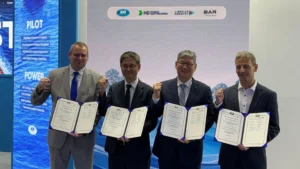
The companies Fleetzero, Thoma-Sea Marine Constructors, and Glosten announced a strategic agreement to design and manufacture highly integrated autonomous vessels. This joint project responds to the growing demand for advanced operational solutions from commercial, government, and national Department of Defense clients.
Technological integration in long-endurance autonomous vessels
With the purpose of optimizing marine resources, the platform will integrate Fleetzero’s Leviathan energy storage system with Thoma-Sea’s shipyard infrastructure and Glosten’s naval engineering. The involved entities are working on the design of a low-profile, autonomous diesel-electric vessel with a reduced radar cross-section. In this way, the vehicle decreases its thermal and acoustic signature, facilitating safe navigation in coastal and offshore environments in conflict zones.
Additionally, the development aligns with the guidelines of the Defense Innovation Unit (DIU) and the Maritime Administration (MARAD). The modular open-system architecture facilitates the execution of automated cargo operations, persistent surveillance activities, intelligence, and coastal logistics. Furthermore, the construction strictly complies with Jones Act regulations and the domestic content standards required for the public defense sector.
On one hand, Thoma-Sea contributes its expertise in the manufacturing of complex vessels, backed by previous contracts with NOAA and the U.S. Navy. On the other hand, Glosten acts as the lead naval architect, coordinating coastal approach angles, efficient propulsion, and automated retraction systems. This synergy ensures that the ships operate effectively without requiring subsequent adaptations or constant maintenance during prolonged deployments.
Finally, this strategic agreement is supported by the financial growth of Fleetzero, an organization that consolidated a $43 million investment round during the previous period. The capital raised, coming from firms such as Y Combinator and Maersk Growth, accelerates the commercialization of the technology at its Houston headquarters. Through this cooperation, the consortium establishes the foundation for a unified industrial infrastructure aimed at transforming maritime logistics through automation and electrification.
Source and photo: Fleetzero