Table of Contents
The official presentation of the WHEEL project at the Port of Las Palmas consolidates a firm proposal to accelerate the transition in deep waters. The Spanish engineering firm Esteyco leads this technical development, which seeks to resolve the main operational complexities of the international market.
The presentation of the WHEEL project
Regarding the execution schedule, the work teams are currently operating at the León y Castillo Poniente pier with the goal of installing the actual prototype by late 2026 or early 2027. This demonstrator will be located in the Plocan test area at a depth of 100 meters. The plan includes a decade-long operational testing period that will serve to capture valuable research and technological development data.
As for the financial section, the initiative has the support of the European Commission through the Horizon Europe program with a grant of 16.6 million euros out of a total budget of 25.6 million euros.
Similarly, the Japanese energy group JPower provides substantial private investment to expand the scientific activities of the industrial consortium. This working group integrates leading firms such as Rover, Bekaert, Vicinay, Cemex, Repnaval, IH Cantabria, EnBW, 2B Energy, CoreMarine, and Sarens.
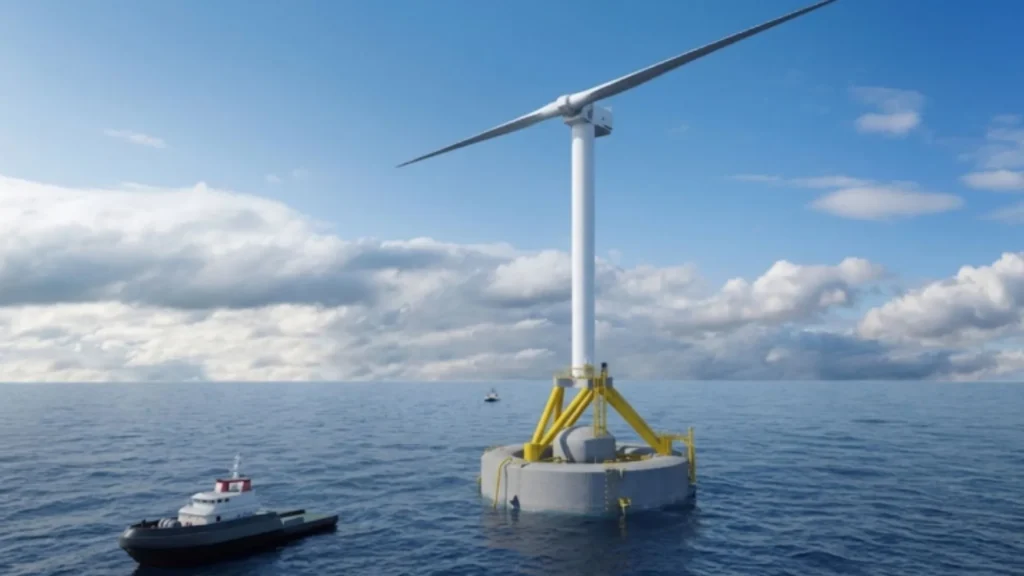
From a design standpoint, this alternative evolves the standard floating spar concept to tackle the cost of energy generation. The structure incorporates the stability advantages of deep cylindrical models and the ease of transport of conventional barges. Through this hybrid approach, the plant substantially reduces the use of heavy materials and decreases the industrial carbon footprint.
Finally, the compact low-draft configuration allows for optimal compatibility with existing shipyards and port basins in the region. The prominence of concrete facilitates a mass-industrialized manufacturing process with a high local supply component. In this way, the technology overcomes the physical barriers that limit the commercial deployment of offshore wind turbines in multiple geographic markets.
Regarding the socioeconomic impact on the archipelago, Canarian authorities and representatives of the blue sector agree on the value of this development. More than 80% of the execution budget is managed directly with local suppliers in the islands. To date, some 24 local corporations are actively participating, providing logistical capabilities and specialized shipbuilding services.
Furthermore, the suitability of the oceanographic conditions and the infrastructure of the Canary Islands position the region as a reference hub for Southern Europe. The practical testing of this prototype will allow for the validation of industrial capabilities before the opening of commercial auctions for offshore wind farms in Spain. Local engineering thus demonstrates its readiness to compete strongly in the global blue energy value chain.
Source and photo: Esteyco