Table of Contents
- AI in maritime transport reaches Mississippi River towboats
- More than 500 miles per ton on one gallon
- From the captain’s knowledge to continuous river monitoring
- Trucks and trains show that the transformation extends beyond the river
- Efficiency does not guarantee an absolute decline in demand
- The next maritime advantage may lie in data
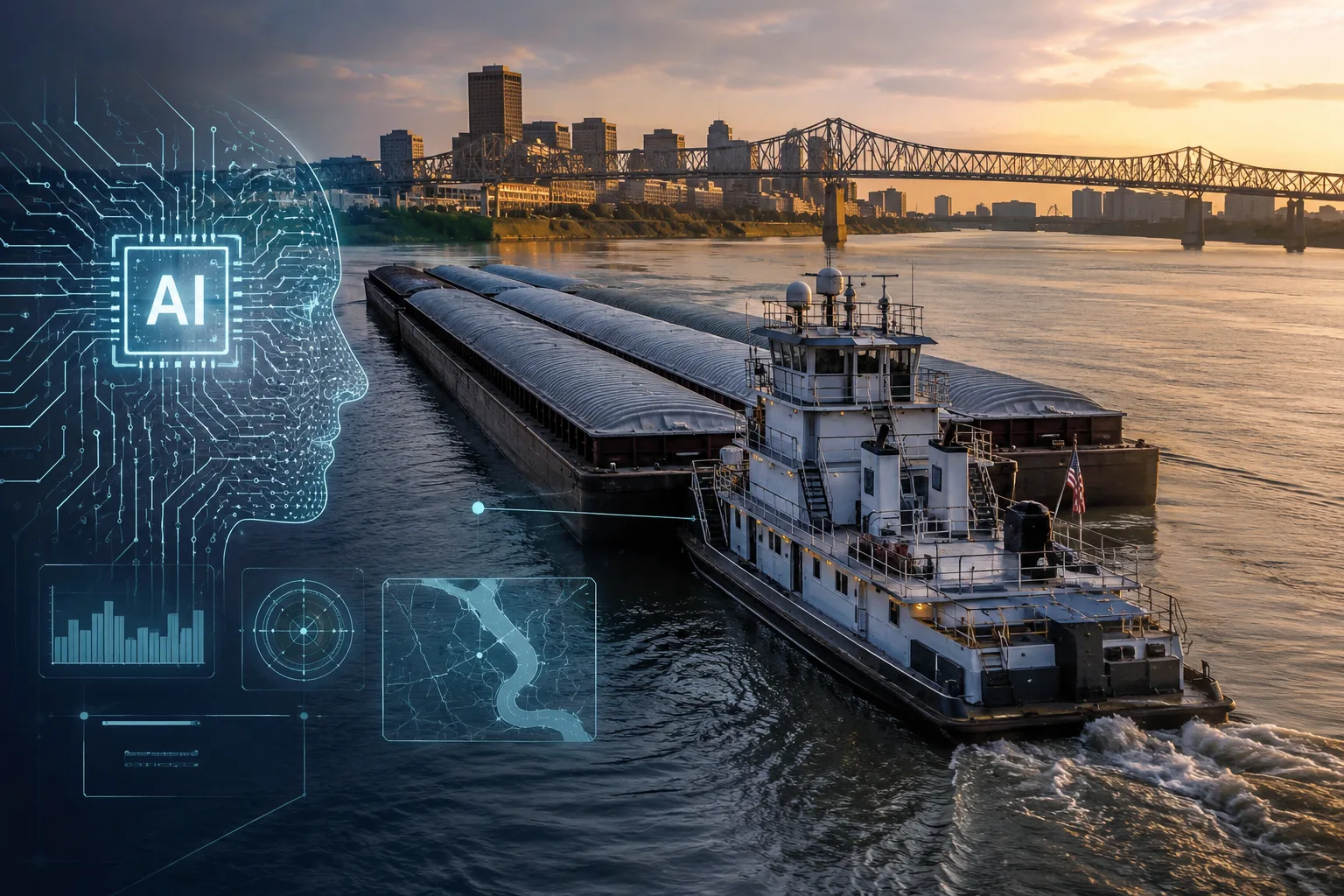
AI in maritime transport is beginning to make its way into one of the most important logistics corridors in the United States. Across the Mississippi River system, commercial vessels are testing technologies capable of monitoring their surroundings, detecting risks, calculating stopping distances, and analyzing operational variables to use fuel, equipment, and infrastructure more efficiently.
This development is particularly significant given the scale of energy consumption in the U.S. transportation sector. In 2025, the sector accounted for approximately 29% of the country’s total energy consumption, while petroleum products supplied nearly 89% of the energy used to move people and goods.
On inland waterways, the relationship between freight movement and energy consumption is particularly favorable. Reuters, citing data from the U.S. Army Corps of Engineers, reports that one gallon of fuel can move one ton of cargo more than 500 miles by barge, compared with approximately 60 miles by truck.
AI in maritime transport reaches Mississippi River towboats
Southern Devall installed the Advanced Pilot Assist System (APAS), developed by Mythos AI, on one of its commercial vessels. The system combines information from cameras, radar, and AIS to provide the pilot with a broader understanding of what is happening around the vessel.
The technology can identify floating objects, nearby vessels, and other conditions relevant to navigation. It also dynamically calculates stopping distances by considering factors such as speed and river conditions, while collecting operational information that can be used to analyze fuel consumption and performance.
However, the incorporation of this technology does not mean that the towboat has become a fully autonomous vessel. At this stage, APAS functions as a pilot-assistance system. The professional pilot continues to make navigation decisions while receiving digitally processed information designed to enhance situational awareness.
This distinction is particularly important in an environment such as the Mississippi River, where currents, traffic, obstacles, locks, and tow configurations can continuously alter operating conditions.
More than 500 miles per ton on one gallon
Inland waterway transportation has a considerable energy-efficiency advantage over certain land-based modes when moving large volumes of cargo. As a result, even relatively small percentage improvements can become significant when repeatedly applied across extensive commercial routes.
AI in maritime transport can contribute to greater operational efficiency without requiring the immediate replacement of engines or fuels. Adjusting speeds to river conditions, reducing unnecessary maneuvers, identifying more efficient operating zones, and providing better information to anticipate decisions are some of the ways data can influence fuel consumption.
The principle differs from installing a new propulsion system: digitalization seeks to extract greater productivity from the energy the vessel already consumes.
This is particularly relevant for towboats pushing barge tows over long distances, where small operational variations can accumulate over hundreds or thousands of miles.
From the captain’s knowledge to continuous river monitoring
Human experience continues to play a central role. Mississippi River pilots develop knowledge of currents, maneuvers, traffic, and vessel behavior that a digital system cannot simply replace by installing sensors.
With AI in maritime transport, what changes is the ability to observe a greater number of variables simultaneously. Radar, cameras, AIS, and other data can be integrated to generate a continuous representation of the surrounding environment. Algorithms can identify relationships within that information and flag conditions requiring attention, while the pilot retains responsibility for the operation.
There is also a cumulative component. Each voyage generates information about vessel behavior, fuel consumption, and navigation that can later be used to refine models and better understand how a vessel responds under different conditions.
Trucks and trains show that the transformation extends beyond the river
The maritime experience is part of a broader logistics transformation. Commercial operations involving autonomous trucks are already underway in Texas, while railroads are incorporating computer vision, sensors, and automated systems to inspect infrastructure and rolling stock.
Each mode pursues different benefits. For trucks, automation can extend the number of hours during which an asset remains productive. In rail transportation, continuous monitoring can detect anomalies and guide interventions before a condition causes an operational disruption.
On the Mississippi, AI in maritime transport opens up opportunities related to safety and navigation as well as energy efficiency. The common element is the use of data to increase the productivity of physical assets that are already part of the logistics infrastructure.
Efficiency does not guarantee an absolute decline in demand
Consuming less fuel per ton transported does not necessarily mean that total energy consumption will decline by the same proportion.
If automation reduces costs and increases the effective capacity of the logistics system, it could stimulate higher freight volumes. Part of the efficiency gains could therefore be offset by increased activity. This effect is one reason why energy efficiency and total energy demand must be analyzed separately.
The transformation will not be determined exclusively by artificial intelligence either. Fuels, electrification, port infrastructure, vessel availability, and economic conditions will continue to influence transportation energy consumption.
The next maritime advantage may lie in data
The Mississippi offers a different path toward maritime modernization. Before fully autonomous vessels become a reality, AI in maritime transport can help professionals better interpret their surroundings and operate assets with access to more comprehensive information..
These intelligent assistance technologies can connect navigation, safety, performance, and energy consumption within a single data architecture. For a mode of transportation that already offers significant efficiency advantages when moving large volumes of goods, further improving vessel and fuel utilization could have meaningful effects on operating costs.
The real test will come from the results achieved during sustained commercial operations. For now, the Mississippi is beginning to serve as a real-world environment where human experience, inland waterway transportation, and intelligent systems are starting to integrate within the same operation.
Sources: gCaptain / Reuters / U.S. Energy Information Administration – Transportation Energy Use / Waterways Journal