Table of Contents
- Petrobras in Foz do Amazonas confirms presence of hydrocarbons
- Finding oil and gas does not yet prove a commercial accumulation
- Morpho puts a deepwater exploration frontier to the test
- The Equatorial Margin gains ground in Petrobras’ exploration strategy
- After Morpho, exploration will continue into new areas
Petrobras in Foz do Amazonas identified the presence of oil and gas while drilling the Morpho exploration well, located in Block FZA-M-59 off the Brazilian state of Amapá. The detection of hydrocarbons opens a new stage in the evaluation of one of the most closely watched areas of Brazil’s Equatorial Margin, although it is still too early to determine the size or commercial viability of a potential accumulation.
The company identified a hydrocarbon-bearing interval through wireline logs and indications obtained from rock samples. Operations are continuing to gather additional information and evaluate the petroleum system encountered by Morpho.
The result is particularly significant because it comes in a frontier area where Petrobras is seeking geological information capable of guiding future exploration decisions. Before drilling began, the company itself had stated that there was no reserve estimate for this area and that exploration activities were precisely intended to obtain the data needed for such an assessment.
Petrobras in Foz do Amazonas confirms presence of hydrocarbons
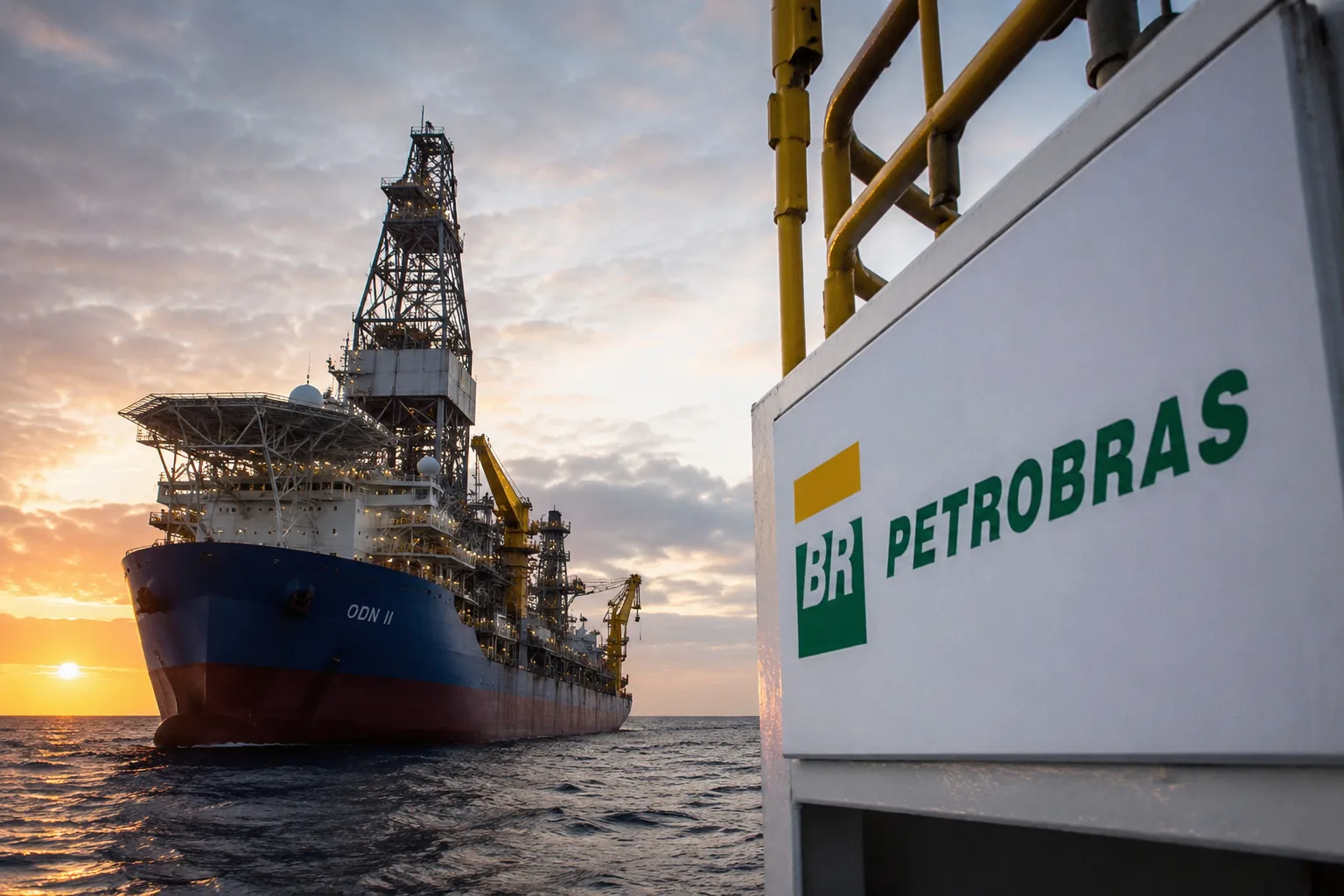
Morpho is being drilled in deep waters of Block FZA-M-59, where Petrobras holds a 100% interest. Drilling began in October 2025 using Foresea’s ODN II drillship, identified by Petrobras as NS-42.
The location helps illustrate the operational challenge. The well is approximately 175 kilometers off the coast of Amapá, in an area with a water depth of about 2,886 meters. The license granted by Ibama in October 2025 also established that the drilling site was located approximately 500 kilometers from the mouth of the Amazon River.
This geographical distinction is important. The activity is not taking place within the Amazon River or in a terrestrial area of the rainforest, but rather in deep waters of Brazil’s Equatorial Margin.
The campaign has not been without difficulties. In January 2026, Petrobras reported a leak in two auxiliary lines connecting the drillship to the well. Operations were subsequently resumed and proceeded cautiously until reaching the interval where hydrocarbons have now been identified.
Finding oil and gas does not yet prove a commercial accumulation
The Morpho result must be interpreted within the technical sequence of an exploration campaign. Detecting a hydrocarbon-bearing interval is a positive indication, but it does not automatically amount to declaring a commercial discovery. Fundamental characteristics still need to be determined, including the accumulation’s extent, thickness, rock properties, fluid quality, reservoir behavior, and recovery potential.
For this reason, Petrobras is continuing to drill. Information obtained through wireline logs helps characterize the formations penetrated by the well, while evidence found in the rocks provides additional information about the petroleum system. Subsequently, the integration of geological, geophysical, and petrophysical data will make it possible to determine more precisely what the interval encountered actually represents.
Petrobras itself had stated before drilling Morpho that Block FZA-M-59 needed to be investigated before reserves could be estimated and that the next steps would depend on the results obtained during drilling.
Morpho puts a deepwater exploration frontier to the test
The significance of Petrobras in Foz do Amazonas extends beyond the result of a single well. Morpho provides direct subsurface information from a region where modern exploration knowledge remains limited compared with Brazil’s extensively developed basins.
Data presented in 2026 by Pré-Sal Petróleo show that more than 700 wells had historically been drilled across the different basins of the Equatorial Margin, including 69 in Foz do Amazonas. However, Morpho represents the first deepwater well licensed in this new exploration phase of the basin.
Drilling was also preceded by a lengthy environmental licensing process. Before authorizing the well, Ibama required a Pre-Operational Assessment designed to verify response capabilities in the event of an emergency. The process included aspects related to wildlife protection, response infrastructure, and resources available for a deepwater operation.
This background explains why Morpho’s progress involves a combination of geology, offshore engineering, and environmental management.
The Equatorial Margin gains ground in Petrobras’ exploration strategy
Its 2026–2030 Business Plan allocates US$7.1 billion to exploration activities over the five-year period. The Equatorial Margin is among the priority areas, alongside the basins of southern and southeastern Brazil and international assets.
The effort forms part of a much broader Exploration and Production strategy. Petrobras plans to allocate US$69.2 billion to E&P projects within its target implementation portfolio for the 2026–2030 period and projects peak oil production of approximately 2.7 million barrels per day in 2028.
In this context, the information generated by Morpho could help determine how significant a role Foz do Amazonas will play within the company’s future exploration portfolio.
After Morpho, exploration will continue into new areas
Morpho is not an isolated effort. Petrobras already has licensing processes underway for other blocks in Foz do Amazonas, including FZA-M-57, FZA-M-86, FZA-M-88, FZA-M-125, and FZA-M-127. The company has indicated that it will evaluate the results of the current well before defining the specific next steps within FZA-M-59.
Activity also extends to other parts of the Equatorial Margin. During the first quarter of 2026, Petrobras reported the renewal of a license allowing the drilling of two additional exploration wells in the Pitu Discovery Evaluation Plan area and in Block POT-M-762 in the Potiguar Basin.
Therefore, the true significance of the Petrobras in Foz do Amazonas result has yet to be determined. Morpho has already confirmed that the well encountered an interval containing oil and gas, but the key questions remain unanswered: how much hydrocarbon is present, what the reservoir characteristics are, and whether a potential accumulation could justify further appraisal and development stages.
Drilling, which continues beneath nearly three kilometers of water, will need to provide those answers. If the next set of data confirms a petroleum system with favorable scale and characteristics, Morpho could become significantly more important in Petrobras’ search for new frontiers capable of contributing to the future replacement of its reserves.