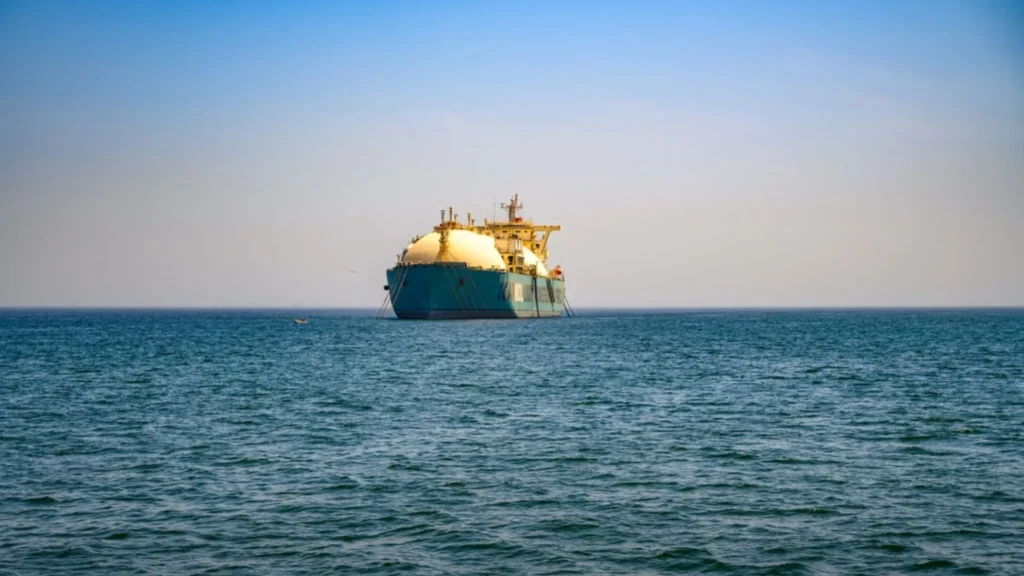
Delfin Midstream accelerated the development of its second floating liquefied natural gas vessel through a strategic agreement with MidOcean Energy and a limited notice to proceed to acquire critical equipment from Siemens Energy.
The U.S. company seeks to reach the final investment decision for the FLNG2 project before the end of 2026. To this end, it has begun securing manufacturing capacity and has brought on board a potential financial partner with international experience in the LNG market.
MidOcean Could Acquire Up to 50% of FLNG2
First, Delfin signed an agreement allowing MidOcean Energy to acquire a stake of up to 50% in FLNG2. The transaction will depend on a positive final investment decision and the fulfillment of customary closing conditions.
As part of the agreement, MidOcean would receive an equivalent proportion of the liquefied natural gas production from the facility. The company was established and is managed by EIG, a firm specializing in energy infrastructure investments.
According to De la Rey Venter, Chief Executive Officer of MidOcean Energy, the potential investment aligns with the company’s strategy to build a diversified and cost-competitive global LNG portfolio.
Furthermore, the executive emphasized that the use of a replicated design can improve execution and offer a more balanced relationship between risk and return.
Siemens Energy Will Supply Critical Equipment
On the other hand, Delfin issued a limited notice to proceed to Siemens Energy to acquire four SGT-750 gas turbines and several mixed refrigerant compressors.
This equipment is part of the FLNG2 liquefaction system and requires long manufacturing lead times. By reserving them in advance, Delfin seeks to reduce potential delays before approving the full investment.
The measure also allows securing manufacturing slots in the supply chain. This point is relevant for LNG projects that depend on specialized equipment and tight industrial schedules.
Following a favorable FID, the project could advance toward a full notice to proceed. Subsequently, execution of the overall engineering, procurement, and construction scope would begin.
FLNG2 Will Have a Capacity of 4.4 Million Tonnes Per Year
The FLNG2 vessel will have an estimated nameplate capacity of 4.4 million tonnes of LNG per year. The unit will be installed offshore Louisiana and will be connected to existing offshore pipeline infrastructure through the Delfin Deepwater Port.
Likewise, FLNG2 will employ the design developed for FLNG1. That first vessel reached its final investment decision on June 3, 2026 and is currently in the execution phase.
The design replication will allow leveraging already completed engineering work. It can also increase cost certainty, reduce technical risk, and shorten the construction schedule.
Dudley Poston, Chief Executive Officer of Delfin, noted that the equipment reservation with Siemens Energy represents an important step forward in controlling timelines. He also described MidOcean as a partner with commercial experience and financial capacity to support FLNG2.
Delfin Prepares a Potential Expansion with FLNG3
While FLNG2 advances toward FID, Delfin and MidOcean are developing preliminary activities for a possible third vessel designated FLNG3.
The initiative is part of a phased growth strategy. Delfin’s deepwater port infrastructure was designed to support multiple floating units and progressively expand the LNG export capacity of the U.S. Gulf Coast.
With FLNG1 under development and FLNG2 in the pre-investment phase, Delfin seeks to consolidate a floating production platform connected to existing infrastructure. This model can reduce the need to build large onshore facilities and facilitate future expansions.
The advancement of FLNG2 will now depend on the closing of commercial agreements, confirmation of financing, and the final approval of the investment expected by the end of 2026.
Source: World Oil
Photo: Shutterstock