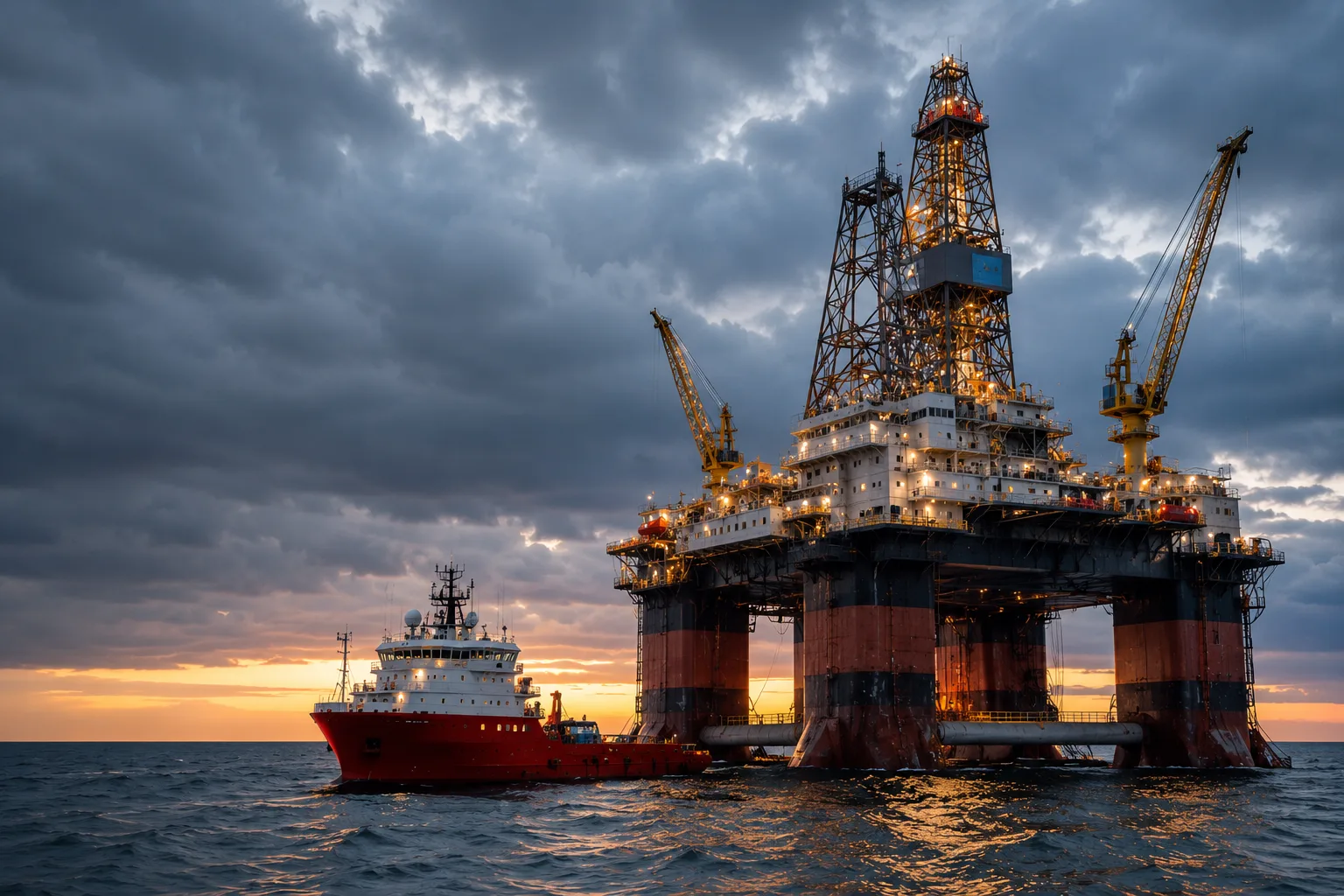
An Aker BP dry well marks the outcome of the recent exploration campaign carried out with Equinor near the Solveig field in the Norwegian North Sea. Well 15/6-17 was drilled with the Scarabeo 8 semi-submersible rig but did not result in a new hydrocarbon discovery, according to information released on August 11.
The result comes just months after Aker BP brought Solveig Phase 2 on stream, an expansion that added approximately 39 million barrels of oil equivalent (boe) of recoverable resources to the existing development. The contrast highlights one of the persistent challenges of upstream operations: even in producing areas with established infrastructure, each new well carries its own exploration risk.
Official records from the Norwegian Offshore Directorate (NOD) identify 15/6-17 as a wildcat exploration well within production license PL979. The official information also confirms Aker BP as the drilling operator and Scarabeo 8 as the rig used for the campaign.
Aker BP dry well was drilled with Scarabeo 8
The campaign was operated by Aker BP using Scarabeo 8, Saipem’s semi-submersible rig that has participated in various drilling operations on the Norwegian Continental Shelf. The NOD’s official database confirms both the operator and the rig used and classifies 15/6-17 as a wildcat well, meaning an exploration well drilled to investigate a potential hydrocarbon accumulation.
The license is associated with Aker BP and Equinor. Regulatory records also show recent changes in participating interests between the two companies within the area, reflecting the portfolio activity accompanying exploration in this part of the North Sea.
The negative result means that this specific drilling operation did not add a new discovery. However, it should not be interpreted as a production problem at Solveig or as evidence that the existing development has lost resources. These are two different situations: well 15/6-17 is an exploration well, while Solveig remains a producing development.
Solveig has just added 39 million boe of recoverable resources
The context is particularly relevant because Solveig is currently undergoing an expansion phase. Aker BP started production from Solveig Phase 2 on February 2, 2026, after completing the project on schedule and within budget. The second phase added approximately 39 million boe of recoverable resources to the field.
Solveig is located approximately 15 kilometers south of the Edvard Grieg platform and was developed as a subsea installation connected to the platform through existing infrastructure. This configuration makes it possible to utilize installed capacity rather than develop a standalone processing hub for each new accumulation.
Phase 2 comprises three wells targeting both new and existing reservoir segments. According to Aker BP, their addition is intended to extend Solveig’s plateau production and efficiently utilize the available capacity at Edvard Grieg.
This scenario helps put the exploration interest surrounding the area into perspective: finding additional resources near existing infrastructure can offer advantages for future developments, provided that discovered volumes, geology, and economics support further development.
Existing infrastructure increases the appeal of exploration near producing fields
Exploration around established developments represents a relevant strategy in mature areas such as the North Sea.
When a discovery is located sufficiently close to platforms, subsea systems, pipelines, and available processing capacity, there is an opportunity to evaluate tie-back schemes that make use of part of that infrastructure. This can substantially change the economics of accumulations that would otherwise be more difficult to develop on a standalone basis.
Solveig is precisely an example of the use of existing infrastructure: its production is connected to Edvard Grieg through subsea facilities. However, the result of 15/6-17 does not provide grounds to state that Aker BP has changed its exploration strategy or that it will abandon further drilling around Solveig. So far, the only confirmed fact is that this drilling operation ended without a new discovery.
It would also be incorrect to extrapolate this result to the reserves or production performance of Solveig Phase 2.
The result highlights the remaining risk in mature exploration
The dry well provides a counterpoint to Aker BP’s recent production advances in the area. On the one hand, Solveig Phase 2 demonstrates how identified resources can be developed using infrastructure that is already in place. On the other hand, 15/6-17 serves as a reminder that proximity to producing fields does not eliminate exploration risk.
For Aker BP and Equinor, the next step will depend on the technical evaluation of the data obtained during drilling and the decisions they make regarding the remaining potential of the license. For now, there is not enough public information to state that the result will lead to changes in future campaigns.
What is clear is that well 15/6-17 did not add a new discovery to the area, while Solveig continues to advance as a producing asset following the start-up of its second phase.
In a mature basin such as the Norwegian North Sea, this combination of existing infrastructure, new developments, and exploration risk will continue to shape where companies decide to drill their next well.