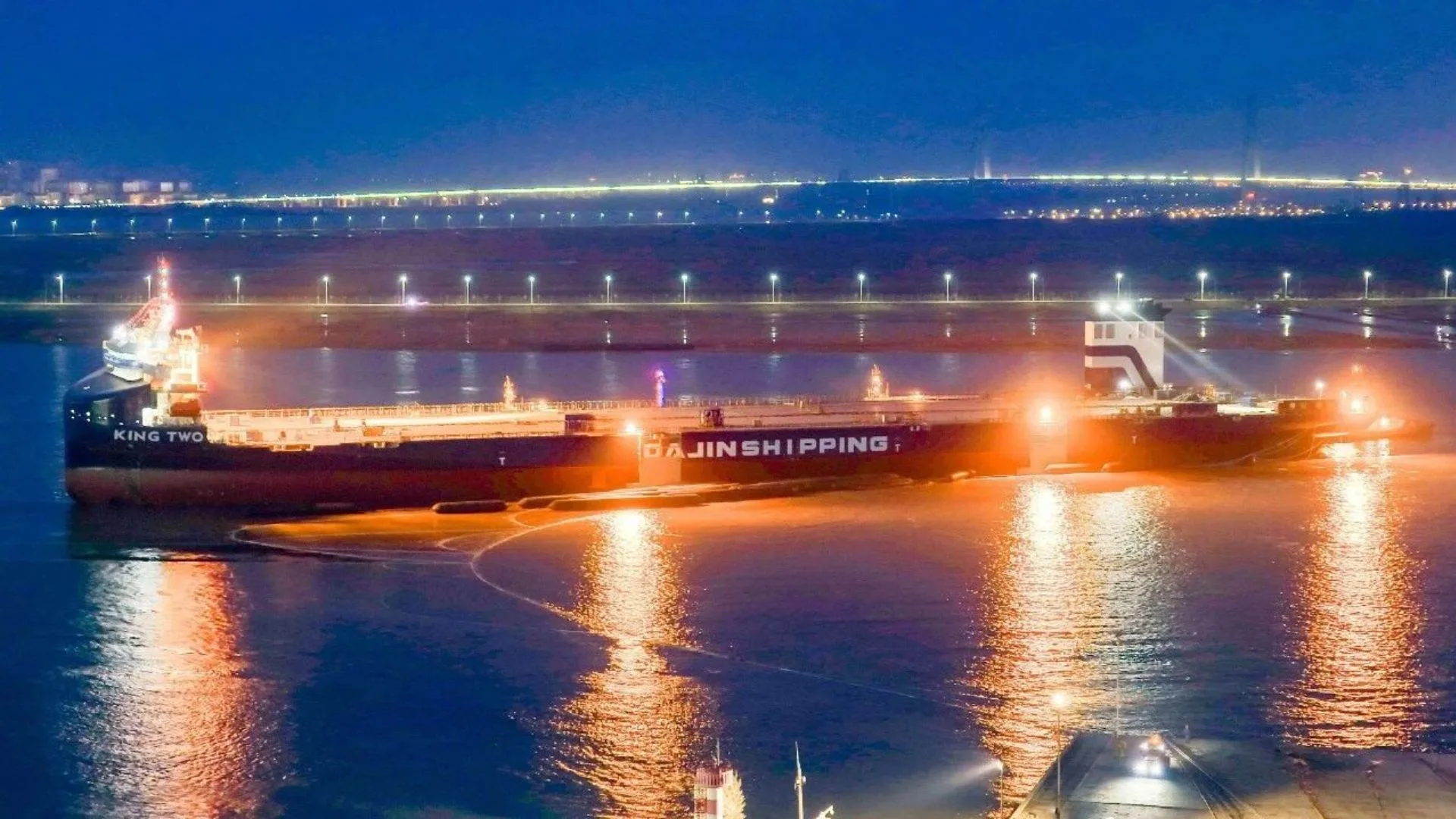
Chinese manufacturer Dajin Heavy Industry has completed the launch of the KING TWO, a 40,000-deadweight-ton deck carrier designed to transport large offshore structures, at its Panjin facility.
The new vessel is the second large ship developed by the shipyard, following the KING ONE, whose previous operation helped validate its performance under real navigation conditions.
A deck carrier designed for large-scale offshore transport
With an overall length of 239.8 m and a beam of 51 m, the KING TWO offers a deck area of approximately 12,000 m², enabling it to transport large-scale components linked to offshore wind energy.
In particular, the vessel is optimized for transporting monopiles for wind turbines between 15 MW and 25 MW, as well as jacket structures, floating foundations, and offshore engineering modules.
Likewise, its twin-engine, twin-propeller configuration provides greater operational stability and efficiency on long-distance voyages.
Operationally, the KING TWO reaches a speed of 13 knots and has a range of up to 16,000 nautical miles, extending its reach on international specialized maritime transport routes.
These features position it as a key solution within the heavy-lift cargo vessel segment, in line with the growing demand for logistics for large-scale offshore projects.
The Panjin shipyard is one of Dajin’s main offshore manufacturing bases in Bohai Bay, where the company concentrates production of high value-added assets such as semi-submersible vessels and heavy transport ships.
Strategy toward full EPCI services
The addition of the KING TWO is part of a broader Dajin strategy aimed at expanding its business model toward integrated services.
With this, the company seeks to consolidate an offering that covers manufacturing, transport, coordination, and installation, moving toward an EPCI-type model within the offshore sector.
In addition, the company plans to launch the third vessel in the KING series in May 2026, with entry into service expected the same year, which will expand its logistics capacity for large-scale maritime projects.
Source and photo: Dajin Heavy Industry