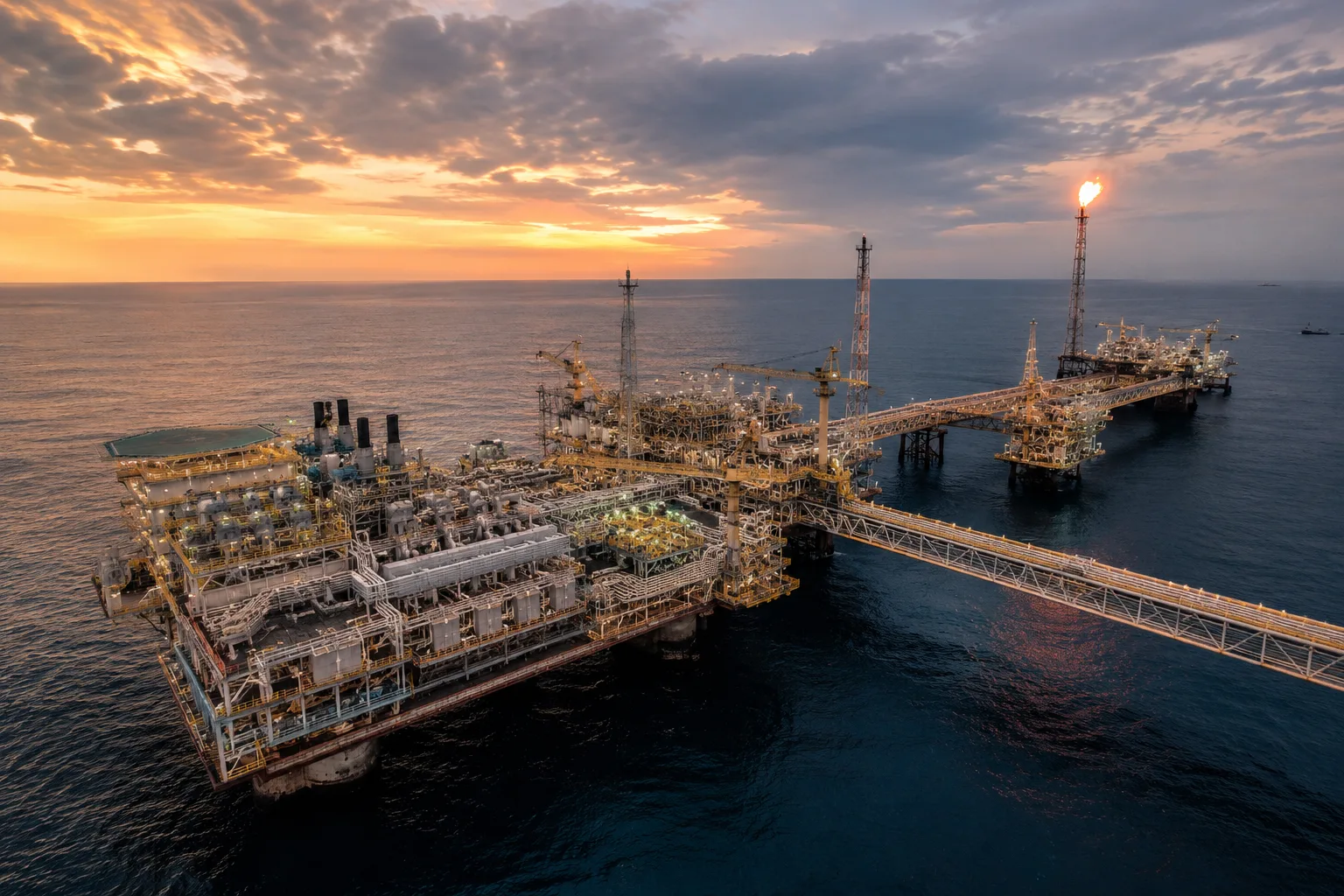
BP has started the first ACG gas production in the Azeri-Chirag-Gunashli field in the Caspian Sea, marking a historic milestone in nearly three decades of the field’s operation in Azerbaijan.
First Gas Production Opens a New Chapter for ACG
British oil company BP has commenced the first commercial production of ACG gas (non-associated gas) in the Azeri-Chirag-Gunashli field, located in Azerbaijan’s Caspian Sea.
This milestone marks the first commercially produced non-associated gas in the field’s nearly three-decade history.
Production began from the AGC-1 well on the Azeri Central East (ACE) platform, as part of the field’s non-associated gas development phase.
Estimated ACG gas reserves reach approximately 6 trillion cubic feet (Tcf).
A second well is planned for the second half of 2026.
The ACG field, discovered in 1987 and producing oil since 1997, is operated by BP with a 30.37% stake.
The consortium includes SOCAR (25%), MOL (9.1%), INPEX (9.31%), Equinor (7.27%), ExxonMobil (6.79%), TP (5%), ITOCHU (3.65%), and ONGC Videsh (2.31%).
The field’s cumulative oil production exceeds 3.5 billion barrels.
Within BP’s regional portfolio, the Caspian field complements its operations in Central Asia.
BP advances in Uzbekistan with new gas contracts, diversifying the company’s supply sources in the region.
The field also exports through the Southern Gas Corridor — the same pipeline that transports INPEX’s Caspian supply to Europe.
“This is a significant milestone for ACG and for Azerbaijan,” BP stated in a press release.
The company noted that non-associated gas will contribute to both the local Azerbaijani market and regional exports.
The decision to develop the non-associated gas potential aligns with BP’s strategy to maximize the value of its existing assets, as part of its structural reform focused on oil and refining.
The company has also made progress on offshore projects such as the Thunder Horse field with ExxonMobil and the gas discovery in Egypt.
ACG Gas and the Energy Market: Strategic Implications
The start of production has direct implications for the regional energy market.
The field has produced over 3.5 billion barrels of cumulative oil.
Adding non-associated gas opens a new productive dimension for BP’s most important asset in the Caspian.
The Southern Gas Corridor, which includes TAP, TANAP, and the South Caucasus Pipeline, has the capacity to transport supply to European markets.
The Azerbaijani state company SOCAR, with a 25% stake, also benefits from this new production phase.
Impact on Regional Energy Security
This development represents a key milestone for Europe’s energy diversification.
The Trans-Adriatic Pipeline (TAP) and the Southern Gas Corridor allow Caspian Sea gas to be transported directly to European markets.
This achievement by BP strengthens Azerbaijan’s position as a strategic energy supplier for Europe, reducing dependence on other supply sources.
The production of non-associated ACG gas has significant implications for the global oil industry.
Unlike associated gas, which is extracted as a byproduct of oil, this gas is produced independently.
This allows for greater flexibility in production management and better long-term supply planning.
According to industry analysts, the field’s success could drive new investments in gas exploration in the Caspian Sea region.
BP, along with its consortium partners, plans to expand production capacity in the coming years, aiming to maximize the utilization of the estimated 6 Tcf reserves.