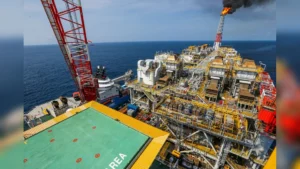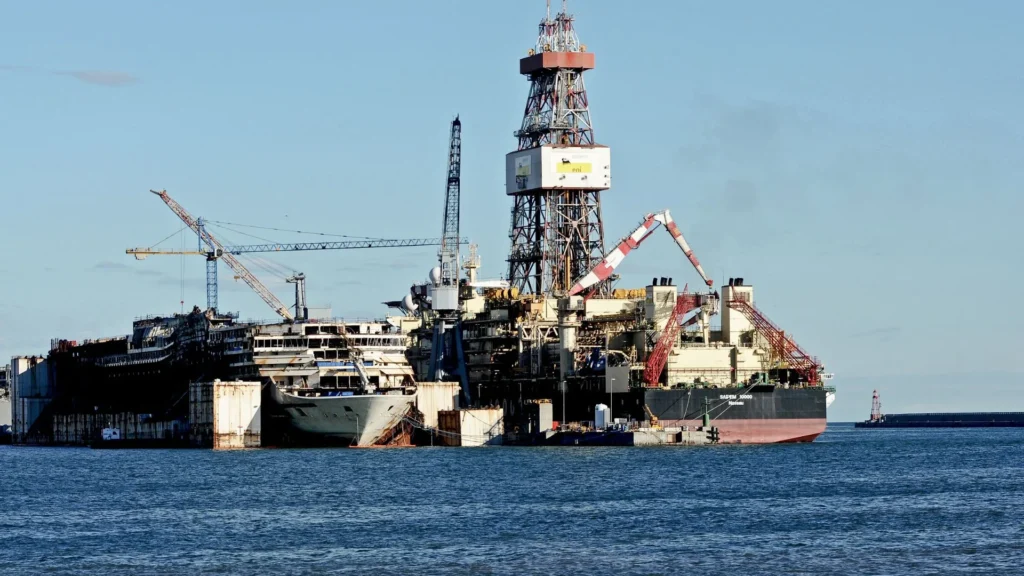
The construction of its first offshore project Carbon capture and storage opens a new chapter for the UK in the development of infrastructure to manage industrial emissions, work by the Northern Endurance Partnership (NEP) has already begun in the southern North Sea with the arrival of the Castorone the vessel, operated by Saipem, is a specialized pipeline-laying ship that reaches 325 meters in length. During this campaign, it will install part of the underwater infrastructure that will allow the carbon dioxide to be transported to its geological storage site.
Construction of its first offshore project with the Castorone
Specifically, the work is taking place about 75 kilometers east of Flamborough Head, where an integrated network will be deployed to collect, compress and transport CO2 captured in industrial facilities. The infrastructure will include a ground-based carbon collection network, compression systems, and a 145-kilometer underwater gas pipeline the pipeline will start from the coast and reach the injection facilities located in the Endurance saline aquifer.
Once there, the CO2 will be injected into a geological formation located approximately 1,000 meters below the North Sea floor. The start of pipeline construction marks a major milestone for the Northern Endurance Partnership, a joint venture comprised of BP, Equinor and TotalEnergies.
The Endurance aquifer will store millions of tons of CO2
Furthermore, Endurance will be the final destination for the captured carbon and will offer a permanent storage alternative for industries seeking to reduce their emissions. During the initial phase, NEP plans to store up to 100 million tons of CO2 over a period of 25 years in the aquifer.
Storage operations are scheduled to begin in 2028. If the timeline holds, the infrastructure would become the first system offshore of the UK’s operational carbon capture and storage. In this way, industrial facilities located on land will be able to send the captured CO2 to a geological formation under the North Sea via a network specifically designed for its transport.
Offshore construction will reduce some of its emissions
During the marine campaign, Saipem plans to use approximately 3,000 tons of marine biofuel aboard the Castorone, to reduce emissions generated by offshore construction work, the project will also incorporate environmental monitoring technology supplied by Sonardyne. The systems will collect data from the seabed and help monitor conditions around the CO2 storage facilities, this monitoring will be especially important during the operational phase, as it will allow observation of the behavior of the stored carbon and assessment of the geological formation’s long-term condition.
Northern Endurance Partnership promotes British CCS infrastructure
Furthermore, NEP is part of the UK’s plans to reduce emissions from industrial sectors whose processes are most difficult to electrify. The infrastructure will allow CO2 captured from industrial facilities on the east coast to be received, compressed, and transported via pipeline to its storage site in the North Sea.
For the Northern Endurance Partnership, the start of offshore work marks the transition from the engineering and preparation phases to the physical construction of one of the key components of the subsea gas network. With the Castorone already operating in the North Sea and pipeline laying underway, the UK is making progress in developing a robust infrastructure geological storage of CO2 which will have the Endurance aquifer as the core of the system.
Fuente: Offshore Energy
Foto: Shutterstock