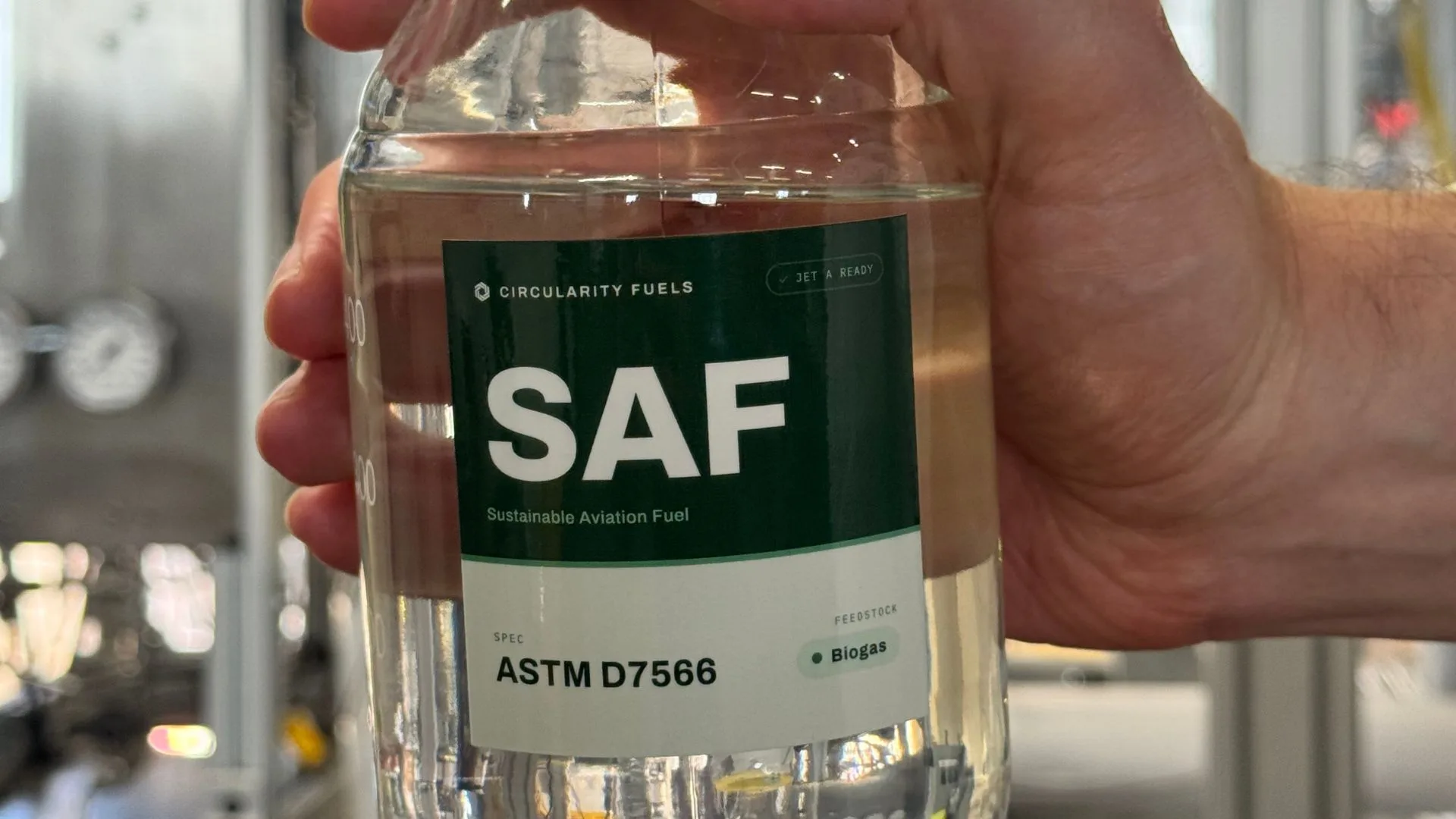
The renewable fuels company Circularity Fuels has completed the comprehensive conversion of raw agricultural biogas into sustainable aviation fuel. This process was carried out during a six-month pilot program at a livestock operation in Madera, California. The resulting fuel meets the international technical specifications of the ASTM D7566 standard, validating its direct use in commercial aviation.
Cost Reduction in Synthetic Fuel Production
Consequently, this technology enables the projection of commercial-scale installed capacity at a cost below $100,000 per daily barrel. This figure represents approximately one-fifth of the capital investment required by the processing plants currently being constructed on the European continent. Due to this financial optimization, sustainable aviation fuel derived from organic waste will achieve price parity with kerosene.
Indeed, dependence on limited raw materials such as used cooking oil from Asian sources poses serious challenges for the global supply of the aviation sector. In contrast, methane extracted from livestock operations constitutes a massive and underutilized resource. Likewise, on-site utilization of this gas mitigates transportation issues and the high energy costs associated with the production of other alternative synthetic fuels.
Integration of Modular Reactors Powered by Agricultural Biogas
Regarding operational performance, the system designed by the company employs two modular reactors mounted on mobile structures adapted to the scale of local producers. The first component, called the Ouro electrified bi-reforming reactor, processes raw gas composed of 65% methane and 35% carbon dioxide. Through this mechanism, the device achieves a conversion rate exceeding 98% for methane and greater than 90% for carbon dioxide in a single stage.
Subsequently, the synthesized gas enters the Aion compact synthesis reactor, where the formulation of the hydrocarbon is completed, which can be blended up to 50% with conventional aviation fuel. Life cycle analyses based on California regulations assign this product a carbon intensity of -350.7 grams of CO2 equivalent per megajoule. This negative score derives from the direct capture of methane that the farm would have otherwise released freely into the atmosphere.
For its part, the executive management of the technology firm emphasizes that real-world validation of the continuous process resolves the historical economic barriers of the clean industry. After securing financial backing from public entities and venture capital funds, expansion plans target the start of construction of the first large-scale commercial plant scheduled for 2027. The deployment strategy contemplates immediate utilization of residual biomass in key regions of the United States, Latin America, and Europe.
Source and photo: Circularity Fuels