Table of Contents
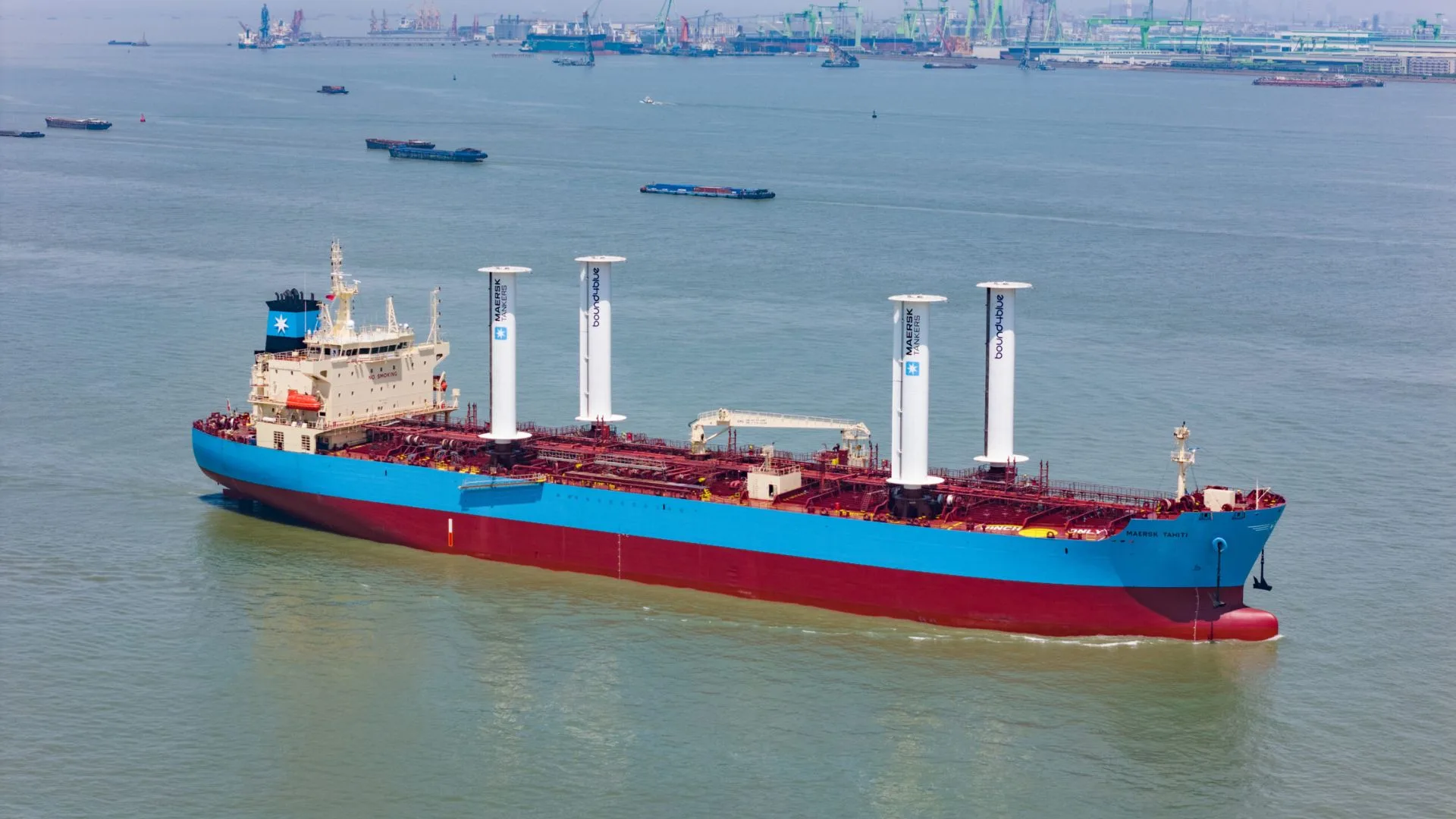
Spanish company bound4blue has recently completed the installation of four 24-meter eSAIL units aboard the Maersk Tahiti vessel. The operation was carried out at the Chengxi shipyard in China and represents the second delivery under an agreement covering five vessels in the Maersk Tankers fleet.
Installation of the eSAIL Sail System on the Maersk Tahiti Vessel
Regarding the system’s operability, the objective lies in its capacity to generate greater lift than rigid sails. The mechanism operates by drawing air through an aerodynamically optimized surface to considerably reduce the load on the main engine.
The direct result is fuel savings and a proportional reduction in polluting emissions. Furthermore, this technology enables the nearly thirty-thousand-ton vessel to operate more cleanly without compromising its cargo capacity and operational speed.
On the other hand, it is evident that regulatory pressures are accelerating the adoption of these wind-assisted propulsion systems. The use of eSAIL units facilitates compliance with the Carbon Intensity Indicator (CII) and offers advantages under the FuelEU Maritime framework.
These types of solutions are essential for shipowners seeking to minimize their exposure to the costs of the European Union emissions trading system. The simplicity of the “plug and play” installation combined with minimal maintenance makes this option one of the most competitive for the current fleet.
Consequently, the execution of this project at a Chinese shipyard demonstrates the logistical and global production capacity of the Cantabrian firm. After establishing strategic alliances in Asia over the past year, the company has demonstrated that it can scale its solution to meet the demand of major corporations such as Louis Dreyfus Company and Eastern Pacific Shipping.
Wind-assisted navigation has ceased to be an experimental concept and has transformed into a practical and scalable decarbonization tool for the global maritime transport sector.
Source and photo: Bound4blue