Table of Contents
- Why do tubes fail?
- Common causes of tube failure in exchangers
- What damages affect tubes the most?
- Nondestructive testing techniques for exchangers
- What inspections help prevent failures?
- Prevention of corrosion and fouling
- Optimization of thermal performance in chemical processes
- Effective strategies to prevent thermal failures
- Conclusion
- References
The reliability of heat exchangers depends heavily on the integrity of their tubes. A small internal defect can quickly evolve into leaks, fluid cross-contamination, and significant losses in thermal efficiency. In this scenario, applying modern exchanger inspection techniques and prevention strategies allows for the early detection of damage, reducing operational risks and extending the lifespan of equipment subjected to demanding pressure, temperature, and corrosion conditions.
Why do tubes fail?
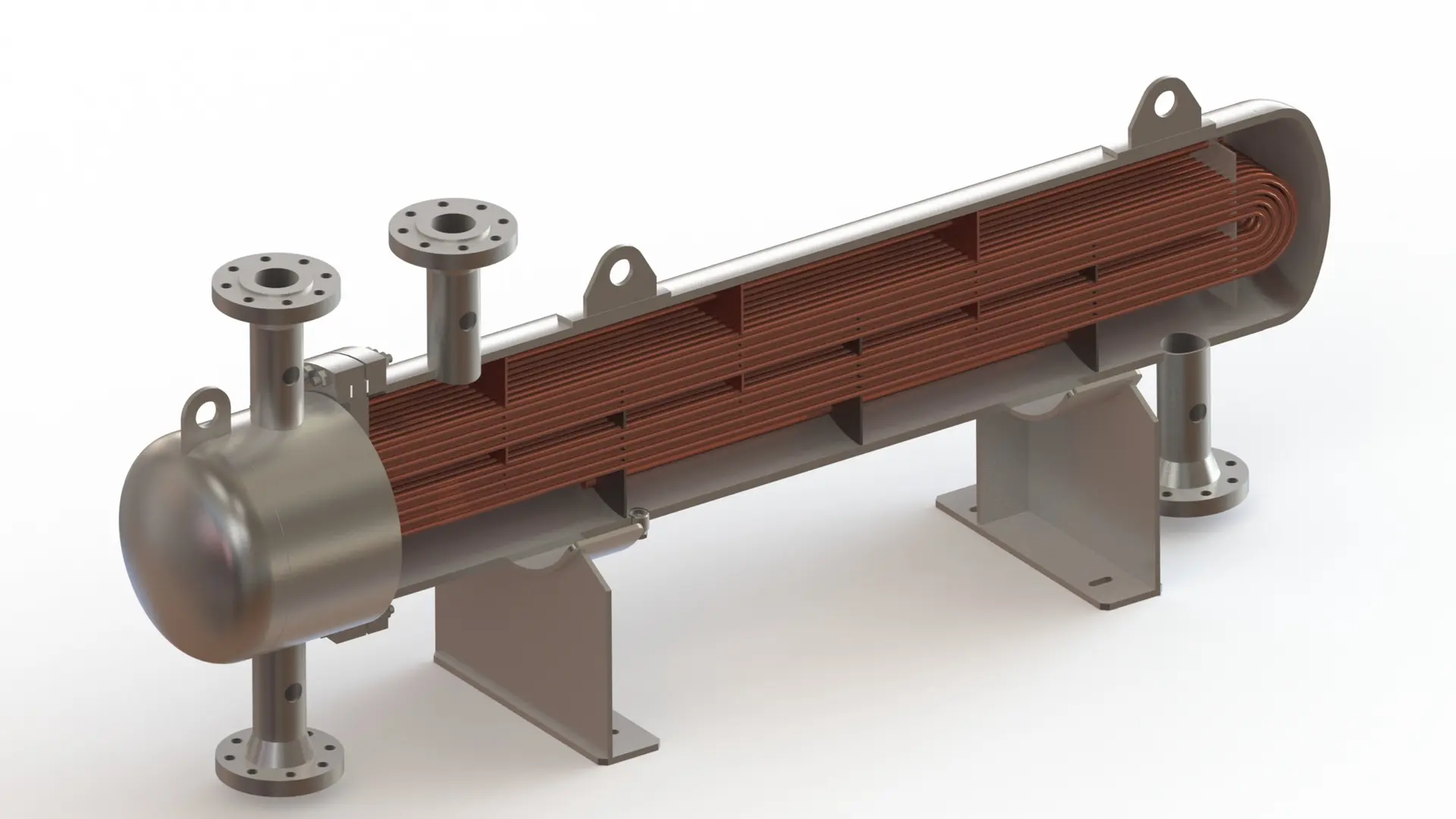
Heat exchanger tubes operate under severe conditions of pressure, temperature, vibration, and chemical exposure. In a shell and tube heat exchanger, deterioration usually stems from a combination of multiple damage mechanisms that can act simultaneously.
Failures rarely occur suddenly. They generally begin with localized corrosion processes, accelerated erosion, scaling, or thermal fatigue that progressively advance until producing failures.
Among the most frequent causes are:
- Internal corrosion due to aggressive fluids.
- Under-deposit corrosion.
- Microbiological attack.
- Erosion-corrosion in areas of high velocity and turbulence.
- Thermal fatigue due to operational cycles.
- Flow-induced vibrations.
- Severe fouling.
- Metallurgical deficiencies.
- Operation outside design limits.
In many cases, failures appear first in the tube bundle because it concentrates the greatest thermal gradients and mechanical stresses.
Common causes of tube failure in exchangers
Pitting corrosion
Localized corrosion is one of the most critical damage mechanisms in heat exchangers. Pitting generates tiny perforations that evolve rapidly until causing leaks.
This damage can occur in different metallic materials exposed to moisture, contaminants, salts, dissolved oxygen, or corrosive fluids. The problem lies in the fact that the loss of thickness may appear minimal, while the depth of the pitting completely compromises the integrity of the tube.
Leaks in heat exchangers caused by pitting usually appear without visible external deformations, making their early detection difficult through conventional visual inspection.
Erosion-corrosion
The combination of high fluid velocity, turbulence, and suspended solid particles can progressively remove the metal’s protective film. This phenomenon mainly affects tube inlets, changes in direction, and areas close to tubesheets.
Thermal fatigue
Frequent startups and shutdowns generate repetitive expansion and contraction in the tubes. When thermal gradients are high, microcracks appear and evolve over time.
Thermal fatigue is common in chemical plants, cracking units, and processes subject to severe operational variations.
Flow-induced vibration
Excessive vibration is one of the main causes of failure in tube bundles. When fluid velocity exceeds certain limits, the tubes begin to oscillate, generating wear due to friction or fracture due to mechanical fatigue.
This damage is usually concentrated at support points, baffles, or areas of high turbulence.
Fouling
Internal scaling reduces heat transfer and generates localized overheating. Furthermore, it promotes under-deposit corrosion and increases system pressure drops.
The accumulation of salts, sludge, coke, or biological products can progressively deteriorate thermal performance and accelerate metallurgical degradation.
What damages affect tubes the most?
The most critical failures in heat exchanger tubes are those that evolve internally without obvious surface evidence.
Among the most severe damages are:
| Damage Mechanism | Main Consequence |
|---|---|
| Pitting | Sudden leaks |
| General corrosion | Thickness loss |
| Erosion | Accelerated wear |
| Thermal fatigue | Longitudinal cracks |
| Vibration | Mechanical fractures |
| Under-deposit corrosion | Localized attack |
| Microbiological attack | Perforations |
Leaks in heat exchangers represent one of the most costly risks due to fluid cross-contamination, loss of energy efficiency, and potential operational incidents.
Nondestructive testing techniques for exchangers
Exchanger inspection is essential to detect damage before it evolves into major failures.
Currently, advanced NDT techniques allow for the evaluation of a large number of heat exchanger tubes in relatively short timeframes, significantly reducing operational risk.
Eddy Current Testing (ECT)
Eddy current inspection is one of the most widely used techniques for non-ferromagnetic materials.
This method can detect:
- Internal and external pitting.
- Thickness loss.
- Cracks.
- Wear at supports.
- Localized attacks.
One of its greatest advantages is the inspection speed and the high sensitivity to detect incipient defects.
Companies specializing in advanced NDT have managed to optimize tube bundle evaluation through automated ECT systems capable of identifying microscopic pitting in critical exchangers with high reliability.
Internal Rotary Inspection System (IRIS)
The IRIS technique uses internal rotating ultrasound to measure wall thickness with high precision.
It is especially useful for:
- Quantifying thickness loss.
- Validating indications detected by ECT.
- Generating internal corrosion maps.
- Evaluating generalized corrosion.
The method offers great dimensional accuracy and is highly effective in mechanical integrity programs.
Remote Field Testing (RFT)
The Remote Field Testing technique is mainly applied to ferromagnetic tubes.
Its ability to detect internal and external defects simultaneously makes it a very effective alternative for equipment manufactured from carbon steel.
The evolution of technologies developed by companies such as Eddyfi Technologies has optimized integrity evaluation in critical exchangers through high-sensitivity ECT, IRIS, and RFT techniques.
Remote Visual Inspection (RIV)
The use of industrial borescopes allows for the evaluation of inaccessible areas inside the equipment.
This inspection helps identify:
- Scaling.
- Deformations.
- Severe corrosion.
- Obstructions.
- Mechanical damage.
Conventional Ultrasound
Ultrasound continues to be widely used to evaluate tubesheets, shells, and associated structural components in heat exchangers.
What inspections help prevent failures?
The best strategy does not consist solely of inspecting when a leak appears, but rather of developing predictive programs based on criticality.
The most effective inspections include:
- Periodic thickness monitoring.
- Scheduled NDT inspection on critical tubes.
- Vibration control.
- Analysis of deposits and scaling.
- Chemical monitoring of the fluid.
- Evaluation of corrosion under insulation.
- Review of operational parameters.
The frequency should be defined according to:
- Fluid type.
- Tube material.
- Damage history.
- Operational conditions.
- Consequence of failure.
RBI (Risk-Based Inspection) programs allow for the prioritization of higher-risk equipment and the optimization of maintenance resources.
Prevention of corrosion and fouling
Prevention remains the most cost-effective tool for reducing heat exchanger failures.
Among the main preventive actions are:
Chemical control of the fluid
Maintaining appropriate parameters for pH, dissolved oxygen, and salt concentration helps reduce corrosive mechanisms.
In cooling water systems, proper chemical treatment can considerably decrease deposit formation and localized corrosion.
Correct selection of materials
Metallurgical selection must consider:
- Temperature.
- Fluid velocity.
- Chloride content.
- Pressure.
- Chemical compatibility.
Periodic cleaning
The removal of scaling prevents efficiency losses and reduces the risk of under-deposit corrosion.
The most commonly used methods include:
- Chemical cleaning.
- Hydrojetting.
- Mechanical brushing.
- Automated online cleaning systems.
Velocity control
Reducing excessive turbulence minimizes the risk of erosion-corrosion and flow-induced vibrations.
Thermal monitoring
Deviations in operating temperatures can indicate:
- Internal fouling.
- Obstructions.
- Loss of thermal transfer.
- Internal leaks.
Strategies to extend the lifespan of static equipment
The integrity of heat exchangers depends on integrated strategies of predictive maintenance and operational reliability.
Organizations with the best availability indicators typically implement programs focused on:
- Risk-based inspection.
- Online monitoring.
- Corrosion control.
- Mechanical integrity management.
- Thermal performance evaluation.
- Root cause analysis.
- Digitalization of historical data.
The combination of advanced NDT and predictive analysis allows for the anticipation of failures before they impact production.
Optimization of thermal performance in chemical processes
Thermal efficiency directly influences energy costs and operational stability.
When a shell and tube heat exchanger presents scaling or internal deterioration, energy consumption increases considerably.
Optimizing thermal performance requires:
- Efficient cleaning of the tube bundle.
- Scaling control.
- Periodic thermal balance.
- Monitoring of pressure drops.
- Verification of flow rates.
- Temperature control.
- Timely replacement or plugging of damaged tubes.
Effective strategies to prevent thermal failures
Thermal failures can be significantly reduced through good operational and maintenance practices.
The most effective strategies include:
Avoiding thermal shocks
Abrupt changes in temperature generate high stresses in tubes and tubesheets. Controlled startups help minimize thermal fatigue.
Maintaining uniform flow distribution
Poor distribution promotes hot spots, vibration, and localized erosion.
Monitoring critical temperatures
Continuous monitoring allows for the detection of deviations associated with obstructions or internal deterioration.
Verifying supports and baffles
Damaged supports increase vibrations and mechanical wear of the tube bundle.
Conclusion
Heat exchangers remain essential equipment in critical industrial processes, but their tubes are exposed to multiple damage mechanisms that can evolve silently until producing severe leaks. The combination of advanced exchanger inspection, operational control, and preventive strategies allows for the reduction of failures, optimization of thermal performance, and extension of the equipment’s lifespan. Technologies such as ECT, IRIS, and RFT have transformed the ability to detect early damage, significantly improving the reliability and availability of industrial thermal systems.
References
- American Petroleum Institute. (2016). API Standard 660: Shell-and-tube heat exchangers (10th ed.). API Publishing Services.
- American Society for Testing and Materials (ASTM International). (2021). ASTM E426-16(2021): Standard practice for electromagnetic (eddy current) examination of seamless and welded tubular products, titanium, austenitic stainless steel and similar alloys.
- Tubular Exchanger Manufacturers Association. (2019). TEMA standards: Standards of the Tubular Exchanger Manufacturers Association (10th ed.). TEMA Inc.
- American Society of Mechanical Engineers. (2023). ASME Boiler and Pressure Vessel Code, Section V: Nondestructive Examination. ASME International.
- American Petroleum Institute. (2021). API Recommended Practice 571: Damage mechanisms affecting fixed equipment in the refining industry. API Publishing Services.
- Eddyfi Technologies. (2023). Advanced electromagnetic inspection solutions for heat exchanger tubing and critical assets. Eddyfi Technologies.