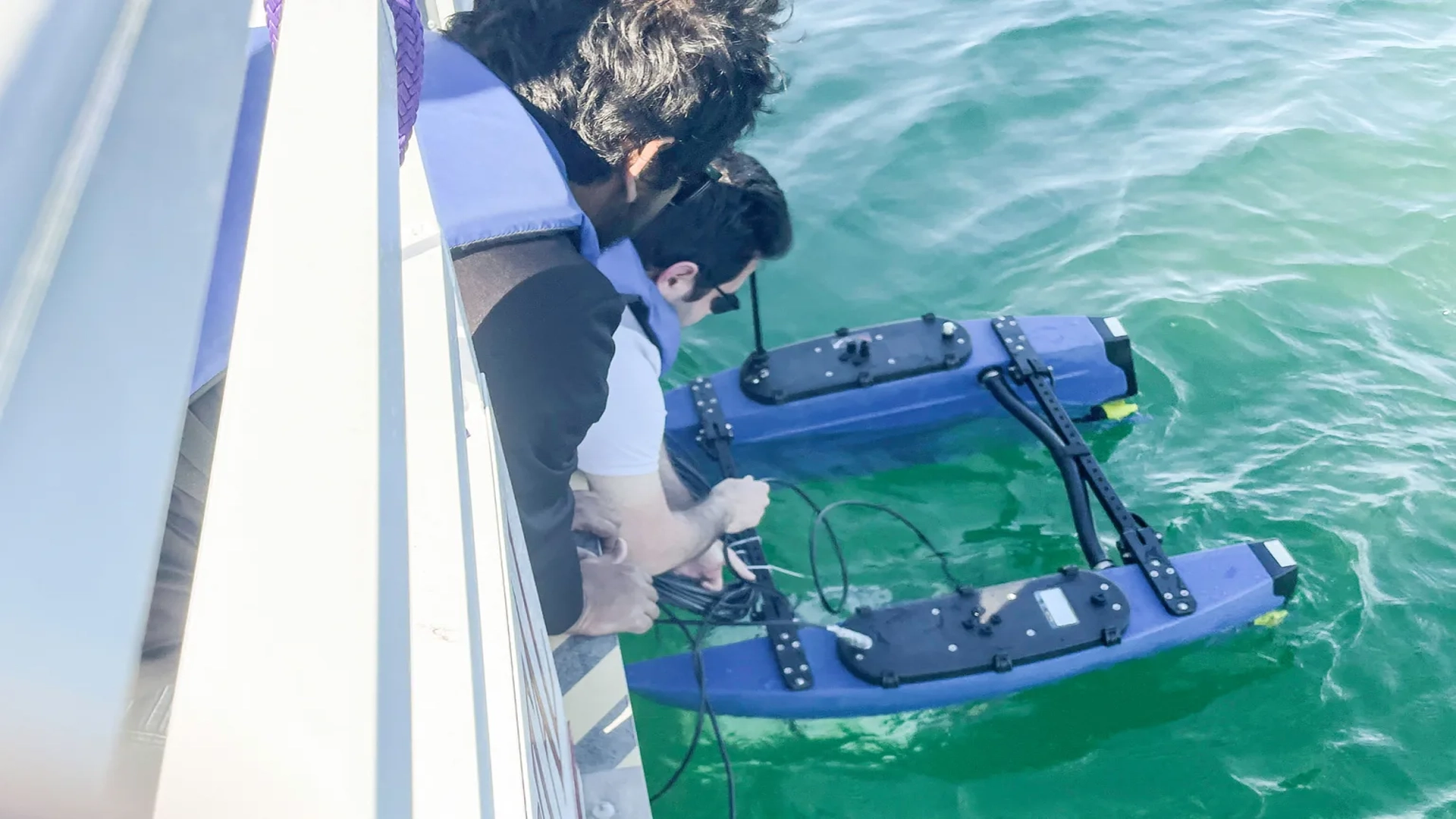
In the field of marine technology, a team of engineers at the University of Florida has developed an effective method for marine robots to share information in challenging aquatic environments. This project, led by Assistant Professors Md Jahidul Islam and Adam Khalifa, aims to optimize environmental monitoring and infrastructure inspection missions using energy-efficient devices.
Biomedical interfacing applied to marine robots
Furthermore, this concept stems from Dr. Khalifa’s experience in developing wireless medical microdevices for the human body. The scientist identified that the physical conductivity constraints faced by implants in the bloodstream are identical to those in the deep ocean. Because of this similarity, the team adapted principles of biological electrical transfer to overcome historical barriers related to bandwidth, range, and battery life.
Testing of magnetoelectric antennas in the ocean
In terms of design, the core of the research lies in BlueME technology, a compact antenna architecture that operates underwater. Unlike traditional equipment that requires large structures, this device uses its own natural resonance frequency to emit low-frequency electromagnetic signals. Furthermore, the system stands out for requiring a maximum power consumption of 10 watts, which is less than that of a conventional stereo camera.
Experiments conducted under real-world ocean conditions demonstrated stable data transmission links over distances exceeding 700 meters. Thanks to this performance, operators of autonomous vehicles will be able to receive frequent updates and modify mission parameters in real time. The institution has already filed a provisional patent application to expand the commercial validation of this technological ecosystem.
Source: UF News