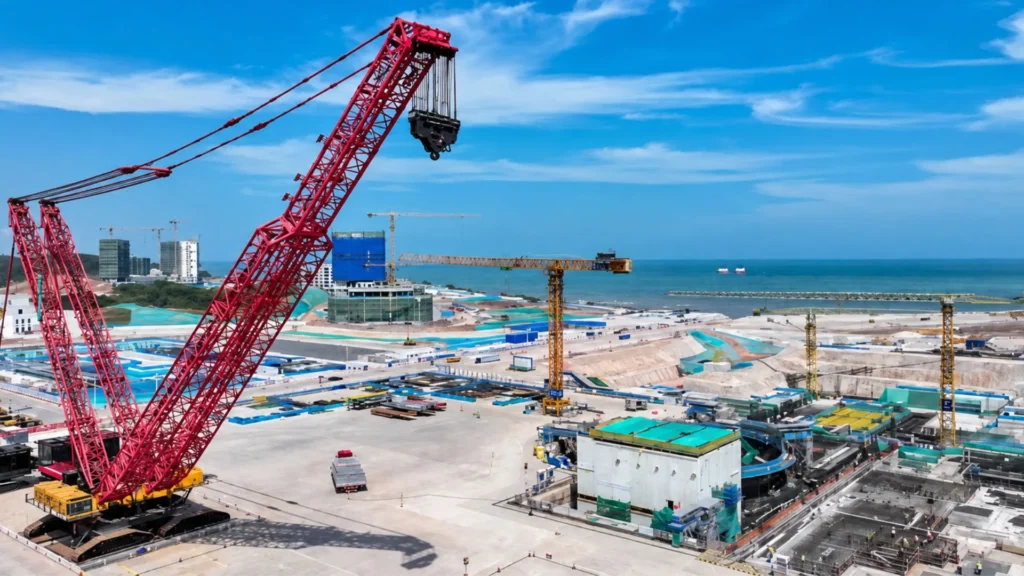
China a new phase of construction began central nuclear de Bailong 2 with the first pour of concrete for the base of the conventional island of unit 2.
The State Energy Investment Corporation (SPIC) it reported progress at the complex located on the Jiangshan Peninsula in Fangchenggang, within the Guangxi Zhuang Autonomous Region. The facility is located about 24 kilometers from the border with Vietnam.
The start of work on Bailong 2 continues the development of the first phase of the plant, in December 2025, the first concrete pour corresponding to the nuclear island of unit 1 had been carried out.
Bailong 2 will use a CAP1000 reactor
Phase I of the project comprises units 1 and 2 and includes the installation of CAP1000 pressurized water reactors this is a technology developed in China based on the Westinghouse AP1000 design.
The SPIC program goes beyond these first two units, later phases include four more reactors, bringing the total number of units at the Bailong complex to six.
Units 3 to 6 are planned to use reactors CAP1400, commercially known as Guohe One this Generation III+ technology is also derived from the AP1000, although it was developed with a greater capacity.
Furthermore, China owns the intellectual property rights to Guohe One, the first demonstration units of this technology were built at the Shidaowan nuclear power plant in Shandong province.
The nuclear project includes six reactors
In economic terms, the first phase of the central nuclear de Bailong it represents an approximate investment of 40 billion yuan, equivalent to about 5.6 billion dollars.
Meanwhile, the projected investment to develop the six units amounts to approximately 120 billion yuan, SPIC anticipates that each of the first two units will require around 56 months to reach full commercial operation. Once operational, Bailong 1 and Bailong 2 will have an estimated combined production of 20 TWh of electricity per year.
Bailong will bolster China’s nuclear power generation
Furthermore, the projected production would allow for the replacement of approximately 6 million tons of standard coal consumption each year. According to project estimates, this would prevent around 16 million tons of carbon dioxide emissions annually.
The advancement of Bailong 2 is part of SPIC’s strategy to expand the deployment of Generation III+ reactors developed in China.
Construction has also had to cope with adverse weather conditions, after Typhoon Mesak passed through Fangchenggang in July, the persistent high temperatures posed additional difficulties for the work on the site.
Given these conditions, the planning of the works involved Guangxi Nuclear Power, the Shanghai Institute of Nuclear Technology and China National Nuclear Corporation to maintain the development of the construction.
Source: Nuclear Engineering
Photo: SPIC