Threats to major shipping routes Middle East are leading to China looking north, the Arctic is gaining importance as a corridor for container shipping between Asia and Europe, while insecurity affects the Red Sea and other strategic locations.
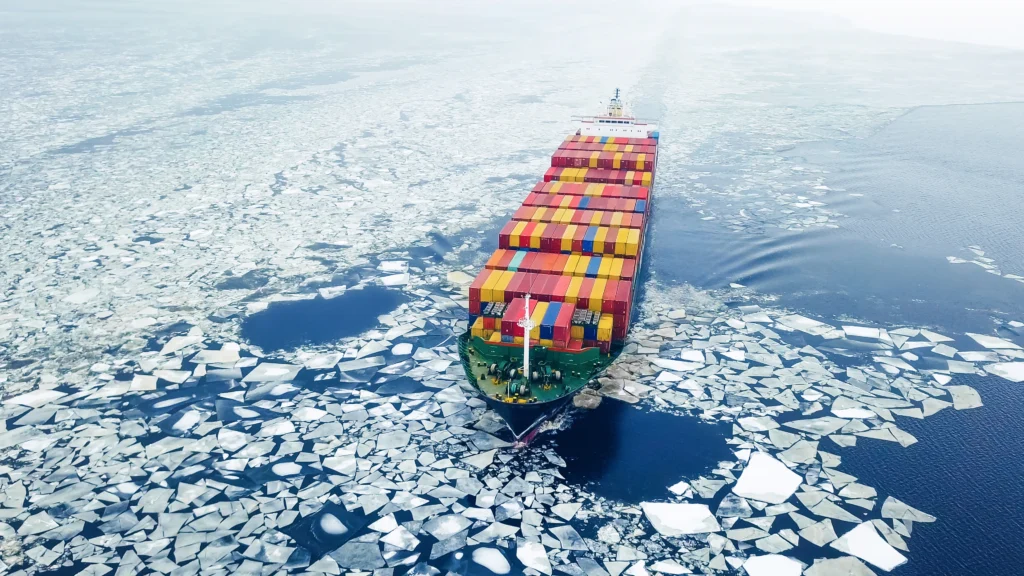
Chinese shipping company Sea Legend is now moving forward with a regular service through the Northern Sea Route, the connection will allow the transport of containers from Ningbo, on the east coast of China, to Felixstowe, in the United Kingdom, skirting the northern coast of Russia.
Sea Legend transports Chinese containers to the Arctic
Specifically, Sea Legend is planning a weekly service during the season when ice conditions permit navigation. The company has named the corridor Ice Silk Road.
The commercial appeal is considerable, the crossing can reduce by approximately half the roughly 40 days normally required for shipping between Ningbo and Felixstowe, although the final time depends on conditions in the Arctic Circle.
Likewise, traffic on the Northern Maritime Route has shown signs of growth, last summer 23 transits were recorded compared to 15 in 2024.
During the most favorable months, the seasonal retreat of the ice also allows some ships to make the journey without icebreaker escort.
The Red Sea enhances the appeal of the Arctic route
On the other hand, China’s advance coincides with a complex scenario for international maritime transport. The threats surrounding the Red Sea and Bab el-Mandeb have increased the risk of using one of the main trade connections between Asia and Europe.
The Arctic corridor offers a different possibility, ships can avoid some of the points of greatest geopolitical tension and at the same time shorten the sailing distance.
The combination of these two factors makes the Northern Sea Route a strategic option for certain Chinese shipping companies. However, its development is contingent upon the weather and a particularly important political relationship with Russia, which controls access to a significant portion of the corridor.
Russia controls access to the Northern Sea Route
Navigation through this corridor is regulated by the Russian Northern Sea Route Administration, Rosatom participates in its management, and the relevant authorities issue the necessary permits to operate in these waters. This situation represents a significant difference between Chinese companies and many of their Western competitors.
The close ties between Beijing and Moscow facilitate China’s interest in developing commercial services in the region. For major European shipping companies, however, the relationship with Russia adds to their environmental and operational concerns.
Maersk tested the route in 2018 with a container ship between Vladivostok and St, Petersburg, however, the Danish company did not make it a regular service. Other major carriers have also avoided incorporating the Arctic corridor into their regular networks.
Navigating the Arctic carries significant risks
Despite the reduced distance, polar navigation presents very different difficulties than conventional commercial routes.
Ships can encounter ice even during the summer months, in addition to the limited support infrastructure, the long distances to organize search and rescue operations and the risk of breakdowns in a particularly remote region.
An analysis by Allianz counted 531 incidents in Arctic waters during the decade up to 2023, of which 261 were related to damage or failure of machinery.
There is also an environmental concern; an accident, a fuel spill, or a complex rescue operation can have especially serious consequences in a sensitive ecosystem.
China gains a logistical advantage that is difficult to replicate
Meanwhile, as the evolution of the ice expands seasonal navigation possibilities, commercial interest is also reflected in the demand for ships prepared to operate in ice.
However, a shorter route does not necessarily mean an easier route, companies must assess weather conditions, the availability of assistance, Polar Code requirements, and the ability to respond to an emergency.
For China, the equation is different from that of many Western operators, its relationship with Russia facilitates access to a corridor that allows it to avoid conflict zones and reduce navigation time between Asia and Europe.
Thus, the increase in threats to maritime routes Middle East this is reinforcing the strategic value of the Arctic. If summer conditions continue to allow regular transit, the Northern Sea Route could gain greater importance within Chinese maritime logistics to Europe.
Source: Oil Price
Photo: Shutterstock