Argentina has intensified pressure on companies linked to oil development in the Falkland Islands as the progress of offshore projects once again raises tensions with the United Kingdom over South Atlantic energy resources.
Over the weekend, President Javier Milei’s press office released statements from Halliburton, SLB, and Baker Hughes in which the three major oilfield services companies confirmed they are not participating in oil development off the archipelago.
The corporate reaction comes as Buenos Aires expands scrutiny of companies directly or indirectly related to hydrocarbon exploration and exploitation activities in the area.
Argentina expands pressure on oil companies
For his part, Foreign Affairs Minister Pablo Quirno has questioned the companies involved in the islands’ nascent offshore oil industry. The Argentine government has also moved forward with sanctioning proceedings against companies, shareholders, and service providers.
The strategy is based on Law 26,659, used by Argentina to sanction hydrocarbon exploration and exploitation activities it considers to be carried out without national authorization on its continental shelf.
Furthermore, the Government announced a criminal complaint against five companies linked to these operations: Navitas Petroleum Development & Production, Navitas Petroleum Atlantic United, Navitas Petroleum LP, JHI Associates, and Eco (Atlantic) Oil & Gas.
According to the Argentine position, some of these companies allegedly received British permits to carry out hydrocarbon-related activities without authorization from Buenos Aires.
Falklands crude drives tension over the Sea Lion project
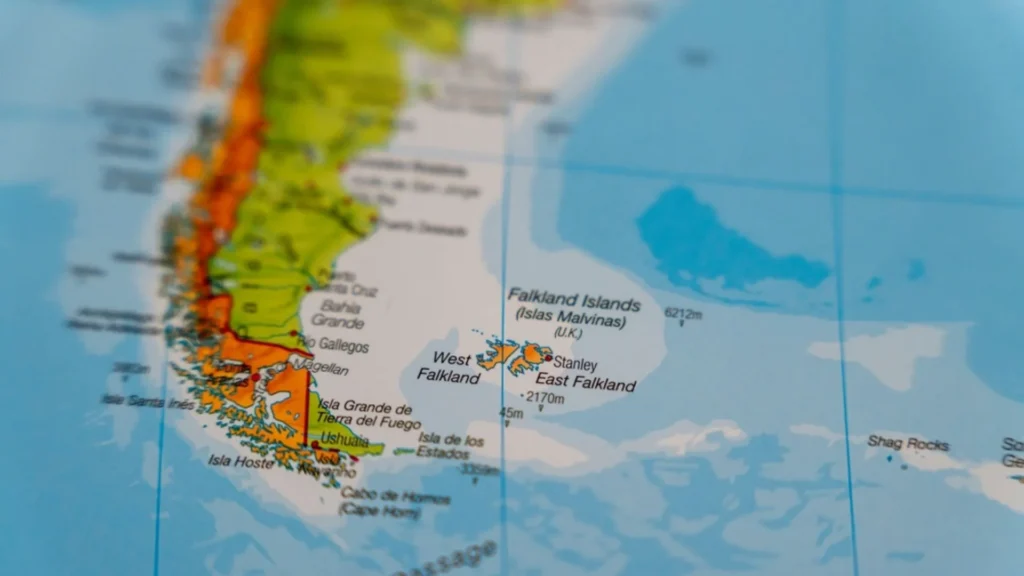
Meanwhile, the progress of the Sea Lion project is increasing the economic significance of the conflict. The field is located in the North Falkland Basin and could become the first development to produce oil in waters near the islands.
Navitas Petroleum controls 65% of the project while Rockhopper Exploration holds 35%. The field was discovered in 2010 and is situated approximately 220 kilometers north of the archipelago, in an area where the seabed reaches depths of about 450 meters.
At the end of 2025, the companies reached the final investment decision for the first phase of development. This step allowed for progress toward project execution after completing technical, economic, and financial evaluations.
Specifically, the progress toward crude production has increased the economic weight of a sovereignty dispute that has pitted Argentina against the United Kingdom for decades.
Halliburton, SLB, and Baker Hughes distance themselves
Likewise, the publication of statements from Halliburton, SLB, and Baker Hughes shows that the Argentine government is extending its attention beyond the operators directly responsible for the oil projects.
The three companies are major international providers of technology and services to the oil and gas industry. Their statements ruling out participation in the development off the Falklands seek to publicly establish their position in the face of growing Argentine scrutiny.
This factor is especially relevant for offshore projects, which depend on an extensive supply chain for drilling, well construction, subsea services, and other operations necessary before starting commercial production.
Eduardo Elsztain comes under scrutiny for his investment
On the other hand, the campaign also reached Argentine businessman Eduardo Elsztain. His Dolphin Fund Ltd. owns approximately 2% of FIH Group Plc, the parent company of the Falkland Islands Company.
Elsztain publicly defended the investment and stated that his goal is to deepen economic and commercial ties between Argentina and the islands.
The businessman had also attempted to acquire a majority stake in the Falkland Islands Company. However, British authorities rejected an Argentine investor taking control of the company.
The controversy shows how the renewed conflict surrounding hydrocarbons is reaching investments and commercial relationships that go beyond the companies directly responsible for oil extraction.
Oil development raises tension between Argentina and the United Kingdom
Finally, Sea Lion’s approach toward its production stage introduces an ever-increasing economic component into the territorial dispute. Argentina maintains its claim of sovereignty over the Falkland Islands while the United Kingdom maintains its position on the archipelago.
For Buenos Aires, the unilateral exploitation of natural resources in the disputed waters lacks Argentine authorization. London maintains a different position regarding the administration of the territory and its economic activities.
In this way, offshore oil is becoming central to the relationship between both countries. As Sea Lion moves toward production, oil companies, their shareholders, and their suppliers could face increasing Argentine scrutiny.
Source: World Oil
Photo: Shutterstock