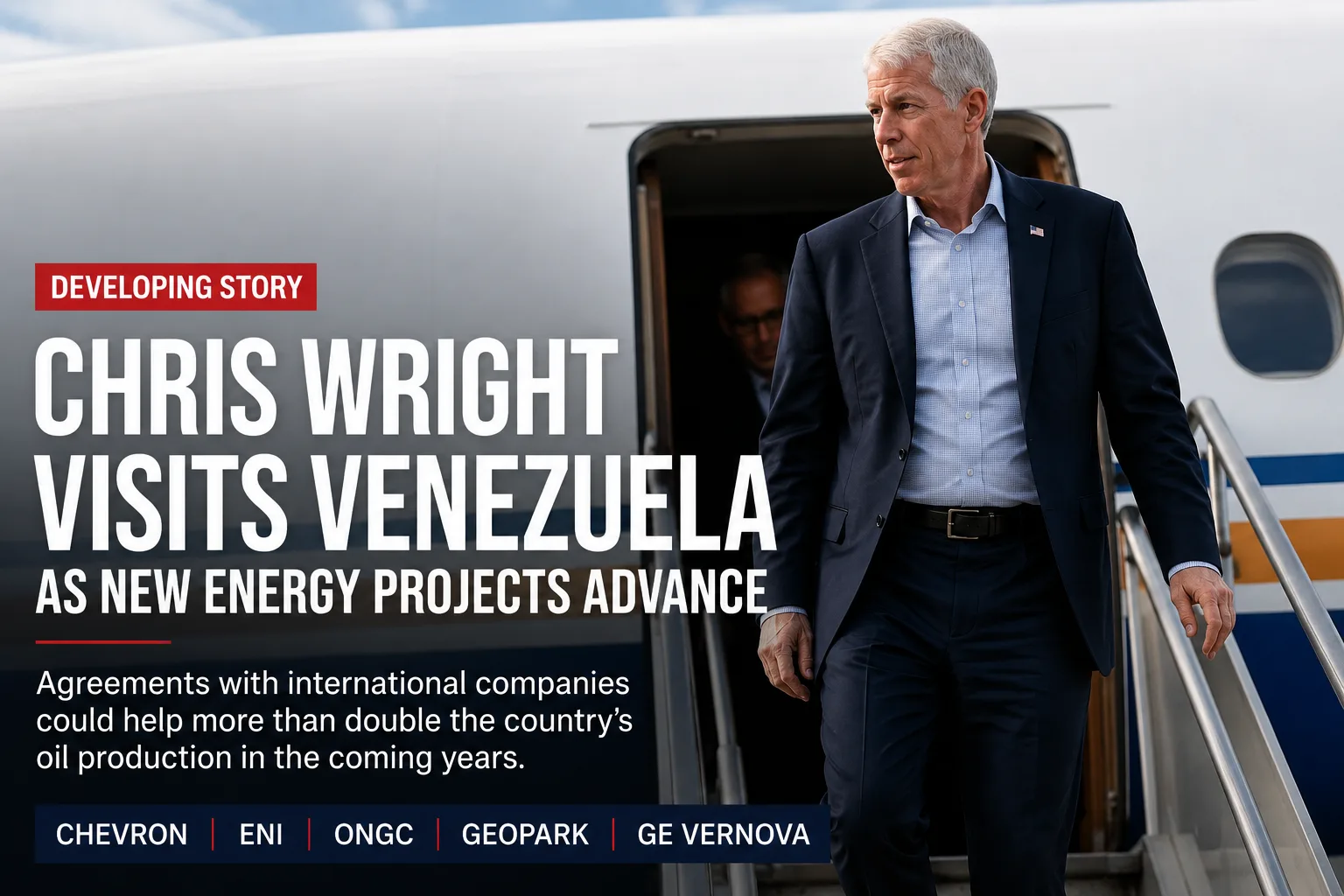
Chris Wright in Venezuela marks a new point of attention for the energy sector this week, as projects move forward to expand hydrocarbon production, recover assets, and bring new infrastructure investments into the country. Chevron, Eni, ONGC, GeoPark, and GE Vernova are among the companies linked to initiatives that could advance during this new phase.
The industrial scope extends beyond new agreements. Venezuela currently produces around 1.1–1.2 million barrels per day (bpd), while projects under development raise the possibility of significantly increasing that volume over the coming years. Achieving this will depend on turning investment into wells, equipment, power capacity, surface facilities, and reliable systems to process and transport production.
What is the agenda for Chris Wright in Venezuela?
The agenda is linked to new agreements aimed at expanding the activity of domestic and international companies within the Venezuelan energy sector. Wright said the associated investments could contribute to more than doubling crude oil production over the coming years.
The scale of that projection is significant. Starting from current levels, doubling production would mean surpassing 2 million bpd and recovering a substantial portion of the capacity Venezuela maintained during previous periods.
However, reserves and investment do not automatically translate into production. Bringing additional barrels online will require well recovery, increased drilling activity, workovers, and sufficient processing, storage, and transportation capacity.
Chevron, Eni and ONGC expand the project landscape
The presence of operators with different profiles allows this phase to encompass several segments of the energy value chain. Chevron maintains an important position in the Venezuelan upstream sector, while Eni and ONGC have interests related to hydrocarbons and asset recovery.
This scenario had already begun to take shape. Inspenet recently analyzed how energy projects in Venezuela are advancing with Chevron, ONGC and Eni, alongside initiatives associated with GeoPark and GE Vernova.
ONGC provides a concrete example of how new investments can be directed toward existing assets. The Indian company is preparing nearly USD 200 million to recover the San Cristóbal field, which is currently operating well below its historical production levels. The ONGC project in Venezuela to recover San Cristóbal aims to progressively bring the asset to approximately 50,000 bpd.
Venezuela could surpass 2 million barrels per day
Potential growth must be analyzed in terms of the physical capacity required to handle higher volumes. Venezuela produced more than 3 million bpd in the late 1990s, but recovering a significant portion of those levels involves addressing an industrial chain that extends far beyond the reservoirs themselves.
The recent recovery already provides a reference point. Inspenet reported in August that Venezuela oil production was advancing with greater Chevron participation, reaching approximately 1.21 million bpd during July.
Surpassing 2 million bpd would require adding hundreds of thousands of barrels through mature fields, well recovery, and new developments. Therefore, the pace of growth will depend on the availability of drilling rigs, oilfield services, tubulars, artificial lift systems, and specialized personnel.
Infrastructure will be decisive in turning investment into production
One of the main challenges will be preventing upstream growth from creating new surface bottlenecks.
Flow stations, separators, electrical systems, tanks, pipelines, terminals, and treatment facilities will need to support any significant increase in production. The reliability and mechanical integrity of these assets also become increasingly important as handled volumes rise.
This requirement is particularly important in the Orinoco Oil Belt, where heavy and extra-heavy resources predominate and require specific production, dilution, and transportation conditions.
This challenge is already reflected in plans to develop 17 strategic oil fields in Venezuela, where infrastructure, electricity, transportation, and export capacity were identified as essential elements for transforming available resources into sustained production.
New projects now enter the execution phase
The next indicator for the industry will be the ability to turn agreements and investments into effective field activity. Drilling new wells, recovering existing production, and rehabilitating infrastructure will help determine how quickly additional volumes can be brought online.
For Venezuela, the energy challenge is not limited to having vast petroleum resources. The new phase will depend on connecting capital, technology, oilfield services, infrastructure, and operational capacity within projects capable of sustaining additional production.
The Chris Wright visit thus serves as the current focal point of an agenda whose outcome will be fundamentally industrial. Over the coming years, the barrels effectively brought online, asset recovery, and infrastructure reliability will be the indicators that determine the actual scope of this new energy phase.
Primary source: Reuters