
Airbus and MTU will create a company to develop a hydrogen engine
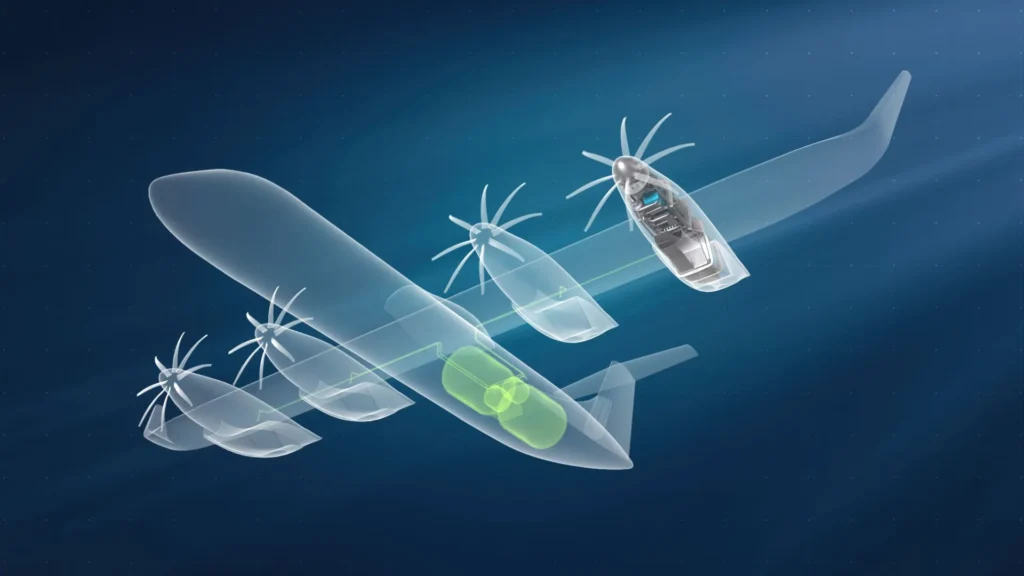
Airbus and MTU Aero Engines are preparing to create a joint venture focused on developing a fully electric propulsion system . The technology will be powered by a hydrogen fuel cell and is intended for future commercial aircraft.
The new entity will handle the design, testing, certification, and marketing of the system. With this structure, both companies hope to accelerate the transition from technical research to a solution suitable for use in aircraft.
According to the announced plans, the company could begin operations in 2027. Before that, it must receive the corresponding regulatory approvals and complete the social processes required in Europe.
Airbus and MTU expand their cooperation in hydrogen
Previously, Airbus and MTU signed a memorandum of understanding during the Paris Air Show in June 2025. That agreement established a common roadmap to study the development of hydrogen-powered electric motors .
Now, the creation of a specialized company represents a more concrete step. The project will bring together engineering and manufacturing teams from both organizations under a structure focused on a single propulsion system.
Airbus will contribute its expertise in commercial aircraft programs, systems integration, and liquid hydrogen storage. MTU will add its capabilities in aircraft engines, validation, certification, and maintenance.
Furthermore, the collaboration will allow for the coordination of technical work that both companies already carry out separately. The intention is to cover the entire product lifecycle, from the initial development phases to its potential market launch.
How will the hydrogen engine work?
The proposed system will not burn hydrogen inside a conventional turbine. Instead, it will use a hydrogen fuel cell to generate electricity through an electrochemical reaction with oxygen.
That electricity will power one or more electric motors responsible for generating the aircraft's thrust. During this process, the main byproduct will be water vapor.
Therefore, the technology could avoid the carbon dioxide and nitrogen oxide emissions associated with combustion during flight. However, its full environmental impact will also depend on how the hydrogen is produced and the energy used in its supply chain.
Hydrogen propulsion presents other technical challenges. The fuel must be kept at very low temperatures and requires larger storage tanks than kerosene. Airports, refueling systems, and safety regulations will also need to be adapted.
The tests carried out by Airbus and MTU
In March 2025, Airbus confirmed that it would focus its research on a fully electric architecture based on fuel cells. The company made this decision after evaluating prototypes, power systems, and cryogenics-related technologies.
Meanwhile, MTU has made progress with its Flying Fuel Cell concept. The company has completed the design of its system, begun manufacturing the fuel cell for a demonstrator, and conducted tests on its eMoSys electric motor.
MTU has also launched a test cell in Munich. This work will be used to study the behavior of the components before integrating them into an aerial platform.
The alliance aims to combine these advancements with Airbus's expertise in aircraft development. This will allow the project to simultaneously address engine performance and its integration into a commercial aircraft.
A European commitment to hydrogen-powered aviation
In addition to the technical work, Airbus and MTU aim to support the creation of an aviation economy based on hydrogen. This will require developing infrastructure for production, transport, storage, and supply at airports.
A regulatory framework defining certification and operational requirements must also be established. These standards will need to cover aspects such as cryogenic storage, fuel management, and failure response.
The joint venture could strengthen European industrial capacity in low-emission propulsion systems. By combining the expertise of aircraft and engine manufacturers, the project aims to reduce development times and facilitate future large-scale production.
Even so, the arrival of commercial aircraft with this technology will depend on testing, costs, the availability of low-emission hydrogen , and the adaptation of airport infrastructure.
Next steps before starting operations
Over the next few months, Airbus and MTU will need to define the legal and operational structure of the new company. They will also have to finalize agreements regarding resources, technology ownership, and team participation.
Afterward, the organization can proceed with the complete design of the hydrogen engine and prepare the testing programs. Certification will be one of the most demanding stages due to the stringent safety requirements of commercial aviation.
If it obtains the necessary approvals, the company will begin work in 2027. Its goal will be to make hydrogen fuel cells a viable alternative for future aircraft and pave the way for reducing the climate impact of air transport.
News of additional interest
Gulfstream tests pure SAF with Montana support
Montana Renewables collaborated with Gulfstream Aerospace as the exclusive fuel supplier for a low-emissions test campaign using the G800 business jet. For the trial, they supplied MaxSAF®, while Washington State University analyzed the fuel's properties before the flight. The objective was to evaluate how different fuel types affect emissions generated during aircraft operation.
The tests allowed Gulfstream to complete a high-altitude flight campaign up to 50,000 feet to compare conventional Jet-A fuel, low-sulfur Jet-A, and 100% HEFA sustainable aviation fuel (SAF). Preliminary results indicate a clear reduction in contrail-producing particles when using pure SAF. Montana Renewables stated that it is working to expand its production capacity to meet growing demand from the industry.
Eni launches a gigafactory for batteries
Eni Storage Systems has begun construction of an industrial complex in Brindisi dedicated to manufacturing lithium iron phosphate batteries for energy storage systems. The project includes the production of cells and modules, as well as the assembly of BESS systems, a technology that allows electricity generated from renewable sources to be stored for use when demand increases or production decreases.
The initiative will be developed in two phases and will also include the manufacture of cathode materials and battery recycling. The goal is to achieve a combined capacity of 16 GWh per year between the Brindisi and Teverola plants by 2030, with a market share exceeding 10% of the European energy storage market. The company maintains that the project will strengthen the local supply chain and contribute to job creation while reducing dependence on suppliers outside Europe.
Bahri expands its fleet for offshore operations
Bahri Logistics has signed an agreement with Grandweld Shipyard to build two offshore support vessels . The ships will be designed to serve the needs of the port of Ras Tanura, one of Saudi Arabia's main energy hubs. Their addition will strengthen the logistics services the company provides to clients in the energy and industrial sectors.
The new vessels will feature advanced navigation, communication, and safety technology to operate in demanding conditions. They will also be able to perform tasks such as crew transport, emergency response, maintenance and inspection support, and maritime administrative procedures. Delivery is scheduled for August 2026 and is part of Bahri's plan to modernize its fleet with more efficient vessels that have a lower environmental impact.
Petrobras strengthens its presence in Africa
Petrobras has completed the acquisition of a majority stake in exploration Block 3, located off the coast of São Tomé and Príncipe. With the closing of the transaction, the Brazilian company assumed the role of operator of the asset with a 75% stake, while Oranto will retain 15% and the São Tomé and Príncipe National Petroleum Agency will hold the remaining 10%.
The addition of this block is part of Petrobras' strategy to expand its exploration portfolio both within and outside of Brazil. In this new phase, the consortium will advance with geological studies and exploration programs to evaluate the area's oil and gas potential. The company seeks to strengthen reserve replacement and expand its asset portfolio in offshore regions considered attractive for its growth.