The development of smart multifunctional coatings is progressing more rapidly than the evolution of qualification systems designed to assess them. Traditional coating standards established by ISO and ASTM primarily address passive barrier properties, including corrosion resistance, adhesion, humidity resistance, abrasion resistance, and visible degradation. Although these standards are essential for conventional protective coatings, they do not comprehensively evaluate the active and responsive characteristics of contemporary smart coatings.
Coatings that incorporate microcapsules, embedded inhibitors, sensing systems, or trigger-responsive components differ fundamentally from passive coatings. These advanced systems can autonomously respond to damage, release active agents, restore protective properties, detect environmental changes, or sustain multiple functions concurrently. Despite these capabilities, a dedicated international qualification framework for evaluating such intelligent behaviors in a harmonized and reproducible manner remains absent.
Currently, most developers of smart coatings utilize a combination of conventional coating tests and custom laboratory procedures. This practice complicates comparisons of results across studies, hinders reproducibility between laboratories, and challenges the qualification of products for industrial applications. Recent literature consistently identifies the lack of standardized qualification protocols as a significant barrier to the broader commercialization of self-healing and multifunctional coatings.
The coatings industry has numerous established standards; however, the primary challenge is the lack of an integrated framework tailored to smart, multifunctional systems.
What Makes Smart Coatings Different
In this context, smart coatings are defined as coatings capable of sensing a trigger, reacting to damage or environmental conditions, and maintaining or restoring functionality. Typical smart functions include:
- self-healing,
- corrosion inhibition,
- self-reporting,
- thermal or moisture responsiveness,
- conductivity adjustment,
- antifouling activity, and controlled release of active agents.
For microcapsule-based systems, qualification becomes even more complex. The coating must demonstrate not only conventional performance, but also that the capsules survive manufacturing and application, remain stable during storage, activate under the correct conditions, release sufficient active material, and continue functioning after environmental exposure.
A coating may pass traditional adhesion or salt-spray testing while still failing to deliver its intended smart functionality in service.
Why Existing Standards Are Not Enough
Many current ISO and ASTM standards are extremely useful for measuring individual coating properties. Standards such as ISO 12944, ISO 9227, ASTM B117, ISO 2409, ASTM D3359, ASTM D5894, and ISO 16773 provide important methods for corrosion testing, adhesion evaluation, cyclic exposure, and electrochemical monitoring. However, these standards were not designed to qualify multifunctional smart coatings as integrated systems.
Current standards cannot fully answer critical questions such as:
¿What defines acceptable healing efficiency?
¿How should trigger sensitivity be measured?
¿How many healing cycles are required?
¿What constitutes smart-function failure?
¿How should multifunctional trade-offs be evaluated?
¿How should residual functionality after activation be assessed?
As a result, qualification approaches remain fragmented and inconsistent.
Major Standardization Gaps
Lack of Harmonized Classification
One of the first challenges is terminology. There is still no universally accepted classification system distinguishing self-healing, self-reporting, inhibitor-releasing, antifouling, EMIshielding, or sensing coatings into separate qualification categories.
Very different technologies are often grouped together under the broad term “smart coatings,” despite operating through completely different mechanisms and requiring different evaluation methods. This creates confusion during certification, procurement, and industrial comparison.
No Standardized Healing-Efficiency Method
Healing efficiency remains one of the largest unresolved gaps. Researchers currently evaluate healing using many different approaches, including: crack closure, impedance recovery, corrosion-current reduction, restored adhesion, barrier recovery, or visual surface restoration.
Due to the use of varying damage geometries, healing durations, and acceptance criteria across studies, direct comparison between systems is highly challenging. The field requires harmonized protocols for evaluating healing efficiency.
Lack of Realistic Damage Protocols
Smart coatings are highly dependent on the type of damage that activates them. Laboratory razor scratches often fail to represent real service conditions such as abrasion, fatigue cracking, dents, impact damage, or cyclic stress.
In the absence of representative and standardized damage protocols, laboratory qualification is unlikely to accurately predict real-world performance.
No Standards for Microcapsule Integrity
Microcapsules must survive mixing, pumping, spraying, curing, and storage. Yet conventional coating standards rarely evaluate capsule survival, shell integrity, or active-agent retention after processing.
This issue is critical, as manufacturing processes may compromise smart functionality before the coating is deployed in service.
No Multi-Cycle Qualification Framework
Many smart coatings are promoted as autonomous or repeatable systems, but most current evaluations only assess performance before and after a single activation event.
There is still no common framework for measuring repeated healing capability, remaining active capacity, degradation after multiple cycles, or long-term functional persistence. This limitation reduces confidence in accurately predicting the actual service life of smart coatings.
Multifunctionality Trade-Offs
Modern smart coatings often combine several functions simultaneously, including corrosion resistance, healing, sensing, conductivity, water repellency, UV resistance, or EMI shielding.
Improving one property may negatively affect another. For example, increasing capsule loading may improve healing but reduce abrasion resistance or adhesion strength.
While existing standards assess these properties individually, there is currently no integrated qualification system that evaluates multifunctional performance holistically within a complete coating system.
Key Qualification Challenges
One of the most difficult technical challenges is trigger sensitivity. Smart coatings must respond only when necessary. If capsules rupture during mixing or storage, the coating loses functionality prematurely. If they are too strong, they may fail to activate during real damage events.
Another major challenge is correlating accelerated laboratory exposure with actual service life. Traditional accelerated tests such as salt spray, humidity, and UV cycling were developed for passive coatings. Smart coatings may fail through entirely different mechanisms, including trigger depletion, premature release, interface instability, or loss of sensing capability.
Scaling laboratory formulations into industrial production also remains difficult. Small laboratory samples can often be carefully optimized, but industrial manufacturing requires uniform capsule dispersion, consistent mixing, sprayability, storage stability, repeatable curing and reliable batch-to-batch quality control.
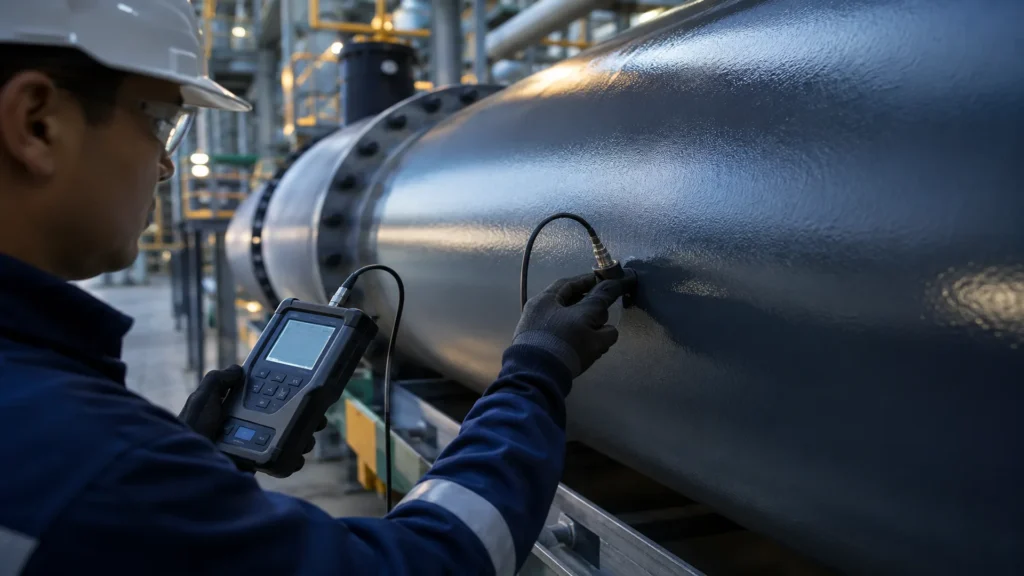
Non-visible functions introduce further complexities. Features such as inhibitor release, electrochemical sensing, or self-reporting are not always amenable to visual evaluation. While conventional defect-rating standards retain value, smart coatings increasingly necessitate instrument-based qualification methods in addition to visual inspection.
What New Standards Are Needed
The coatings industry now needs a dedicated smart-coating qualification framework. Several new categories of standards are particularly important.
First, a harmonized terminology and classification standard is required to clearly separate different smart-coating technologies and response mechanisms.
Second, standardized damage-generation protocols are needed for scratches, cracks, impact damage, abrasion scars, and fatigue-related defects.
Third, the industry urgently needs unified healing-efficiency standards defining baseline performance, controlled damage, healing conditions, recovery measurements and acceptance criteria.
Dedicated quality-control standards are also necessary for microcapsule systems, including capsule size distribution, shell integrity, spatial dispersion, retained active-agent content and compatibility with resin systems.
Trigger-response characterization standards should evaluate activation reliability under mechanical, thermal, chemical, pH, moisture, or electrochemical triggers.
In addition, multi-cycle durability standards are required to assess repeated activation, remaining functionality, and failure mechanisms after exhaustion of active components.
Finally, multifunctional coatings need integrated qualification matrices capable of balancing combined performance instead of evaluating isolated properties.
The primary challenge for smart multifunctional coatings is not the lack of testing methods, but rather the absence of a unified qualification philosophy.
ISO and ASTM standards already provide valuable tools for evaluating corrosion resistance, adhesion, humidity resistance, abrasion, impact behavior, electrochemical response, and environmental degradation. However, these standards were originally developed for passive protective coatings and do not yet form a complete certification system for intelligent multifunctional materials.
The largest gaps remain standardized healing-efficiency evaluation, realistic damage protocols, microcapsule-specific quality control, repeated activation qualification and multifunctionality assessment.
These limitations persist in hindering industrial adoption, diminishing interlaboratory reproducibility, and generating uncertainty throughout the commercialization process.
Currently, the qualification of smart coatings should involve both established coating standards and rigorously documented protocols for smart functions. In the future, the coatings industry will require dedicated international standards specifically developed for multifunctional and microcapsule-based smart coatings that exhibit active, responsive, and self-healing properties.
This article was developed by Arezoo Assarian from ERINCO and published as part of the eighth edition of Inspenet Brief magazine July 2026, dedicated to technical content of the energy and industrial sector.