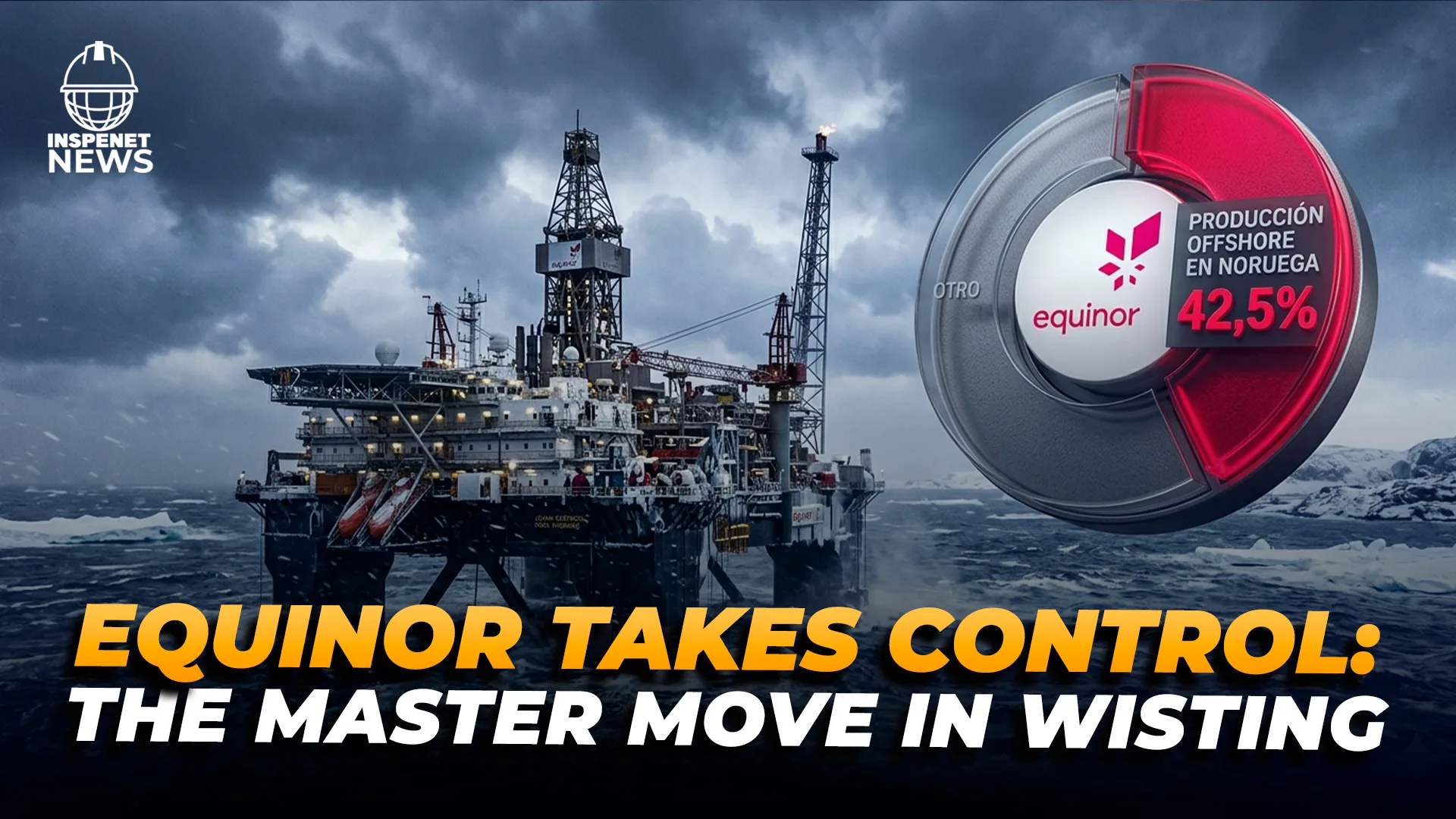
Equinor strengthens its offshore strategy with Aker BP in Norway
Equinor and Aker BP announced a strategic collaboration focused on accelerating oil and gas development on the Norwegian continental shelf. The agreement aims to increase future oil production and optimize offshore assets considered priorities for the country's energy industry.
Furthermore, both companies will advance operational alignment on undeveloped discoveries in the North Sea and other areas of the Norwegian Continental Shelf (NCS). This initiative aims to reduce project complexity and facilitate faster investment decisions.
Equinor reorganizes stakes in offshore projects
As part of the initial transactions, Equinor will transfer a 19% stake in several discoveries linked to the Ringvei Vest area to Aker BP. These include Grosbeak, Swisher, Toppand, and Røver Nord & Sør.
According to Kjetil Hove, executive vice president of Exploration & Production Norway at Equinor, the alignment of interests will accelerate developments and improve resource utilization in assets still pending commercial exploitation.
The companies are also exploring incorporating the Kveikje discovery into the Ringvei Vest development. This area is part of the Troll-Fram area of the North Sea and is considered one of Norway's most important offshore prospects for future production.
Wisting gains importance within Equinor's strategy
Furthermore, Equinor will increase its stake in Wisting from 35% to 42.5%. The asset is recognized as the largest undeveloped discovery on the Norwegian continental shelf.
The transaction strengthens the company's position in the Norwegian Arctic and consolidates its presence in long-term oil and gas projects . The move also reinforces the corporate strategy of securing new production volumes through 2035.
Frigg UK will promote cross-border developments
The agreement also includes the divestment of a 38.16% stake in the Frigg UK license to Aker BP. This move will allow both companies to jointly advance the development of the Omega Alfa discovery and the associated oil potential of the Frigg Field area.
Similarly, the companies will seek to coordinate technical assessments and future phases of exploitation in cross-border assets located between Norway and the United Kingdom.
Norwegian oil production seeks to sustain its growth
With this alliance, Equinor and Aker BP aim to maintain high levels of offshore production over the next decade. The strategy responds to the need to develop existing resources more rapidly in an increasingly competitive energy environment.
Equinor USD 23 million as part of the agreed consideration. The transactions will take effect on January 1, 2026, and remain subject to regulatory approvals.
News of additional interest
Google allocates $15 billion to Missouri
Google announced a $15 billion investment to build new technology infrastructure in Montgomery County, Missouri. The project, located in New Florence, is expected to create thousands of jobs during construction and hundreds of permanent positions once the data center is operational. The company also pledged to support job training programs and small businesses and communities in the area.
The company stated it will work with local organizations to train workers in technical and construction fields. Part of the plan includes educational programs for students and support for improving homes with energy-efficient systems. Google also confirmed a $20 million fund aimed at reducing electricity costs for Missouri households and strengthening the state's energy infrastructure without passing the extra burden on taxpayers.
Mining companies accelerate investments in Africa
Mining services companies are gaining prominence in Africa's industrial development and are now involved in areas beyond construction and technical support. During African Mining Week 2026 in Cape Town, discussions will focus on how these companies are helping to transform vast mineral reserves into projects ready for international investment. Africa holds resources valued at approximately $8.5 trillion, and several firms are seeking to accelerate their exploitation through infrastructure and financing.
Companies from countries such as China, Australia, Canada, and the United States are already involved in copper, iron, manganese, and platinum projects in various African regions. Companies like Metso Lycopodium and JCHX Mining Management are working in strategic mines in Namibia, Botswana, and Guinea, while African governments seek to increase exports and strengthen local industrial chains. This movement is also driven by global competition to secure essential minerals for technology, energy, and manufacturing.
Africa and Venezuela strengthen energy alliance
The African Energy Chamber and the African Petroleum Producers Organization advanced in new talks to strengthen energy cooperation on the continent. The meetings, held in Brazzaville, focused primarily on the development of the African Energy Bank, an initiative that seeks to finance oil and gas projects to accelerate investment and improve the energy capacity of several African countries.
Venezuela also participated in the meeting as an observer country of the APPO. The discussions focused on expanding technical collaboration between the two regions through training programs, knowledge sharing, and support for energy infrastructure development. Venezuela offered to share its expertise in hydrocarbon exploration and production, while Africa seeks to better utilize its natural resources and increase its industrial capacity.
MiQ creates digital registry for oil and gas
MiQ has launched a new digital system for registering methane emission certificates in the energy industry. The platform will, for the first time, allow the inclusion of certificates linked to crude oil production in addition to natural gas. The goal is to improve emissions tracking and help companies and governments prepare for new environmental regulations to be implemented by the European Union.
The registry functions as a secure database where certificates of emissions verified by independent third parties are stored. The tool aims to prevent fraud such as double-counting certificates and facilitate lower-emission operations in the oil and gas market. MiQ stated that it already certifies more than 7% of the world's gas supply and expects to expand the system to international oil and liquefied natural gas projects.