
Table of Contents
- How corrosion mapping reduces risk
- How ECA improves detection and reduces risk
- When to use eddy current array in inspection
- How corrosion mapping reduces cost and time
- Applications of corrosion mapping
- How Eddyfi Technologies reduces risk, cost, and time
- Applicable standards for corrosion mapping
- Technical feasibility and selection criteria
- Conclusions
- References
- Frequently asked questions (FAQs)
Corrosion mapping with eddy current array allows operators to reduce inspection uncertainty by replacing subjective assessments with traceable, high-resolution data. in environments where traditional non-destructive testing methods cause delays, this technology improves defect detection and accelerates decision-making.
By strengthening asset integrity through faster surface inspection, operators can reduce risks, minimize downtime, and optimize operational costs.
How corrosion mapping reduces risk
Limitations of conventional NDT
Many inspection programs still rely on conventional methods that are heavily influenced by operator experience, access conditions, and variability in interpretation. This creates a recurring problem: the data exists, but it does not always have the accuracy or repeatability needed to support critical integrity decisions.
In practice, this limitation goes beyond technical confidence. When results are inconsistent, it leads to delays in maintenance decisions, rework in the field, and greater uncertainty about the asset’s actual condition. In high-consequence industries, that uncertainty translates directly into operational risk.
For an operator, the point is not just to perform the inspection, but to ensure that the result is reliable enough to prevent failures, justify a shutdown, or postpone an unnecessary intervention
How ECA improves detection and reduces risk
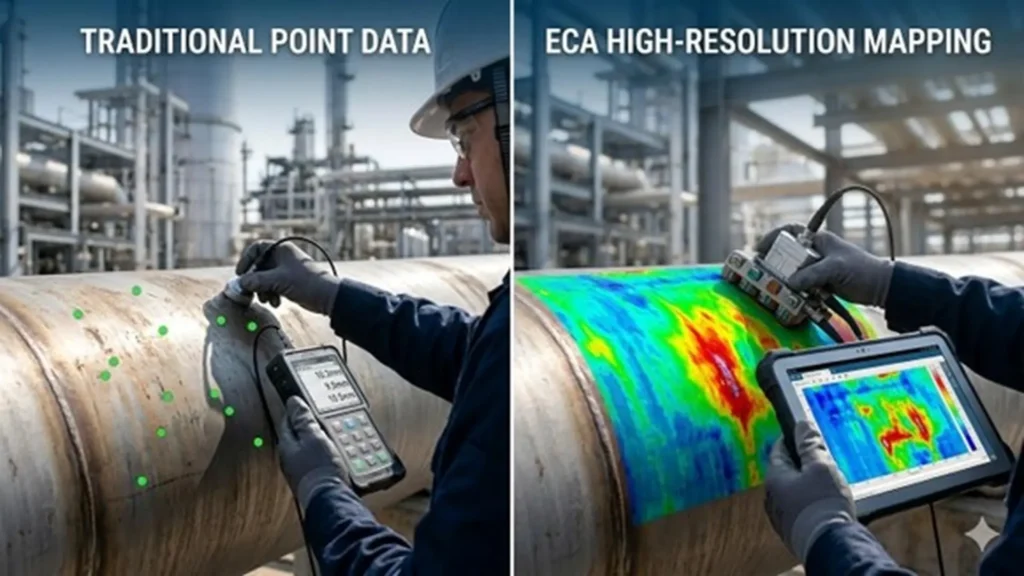
The Eddy Current array Technology improves inspection reliability through the use of multiple coils arranged in a matrix, enabling broader coverage and more consistent signal acquisition than many conventional methods.
In the context presented by eddyfi technologies, the value is not limited to technical sensitivity. the real advantage lies in data stability, improved signal interpretation, and the creation of a stronger foundation for integrity decision-making.
This is critical because operators do not acquire inspection technologies for their own sake. they invest in solutions that reduce the likelihood of missing critical indications and minimize the risk of unexpected events during operation.
Inspection based on reliable data
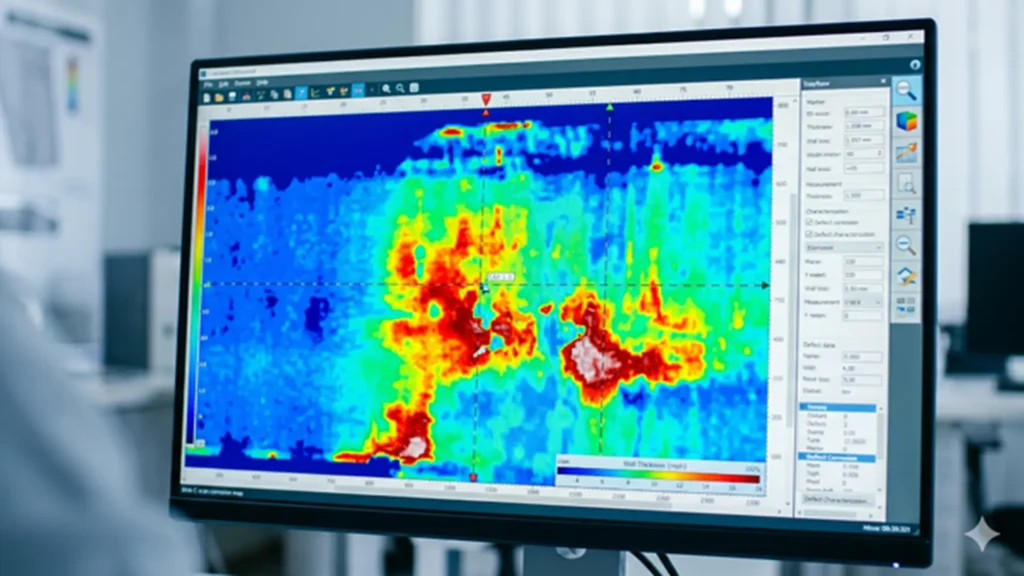
The greatest value of corrosion mapping lies in its ability to turn inspection into verifiable evidence. when signals are digitally recorded and linked to precise locations, the result is no longer an isolated report but a reliable input for integrity management.
this becomes especially relevant when multiple areas—maintenance, integrity, and operations—must align to make decisions about service continuity, repair, or monitoring.
A digital, repeatable record reduces disagreements, improves internal communication, and speeds up the decision-making process. For the operator, this means less uncertainty and greater control over critical assets, as shown in the image below.
Impact on asset integrity
Corrosion mapping strengthens integrity programs by providing structured data that can be analyzed over time.
Today, integrity management depends less on isolated inspections and more on the quality of available data. in this context, corrosion mapping evolves from a one-time activity into a continuous degradation analysis tool.
By enabling comparison of historical data, identification of trends, and evaluation of damage evolution, ECA supports more structured management. this allows operators to decide where to intervene, where to monitor, and where to defer actions without increasing risk.
The result is more precise planning, reduced reactivity, and more efficient use of budget.
Corrosion mapping in asset integrity
Corrosion mapping strengthens asset integrity programs by providing structured data that can be analyzed over time.
Today, integrity management depends less on isolated inspections and more on the quality of available data. in this context, corrosion mapping evolves from a one-time activity into a continuous degradation analysis tool.
By enabling comparison of historical data, identification of trends, and evaluation of damage evolution, ECA supports more structured management. this allows operators to decide where to intervene, where to monitor, and where to defer actions without increasing risk.
The result is more precise planning, reduced reactivity, and more efficient use of budget.
Reduction of unplanned downtime
Unplanned shutdowns are often the result of insufficient inspection visibility. when data quality is questionable, operators tend to act conservatively.
This means stopping equipment, expanding inspections, or performing unnecessary repairs.
With better data visualization and clearer information, ECA allows more accurate differentiation between what requires immediate intervention and what can remain in service.
Operationally, this reduces unnecessary interruptions and improves shutdown planning, directly lowering production impact.
Traceability as an operational advantage
Traceability is not just a technical requirement. for operators, it is an operational safeguard.
Digitized data enables decision justification, audit support, and improved long-term integrity planning.
Instead of relying solely on descriptive observations, teams can visualize, compare, and validate damage evolution. this improves communication across departments and reduces friction in decisions affecting cost, safety, and production.
When to use eddy current array in inspection
Use cases in industrial inspection
Operators should consider eddy current array when their inspection programs require speed, repeatability, and reliable detection of near-surface damage. this is especially relevant when assets are numerous, access windows are limited, or inspection uncertainty directly impacts production decisions.
Typical situations include:
- Evaluation of corrosion in pipelines and piping systems.
- Inspection of tanks and pressure-containing assets.
- Areas affected by external corrosion mechanisms.
- Programs requiring solid evidence for audits.
In these cases, the operator is not simply choosing another inspection method, but a faster path to a defensible maintenance decision.
Hidden costs of traditional inspection
Conventional ndt methods can still be useful, but become costly when multiple inspections are needed to validate results, when defect visualization is limited, or when field execution takes too long. direct cost is not just labor—it also includes repeated mobilizations, maintenance planning delays, and unnecessary production exposure.
This is where corrosion mapping offers a different value proposition. the benefit is not just detecting defects, but reducing uncertainty that often generates hidden costs throughout the inspection and maintenance workflow.
For operators with tight budgets and critical assets, reducing uncertainty is often more valuable than marginally reducing inspection scope.
How corrosion mapping reduces cost and time
Speed in industrial inspection
Corrosion mapping accelerates industrial inspection processes by reducing scanning time and improving coverage.
One of the clearest operational advantages of eddy current array is inspection speed. the ability to scan larger areas efficiently reduces field time, directly impacting man-hours, access coordination, and schedule pressure.
For operators, speed matters because inspection is rarely an isolated activity. it is usually linked to permits, scaffolding, shutdown windows, contractor coordination, and production planning. when inspection takes less time, the entire intervention becomes more manageable.
This is how faster execution translates into lower cost and reduced operational disruption.
Better data: Elimination of rework
Repeated inspections are one of the most underestimated cost drivers in integrity programs. when results are inconclusive, teams must return to the field, expand scope, or use secondary methods to confirm what should have been clear from the start.
By improving data consistency and inspection clarity, corrosion mapping helps reduce this rework cycle. fewer re-inspections mean lower cost, better resource allocation, and less interference with operations.
For operators, this is one of the most practical reasons to invest in better inspection technology: getting the job done once, with enough confidence to act.
Data for operational decisions
Corrosion mapping enables the transformation of inspection data into actionable information for operational decision-making.
Operators rarely measure inspection success solely by technical execution. they measure it by whether it prevented a shutdown, improved a maintenance decision, or reduced cost exposure. that is why asset integrity data matters more than the inspection activity itself.
when surface inspection is linked to clear digital outputs and faster interpretation, the result is a more actionable inspection process. this supports decisions on repair, operational continuity, monitoring frequency, and budget prioritization.
From a business perspective, inspection becomes part of operational optimization rather than an isolated compliance task.
Applications of corrosion mapping
Pipeline inspection and corrosion monitoring
For pipeline operators, corrosion mapping improves visibility in areas where degradation must be assessed quickly and decisions made without unnecessarily slowing operations. better data quality supports more targeted interventions and reduces the risk of overlooking active damage.
The business impact is direct: fewer unnecessary shutdowns, better repair prioritization, and stronger justification for integrity-related decisions.
Inspection in tanks and critical assets
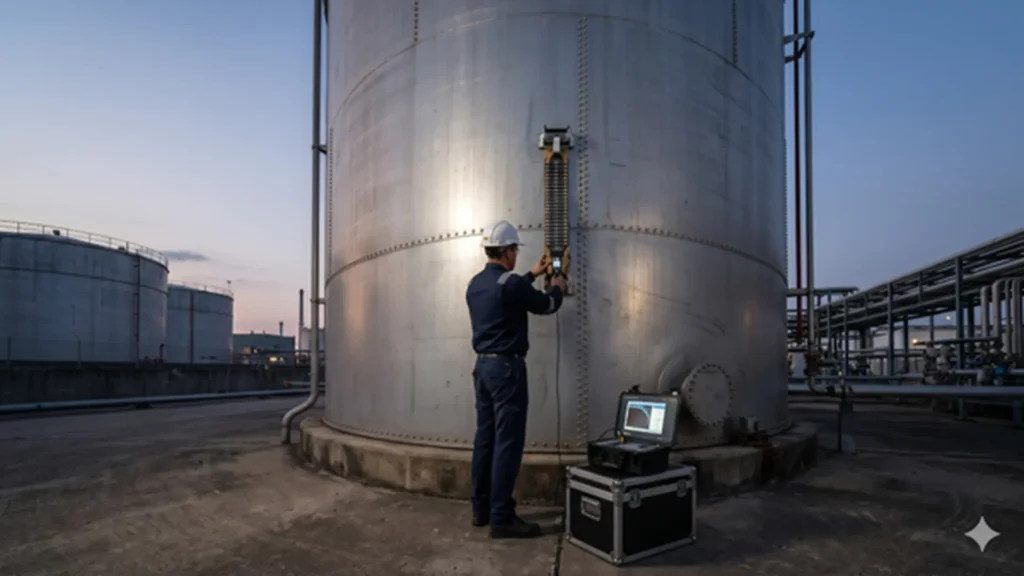
In tanks and other critical assets, inspection decisions often affect maintenance cost, shutdown planning, and risk exposure simultaneously. using eddy current array in these environments supports faster assessments and more reliable characterization of surface damage.
This provides operators with a stronger technical basis to determine whether an asset requires immediate action or can remain in service under controlled conditions. the business benefit is not only reduced inspection time, but better decision quality under pressure.
Industries where downtime is critical
In critical industries, corrosion mapping reduces uncertainty and prevents decisions that negatively impact production. in sectors such as oil and gas, petrochemicals, and power generation, downtime and uncertainty are costly. inspection tools that improve speed and confidence create value because they support continuity as much as defect detection.
NDT methods should be evaluated not only for technical capability, but also for their operational impact. if a method improves inspection quality while reducing production disruption, it becomes far more relevant for operators.
How Eddyfi Technologies reduces risk, cost, and time
ECA solutions for fast decisions
The adoption of eddy current array solutions responds to a clear operator need: reduce risk without increasing operational costs or inspection time.
Unlike conventional methods, eddyfi systems generate reliable data from the first inspection, avoiding rework, reducing unnecessary shutdowns, and improving decision speed.
For operators, this translates directly into:
- Lower exposure to critical failures.
- Reduced reinspection costs.
- Optimized intervention times.
This approach turns inspection into an operational control tool rather than just a technical activity.
Operational decisions with corrosion mapping
A recurring challenge in integrity management is that inspection results do not always translate easily into action. data may exist, but not in a form that supports timely business decisions. by generating mapped outputs that are easier to interpret and compare, corrosion mapping helps close this gap.
This enables integrity managers to communicate more clearly with operations teams and justify intervention priorities with stronger evidence. the result is not only technical clarity, but organizational efficiency.
This is a value proposition operators understand: a system that reduces ambiguity across functions saves time and protects budgets.
Reduction of risk, cost, and time
Corrosion mapping with advanced technologies directly addresses critical operational variables.
Most operators are not looking for a solution that improves just one variable. they need a method that reduces risk, lowers cost pressure, and shortens inspection time without compromising confidence. this is the strongest commercial position of eddy current array.
Its value can be summarized in three business drivers:
- Risk: greater confidence in detection and improved traceability.
- Cost: fewer re-inspections and better maintenance targeting.
- Time: faster execution and reduced operational disruption.
The following interview shows how Eddyfi solutions apply corrosion mapping in real industrial scenarios, enabling operators to reduce risk, cost, and inspection time.

This combination is what makes the solution commercially relevant, not just technically attractive.
Applicable standards for corrosion mapping
The use of advanced techniques such as corrosion mapping with eddy current array is supported by international standards that ensure result reliability and applicability in asset integrity programs.
These standards define criteria for ndt execution, defect evaluation, and in-service decision-making, ensuring that the data obtained is technically valid and auditable.
The use of corrosion mapping technologies such as eddy current array is supported by international standards that guarantee result reliability and application in asset integrity programs.
Table 1. Main applicable standards
| Standard | Description | Application |
|---|---|---|
| ASME BPVC Section V | Code establishing requirements for applying ndt methods in pressure equipment | Inspection and evaluation of pressure vessels, piping, and industrial equipment |
| API 579-1/ASME FFS-1 | Fitness-for-service standard to determine equipment suitability for continued operation | Analysis of defects detected through corrosion mapping for in-service integrity decisions |
| ISO 9712 | International standard for certification and qualification of ndt personnel | Ensures competency of personnel performing eddy current array inspections |
The application of corrosion mapping under these standards allows operators to validate inspection strategies, reduce technical uncertainty, and support critical decisions based on internationally recognized codes.
Technical feasibility and selection criteria
When to use ECA in inspection
Like any advanced inspection method, eddy current array must be selected based on asset condition, material properties, geometry, and inspection objectives. proper technical alignment is essential if the operator wants to capture the expected value.
Selection criteria should include:
- Material conductivity.
- Access conditions.
- Expected damage mechanism.
- Inspection speed requirements.
- Need for traceable digital outputs.
when these factors align, ECA can deliver benefits far beyond the inspection task itself.
Technology selection for business outcomes
For operators, choosing an inspection technology should not be treated as an isolated technical exercise. it must support broader business objectives such as production continuity, budget efficiency, and integrity risk reduction.
That is why corrosion mapping should be evaluated not only against alternative methods, but also against the operational and financial consequences of delayed or uncertain decisions.
The right technology is the one that improves decision quality, not just scan quality.
Conclusions
Corrosion mapping with eddy current array offers operators much more than improved surface inspection. it provides a stronger foundation for managing asset integrity with better traceability, faster execution, and clearer evidence for maintenance decisions. in environments where inspection delays, rework, and data uncertainty can increase both risk and cost, this has a direct business impact.
Corrosion mapping is positioned as a key tool to improve reliability, reduce costs, and optimize asset management.
For operators, the real value is clear: a better way to reduce inspection-related uncertainty, protect operational continuity, and improve how integrity decisions are made. this is what makes advanced non-destructive testing commercially relevant in today’s industrial operations.
Evaluating advanced solutions such as eddy current array can help operators strengthen asset integrity, improve the reliability of surface inspection, and turn corrosion mapping into a practical tool for better operational and financial decision-making.
To learn more about real-world applications of corrosion mapping, review advanced inspection solutions available in the industry.
References
- American Petroleum Institute. API 579-1/ASME FFS-1: Fitness-for-service. API Publishing Services.
- AmericaMapa 2D de corrosión con datos trazables en software industrial.n Society for Nondestructive Testing. Nondestructive testing handbook: Electromagnetic testing (3rd ed.). ASNT.
- ASTM International. ASTM E1004-17: Standard practice for electromagnetic (eddy current) examination of metallic tubing products. ASTM International.
- ASME. Boiler and pressure vessel code, Section V: Nondestructive examination. American Society of Mechanical Engineers.
- Eddyfi Technologies. Advances in eddy current array for corrosion mapping and asset integrity. https://www.eddyfi.com
- International Organization for Standardization. ISO 9712: Non-destructive testing — Qualification and certification of NDT personnel. ISO.
- Inspenet. (2025). NDT advances with eddy current array (Video). https://inspenet.com/en/inspenet-tv/ntd-advances-with-eddy-current-array/
- Mix, P. E. Introduction to nondestructive testing: A training guide. John Wiley & Sons.
- Schmidt, T. R., & Lord, W. Eddy current testing: Theory and applications. ASM International.
Frequently asked questions (FAQs)
What is corrosion mapping?
Corrosion mapping is an advanced inspection technique that allows identification, visualization, and evaluation of corrosion damage distribution in industrial assets using digital, traceable data.
When should corrosion mapping with ECA be used?
Corrosion mapping with eddy current array is recommended when high precision in surface inspection and rapid detection of near-surface defects are required.
What are the advantages of corrosion mapping?
Corrosion mapping offers higher inspection speed, better data traceability, and reduced rework compared to traditional ndt methods.
Does corrosion mapping reduce costs?
Yes, corrosion mapping reduces costs by minimizing re-inspections, avoiding unnecessary shutdowns, and optimizing maintenance planning.
Where is corrosion mapping used?
Corrosion mapping is used in oil & gas, petrochemical, power generation, and industrial infrastructure sectors where asset integrity is critical.