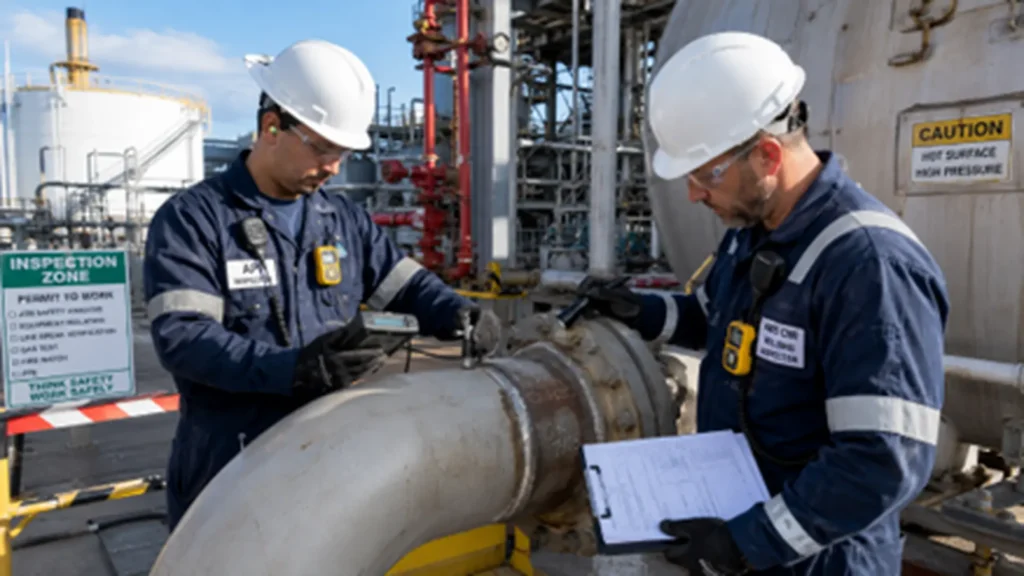
An industrial failure rarely begins with an explosion, a leak, or an unplanned shutdown; it often starts with an unevaluated discontinuity, a poorly controlled repair, a weld released without sufficient evidence, or an inspection lacking code-based criteria. Under these conditions, certified API and AWS inspectors transform technical data into decisions that protect assets, personnel, and operational continuity.
Their role in industrial safety consists of verifying mechanical integrity, weld quality, non-destructive testing, repairs, document traceability, and compliance with applicable codes. Every acceptance, rejection, repair, or return-to-service decision determines whether equipment operates within safe margins or whether a technical deviation evolves into an incident.
In industries where industrial safety, regulatory compliance, and operational continuity are critical priorities, certified inspection gains strategic value. It converts codes, field evidence, and acceptance criteria into preventive actions capable of controlling failures before they reach major consequences.
API and AWS inspectors in industrial safety
API and AWS inspectors operate on two complementary fronts of industrial inspection. API, from the American Petroleum Institute, is associated with process equipment, mechanical integrity, and in-service assets. AWS, from the American Welding Society, focuses on welding, critical joints, procedures, and acceptance criteria.
The difference is both technical and operational. The API inspector evaluates whether a vessel, piping system, or storage tank maintains acceptable conditions for operation. The AWS CWI inspector, Certified Welding Inspector, verifies whether a weld complies with the applicable code, drawing, specification, and procedure. The integration of both criteria reduces the probability of releasing work without sufficient evidence.
In industrial safety, this coordination has direct impact: a defective weld can initiate loss of containment in a pressure vessel; a critical pipeline with misalignment or inadequate support can fail due to vibration or fatigue; and a tank released with incomplete evaluation may generate leakage, exposure to flammable vapors, or environmental impact.
Technical scope and preventive functions
API and AWS inspectors act toward a common objective: preventing a technical deviation from evolving into an operational failure. Their work consists of interpreting actual conditions of equipment, welds, repairs, and inspections to determine whether a facility can continue operating safely.
API recognizes its certified inspectors as professionals with knowledge of codes, standards, and accepted inspection practices. API 510, API 570, and API 653 certifications are also ANSI-accredited by the American National Standards Institute, reinforcing their value as structured technical credentials for high-risk assets.
API inspector: Safety of in service assets
An API inspector is a certified professional qualified to evaluate in-service assets, mainly pressure vessels, piping systems, storage tanks, and associated components. Their competence includes inspection, repair, alteration, damage mechanisms, inspection intervals, remaining life, and operational continuity.
In the field, their preventive contribution consists of anticipating failure scenarios. They identify wall thickness loss, localized corrosion, deformations, settlements, distortions, relevant indications, and service conditions that may compromise pressure, containment, stability, or structural resistance. Based on this evaluation, they may recommend monitoring, repair, engineering assessment, interval adjustment, reclassification, or temporary removal from service.
In API 510, their value is concentrated on equipment containing pressure, temperature, and fluids with potential for damage. An out-of-control pressure vessel can suddenly release energy, project fragments, expose personnel to hazardous substances, or create fire and explosion scenarios. Therefore, certified inspection interprets damage mechanisms, operational history, repairs, and alterations that may compromise safe containment.
The most common certifications are API 510 for pressure vessels, API 570 for in-service metallic piping, API 653 for aboveground storage tanks, and API 580 for Risk-Based Inspection (RBI). This framework transforms inspection into a tool for prevention, prioritization, and consequence control.
AWS CWI inspector: Critical welding control
An AWS CWI inspector is a professional certified by the American Welding Society to verify that welds comply with code requirements, drawings, specifications, approved procedures, and acceptance criteria. Their field of action begins before striking the arc.
They review the Welding Procedure Specification (WPS), Procedure Qualification Record (PQR), and Welder Performance Qualification (WPQ). They also verify base materials, consumables, joint preparation, alignment, cleanliness, preheating, interpass temperature, pass sequence, visual inspection, and documentation.
Their contribution to industrial safety is direct: preventing nonconforming welds from being installed in assets subjected to pressure, temperature, vibration, cyclic loading, hazardous fluids, or corrosive environments. Lack of fusion, cracks, undercut, significant porosity, or poorly evaluated linear indications can become initiation points for leakage, rupture, or loss of containment.
API and AWS comparison in plant operations
| Aspect | API Inspector | AWS CWI Inspector |
|---|---|---|
| Focus | In-service asset | Welding and joints |
| Main Risk | Degradation and loss of containment | Nonconforming welds |
| Technical Decision | Continue, repair, monitor, or remove | Accept, reject, or repair |
| Key Evidence | History, thickness readings, NDT, RBI | WPS, PQR, WPQ, visual inspection |
| Preventive Contribution | Anticipates service-related failures | Prevents release of defective joints |
During a plant shutdown, this coordination is decisive. The API inspector defines scope, equipment condition, and repair requirements; the AWS CWI controls welding execution; Non-Destructive Testing (NDT) personnel generate technical evidence; engineering validates acceptance; and operations authorize return to service. When this technical chain functions correctly, accident prevention becomes a traceable system.
Certification API and AWS: Preventive Value
In industries where industrial safety and regulatory compliance are central operational criteria, inspector certification gains value beyond the credential itself. It represents a technical basis for making verifiable decisions regarding equipment, welds, repairs, and return-to-service conditions.
API certification and AWS certification validate technical knowledge for decision-making under recognized codes, acceptance criteria, written procedures, and documented responsibilities. They also standardize the language of inspection: what is accepted, what is rejected, what is monitored, what is repaired, and which conditions require escalation to engineering evaluation.
Knowledge validated by codes
Certified knowledge allows inspectors to interpret what a finding means within the real service conditions of the asset. An ultrasonic indication, wall thickness loss, surface discontinuity, or welded repair is evaluated according to location, orientation, geometry, severity, damage mechanism, applicable code, and operational consequence.
In industrial safety, this capability prevents two dangerous extremes: accepting an unsafe condition or rejecting a technically acceptable condition without justification. Effective industrial inspection is based on evidence, standards, engineering judgment, and traceability.
Technical criteria and traceability
Traceability transforms findings into useful evidence. Therefore, inspectors must document equipment, location, method, scope, results, acceptance criteria, limitations, and technical recommendations. In industrial safety, a report justifies whether a condition can be accepted, whether a repair must be repeated, or whether an asset should remain out of service.
Asset integrity and operational safety
Mechanical integrity must be understood as a discipline serving industrial safety. It includes design, fabrication, operation, inspection, maintenance, repair, management of change, testing, and document verification. Its practical objective is preventing loss of containment, structural collapse, fire, explosion, personnel exposure, or environmental impact.
API and AWS inspectors contribute from different perspectives. API interprets the condition of in-service assets. AWS verifies the quality of welds used to construct, modify, or restore those assets. Integrating both criteria reduces technical uncertainty and improves operational reliability.
Equipment, piping, and storage tanks
In pressure vessels, API inspectors review thickness readings, corrosion, nozzles, supports, welds, repairs, relief devices, and pressure-temperature history. A repaired weld without proper evaluation may lose containment during operation, release hazardous fluids, and trigger fire, toxicity, or localized overpressure scenarios.
In piping systems, inspectors evaluate circuits, monitoring points, corrosion under insulation, erosion-corrosion, vibration, supports, and service changes. A critical line with welded joint misalignment, displaced supports, or poorly absorbed thermal expansion may concentrate stresses, generate fatigue, and fail during service.
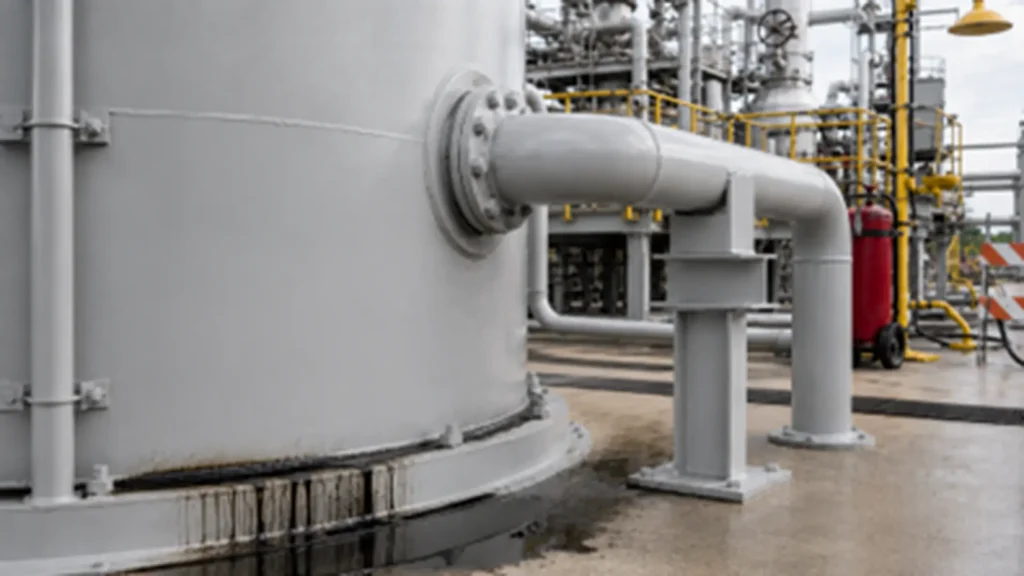
In storage tanks, the inspection scope includes bottom plates, shell, roof, nozzles, settlements, welds, distortions, and internal or external corrosion. A tank returned to service after maintenance with deficient evaluation of the bottom, shell-to-bottom weld, or settlement may generate leakage, soil contamination, exposure to flammable vapors, and inventory losses.
Welding, repairs, and NDT
Every welded repair on a critical asset must be understood as an intervention affecting system safety. In pressure equipment, piping, and tanks, such intervention may directly impact containment capability, structural resistance, or service reliability.
Therefore, qualified procedures, qualified welders, correct materials, adequate preparation, thermal control, visual inspection, and NDT must be applied when required. Methods such as conventional ultrasonics, Phased Array Ultrasonic Testing (PAUT), Time of Flight Diffraction (TOFD), digital radiography, magnetic particle testing, liquid penetrant testing, thickness measurement, and Positive Material Identification (PMI) strengthen technical evidence.
The quality of NDT data depends on verifiable competence. ANSI/ASNT CP-189 establishes requirements for employer-based certification of NDT personnel, including Levels I, II, and III, examinations, vision requirements, and image interpretation.
Accident prevention and inspection
Accident prevention improves when industrial inspection detects degradation before it leads to loss of containment, structural collapse, fire, explosion, injury, or environmental damage. The most valuable outcome of a certified inspector may be a leak that never occurred, a shutdown planned on time, or a defective weld that never entered service.
In pressurized equipment, an early signal may appear minor: a stain near a weld, localized corrosion, a linear indication, localized wall loss, or evidence of an incipient leak. For a certified inspector, that signal represents a potential failure path. Their role is relating it to pressure, temperature, fluid, damage mechanism, and consequence before the asset loses its safety margin.
API/AWS inspection in high-risk industries is associated with compliance, shutdown support, welding control, positive material identification, NDT, and integrity management. Its value increases when each finding is connected to a consequence: energy release, personnel exposure, environmental impact, damage to adjacent equipment, or operational interruption.
Detection before failure
Early detection requires understanding damage mechanisms. Inspectors must differentiate uniform wall loss, pitting, corrosion under insulation, cracking, fatigue, laminations, lack of fusion, undercut, porosity, or linear indications.
Each finding must answer an operational question: can the equipment continue in service? Does it require immediate repair? Should it be monitored? Does it require engineering evaluation? Does it demand procedure changes or root cause investigation? This ability to translate condition into risk is one of the most valuable competencies of a certified inspector.
RAGAGEP, PSM, and safe decisions
The Occupational Safety and Health Administration (OSHA), within Process Safety Management (PSM), requires inspections and testing of equipment to be performed according to Recognized and Generally Accepted Good Engineering Practices (RAGAGEP). These practices include codes, standards, manufacturer specifications, and technical criteria accepted by industry.
This directly connects certified inspection with industrial safety. Inspectors are part of a decision-making chain that may activate maintenance, repair, shutdown, management of change, risk review, redesign, or operational restrictions.
Competencies that reduce risk
Competencies that reduce risk include communication, ethics, experience, code interpretation, document control, critical thinking, and independence to stop activities when technical conditions threaten safety.
A competent inspector translates data into risk: loss of containment, progressive damage, weld failure, reduced remaining life, code deviation, or unacceptable condition. This analytical capability transforms industrial inspection into a prevention tool.
Training, recertification, and NDT quality
Continuous training is essential because codes evolve, technologies advance, and damage mechanisms vary according to service conditions. API, AWS, ASME, and ASNT require ongoing technical updates, especially when acceptance of repairs, welds, or equipment depends on evidence generated through NDT.
The competence of personnel performing and interpreting these examinations directly impacts industrial safety. Lavender International contributes value through specialized technical training in NDT, competency development, and programs focused on strengthening inspection quality. Their experience helps inspectors and technicians generate reliable data to evaluate assets, validate repairs, and support operational continuity decisions.
When inspection data is correct, traceable, and generated by competent personnel, decisions regarding mechanical integrity, welding, and accident prevention gain greater reliability. Poorly calibrated ultrasonic testing, misinterpreted radiography, or visual inspection without adequate access can lead to incorrect conclusions.
Conclusions
API and AWS inspectors perform a decisive role in industrial safety because they transform codes, field findings, and technical evidence into preventive decisions. Their contribution consists of interpreting whether wall thickness loss, welding discontinuities, repairs, or NDT results may compromise the mechanical integrity, operational continuity, or safe containment of an asset.
API certification strengthens the evaluation of in-service equipment, while AWS certification ensures technical control of critical welded joints. Integrated into industrial inspection programs, RBI, PSM, quality control, and maintenance management, these professionals help prioritize risks, validate repairs, prevent releases without sufficient evidence, and reduce the probability of accidents. Their greatest value lies in anticipating when a technical deviation may evolve into a major event.
Frequently Asked Questions About API and AWS
What does an API inspector do?
They evaluate in-service equipment such as vessels, piping systems, and tanks to determine whether they can continue operating, require repair, monitoring, reclassification, or engineering evaluation under applicable API codes.
What does an AWS CWI inspector contribute?
They verify that welds comply with procedures, codes, drawings, and acceptance criteria, preventing nonconforming joints from being released into assets subjected to pressure, vibration, or corrosive environments.
How do API and AWS complement each other?
API evaluates the integrity of operating assets, while AWS controls the quality of the welds used to fabricate, repair, or modify those assets. Together they strengthen failure prevention.
Why do they prevent failures?
Because they apply technical criteria before a deviation evolves into leakage, rupture, fire, unplanned shutdown, or accident.