PROTEGO® analyzes safety in LNG venting systems
The growth of cryogenic storage, LNG applications, and new projects linked to hydrogen and decarbonization are raising the bar for the industrial storage industry. In this scenario, operators must ensure operational safety, pressure stability, and long-term reliability in facilities operating under complex conditions and potentially hazardous environments.
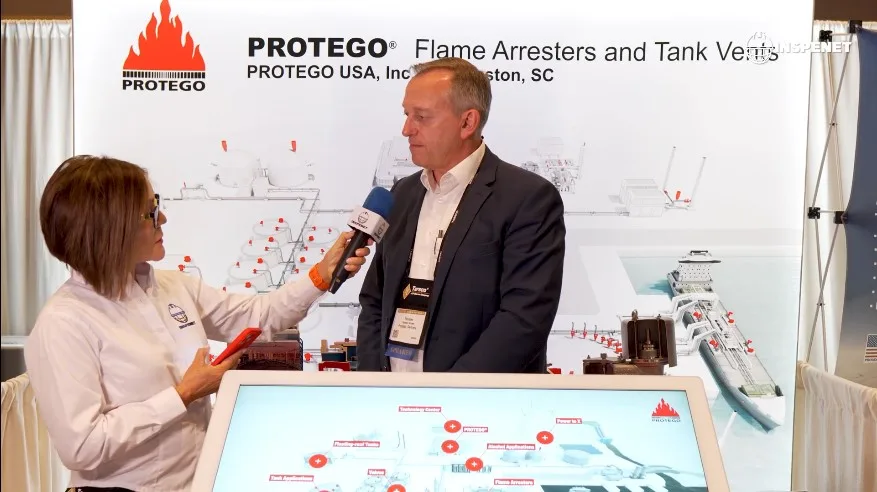
During NISTM 2026, Thorsten Schaper, PROTEGO's Business Development Manager, addressed several of the challenges currently facing the sector. The executive explained how applied engineering and the maintenance of venting systems have become decisive factors for the protection of critical industrial assets.
PROTEGO®, a German company founded in 1954, develops flame arresters, valves, and tank accessories for the chemical, petrochemical, pharmaceutical, and energy industries. The company has international operations and research centers focused on the development and validation of industrial safety devices.
Industrial safety as the basis of operation
Since its inception, PROTEGO® has built its activity around the protection of industrial facilities exposed to flammable atmospheres and hazardous environments. For Schaper, this vision remains the core of the company.
The executive explained that venting systems and flame arresters are constantly exposed to aggressive conditions, pressure variations, and potentially explosive media. Therefore, factors such as material selection, operational resistance, and maintenance play a central role in equipment performance.
Furthermore, he noted that these components are often perceived as standard elements within a facility. However, their impact on operations is much greater than typically considered.
A tank vent is very often understood as a commodity item. In many cases, it is a very special element that generates performance and guarantees the safe operation of a tank.
Schaper commented.
This approach is particularly important in applications related to LNG, chemical storage, and cryogenic tanks, where small design or maintenance errors can affect the entire system's operation.
The most frequent errors in venting systems
One of the most relevant points addressed by Schaper was related to the most common causes of failures and poor performance in tank venting systems.
As he explained, many operational problems are associated with a lack of technical information and unfamiliarity with the comprehensive behavior of the ventilation system. In some cases, operators do not consider critical variables such as venting capacity, environmental conditions, or the interaction between different safety devices.
The executive emphasized that the correct interpretation of technical standards is crucial to avoid such situations. In this regard, PROTEGO® actively participates in meetings and working groups related to American Petroleum Institute (API) standards, where field experiences and regulatory updates for industrial applications are reviewed.
Likewise, Schaper noted that there are special applications that are not always fully covered by conventional standards. In these cases, customized engineering and direct collaboration with the manufacturer become fundamental.
To support operators, the company also developed PROTEGO® QuEST, a digital tool for calculating and sizing venting systems. The objective is to facilitate technical evaluations and help users select appropriate configurations based on operating conditions.
The need for more precise solutions has increased with the growth of LNG facilities, industrial gas storage, and projects related to energy transition.
LNG and cryogenic storage increase technical complexity
The advancement of maritime decarbonization and the growth of new energy infrastructures are generating increased demand for cryogenic storage systems and low-pressure solutions.
For Schaper, this scenario requires a much deeper understanding of the complete behavior of the venting system.
The executive explained that cryogenic applications require pressure stability, reliable sealing, and constant operation even under extreme environmental conditions. Some facilities operate in Arctic regions, while others operate in deserts with high temperatures and severe conditions for valves and metallic components.
Consequently, the design cannot be limited solely to the individual device. It must also consider operational factors, available maintenance, access to technical support, and intervention capability throughout the tank's lifecycle.
Whatever is sized must consider the entire venting system and also the conditions where the customer operates.
Schaper stated.
The executive also mentioned that many industrial facilities are located in remote areas where there is limited availability of specialized workshops or local technical services. This necessitates the development of robust devices that are easy to maintain for decades of operation.
In LNG and cryogenic storage applications, long-term reliability represents one of the most critical factors. A venting system must maintain operational stability and consistent performance even after years of continuous service.
Applied engineering for extreme conditions
Part of PROTEGO®'s differentiation is based precisely on its research capabilities and technical testing. The company has specialized facilities in Germany where it conducts explosion tests and flow tests to validate the behavior of its devices under different operating scenarios.
Schaper particularly highlighted the company's explosion test center and flow test bench, considered among PROTEGO®'s most important technical assets.
These resources allow for the evaluation of the performance, resistance, and behavior of flame arresters and venting systems before their field implementation.
In addition to technical validation, the company works on developing solutions aimed at facilitating maintenance and inspection. According to the executive, equipment lifespan and ease of service are increasingly valued aspects by industrial operators.
The need to maintain safe operation for extended periods requires designing devices capable of sustaining stable performance for decades.
Schaper used LNG facilities and ammonia storage tanks as examples, where operators need to ensure that devices will maintain the same level of performance after 20 or 25 years of continuous operation.
This approach is particularly relevant in a context where the energy industry faces increasing regulatory, environmental, and operational demands.
Venting systems are no longer secondary components
As demands on industrial facilities increase, venting systems are ceasing to be considered secondary accessories and are becoming strategic components within operational safety.
The expansion of LNG, hydrogen, and cryogenic storage is forcing operators and engineering firms to review design criteria, maintenance, and technological selection for highly complex applications.
In this context, PROTEGO® is committed to combining research, technical expertise, and regulatory participation to respond to the industry's new challenges.
During NISTM 2026, Thorsten Schaper made it clear that the reliability of a venting system depends on both initial engineering and the maintenance carried out throughout the asset's lifespan. And in facilities where flammable substances or cryogenic gases are handled, that level of reliability can make the difference between stable operation and a large-scale operational risk.
For more content about NISTM 2026, visit our LinkedIn profile.
Source: Inspenet.