Table of Contents
The global energy transition is driving an accelerated expansion of infrastructure for carbon capture, utilization, and storage (CCUS). Within this context, CO₂ pipelines play a strategic role as large-scale transport systems capable of moving massive volumes of carbon dioxide from industrial sources to geological storage sites or enhanced oil recovery (EOR) applications. However, transporting CO₂ in a supercritical state introduces metallurgical, thermodynamic, and structural integrity challenges significantly different from those observed in conventional hydrocarbon pipelines.
Under supercritical conditions, carbon dioxide exhibits intermediate properties between a liquid and a gas, combining high density with low viscosity. This behavior improves hydraulic transport efficiency, but it also radically modifies decompression dynamics, crack propagation, and fracture behavior during failure events. In this operational environment, ductile fracture becomes one of the most critical failure mechanisms in CO₂ pipeline design.
Supercritical Fluid and CO₂ transport
A supercritical fluid (SCF) is a substance operating above its critical temperature and pressure, where the distinction between liquid and gaseous phases disappears. In the case of CO₂, the critical point occurs at approximately 31.1 °C and 7.38 MPa. Above these conditions, carbon dioxide acquires high density and elevated volumetric transport capacity, characteristics essential for large-scale CO₂ transport projects.
The use of supercritical CO₂ reduces compression requirements, minimizes pressure losses, and optimizes transport capacity per unit diameter. However, this thermodynamic regime also generates complex rapid expansion phenomena during leak or rupture events, producing severe cooling associated with the Joule-Thomson effect and multiphase changes that directly affect material toughness.
Pipeline design for supercritical service requires an integrated assessment between fracture mechanics, CO₂ thermodynamic behavior, and the metallurgical response of steel under dynamic loading. This is where standards such as API RP 1192 become highly relevant, specifically developed for CO₂ transport systems.
Ductile fracture in CO₂ pipelines
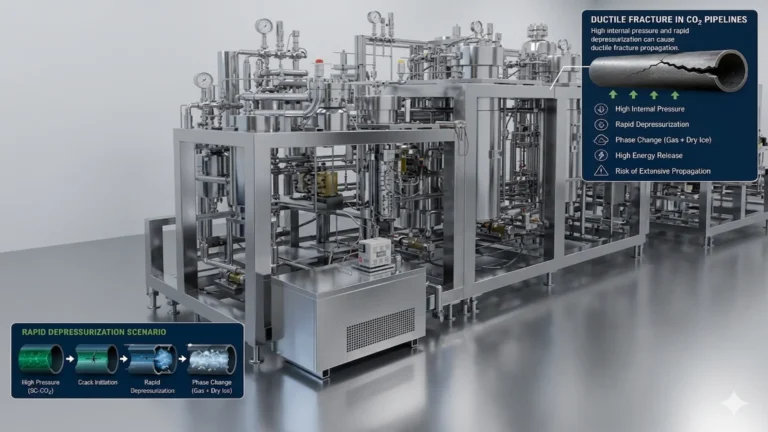
Ductile fracture represents one of the primary integrity risks in high-pressure CO₂ pipelines. Unlike brittle fractures, this mechanism involves significant plastic deformation before crack propagation. However, in large-diameter pipelines operating under high internal pressure, a ductile fracture can propagate at extremely high speeds if the energy released during decompression exceeds the arrest capability of the material.
In CO₂ transport systems, crack propagation becomes particularly complex due to the multiphase behavior of the fluid during depressurization. As CO₂ escapes, pressure rapidly drops and the fluid may partially transform into gas and dry ice, altering pressure wave velocities and the energy available for fracture propagation.
This phenomenon requires the development of specific fracture arrest models different from those traditionally used for natural gas. The decompression velocity of supercritical CO₂ may maintain elevated pressures behind the crack front for longer periods, promoting extensive propagation if the steel lacks sufficient toughness.
ROSEN Group has played a leading role in advanced research on fracture propagation and integrity assessment for the conversion of conventional pipelines to supercritical CO₂ transport. Its studies integrate thermodynamic modeling, fracture mechanics, and experimental evaluation of ductile propagation in high-strength steels. This technical consulting capability has become a strategic asset for operators seeking to repurpose existing infrastructure under industrial decarbonization schemes.
CO₂ pipeline materials
Material selection for CO₂ pipelines requires simultaneous consideration of mechanical strength, toughness, weldability, and susceptibility to corrosion for CO2 induced by impurities. API 5L carbon steels remain the predominant materials for CO₂ transport due to their availability, structural performance, and economic feasibility.
However, supercritical service introduces additional requirements related to chemical composition control, microstructure, and fracture behavior. The steel grades used must maintain high Charpy energy and strong resistance to ductile propagation even under low-temperature conditions generated by rapid decompression.
In many projects, API 5L X65 and X70 steels represent a balanced solution between strength and toughness. However, increasing mechanical strength does not always improve crack propagation behavior. In fact, ultra-high-strength steels may exhibit lower arrest capability if toughness is not properly controlled.
Modern metallurgical design for CO₂ pipelines incorporates grain refinement, non-metallic inclusion control, and advanced thermomechanical processing aimed at improving fracture resistance. Weld quality also becomes critically important because heat-affected zones may become vulnerable regions for crack initiation.
Corrosion in CO₂ transport systems
Although dry CO₂ exhibits relatively non-corrosive behavior toward carbon steel, the presence of water and impurities drastically changes the integrity scenario. Even small concentrations of moisture may generate carbonic acid, promoting localized internal corrosion.
In supercritical CO₂ pipelines, the main corrosion threats include:
- Carbonic acid corrosion.
- Localized corrosion induced by free water.
- Under-deposit corrosion.
- Corrosion induced by acidic impurities.
- Embrittlement associated with contaminants.
The presence of H₂S, SO₂, NO₂, and oxygen can significantly increase the chemical aggressiveness of the transported medium. These impurities alter pH, modify corrosion products, and may accelerate electrochemical degradation mechanisms.
Water content management therefore becomes a critical operational requirement. CO₂ transport systems establish strict moisture limits to avoid aqueous phase formation and minimize internal corrosion risk. In many cases, dehydration systems and continuous monitoring of stream chemical composition are required.
Carbon dioxide pipeline design
Carbon dioxide pipeline design requires integrating hydraulic analysis, fracture assessment, material selection, and thermodynamic modeling. Unlike conventional pipelines, CO₂ behavior during operational transients demands advanced multiphase simulation tools.
Critical design factors include:
- Operating pressure and temperature.
- Decompression velocity.
- Fracture arrest capability.
- Impurity content.
- Wall thickness.
- Charpy toughness.
- Weld integrity.
- Geotechnical and geohazard assessment.
In this context, the ROSEN Group develops inspection and monitoring technology for pipelines that transport fluids in a dense phase or supercritical state (e.g., CO2). Given that supercritical CO2 exhibits complex decompression behavior and poses a risk of fracture, ROSEN offers advanced assessment tools tailored to these challenges.
API RP 1192 provides specific guidelines for the design, construction, and operation of pipelines dedicated to CO₂ transport. The recommended practice addresses aspects related to material selection, corrosion control, risk assessment, and accidental release scenarios.
One of the most important contributions of API RP 1192 is recognizing the thermodynamic differences between CO₂ and natural gas, promoting specific integrity criteria for supercritical systems. This includes fracture propagation assessment, impurity control, and consequence analysis for massive CO₂ releases.
Conversion of existing pipelines for CO₂ transport
The reuse of existing infrastructure is emerging as an economically attractive strategy to accelerate CCUS projects. However, transitioning conventional pipelines to CO₂ transport requires comprehensive integrity reassessments.
Many pipelines originally designed for natural gas were not conceived considering ductile propagation phenomena associated with supercritical CO₂. This requires detailed analyses of toughness, metallurgical behavior, and chemical compatibility.
ROSEN Group has led multiple integrity assessment programs aimed at determining the feasibility of repurposing existing pipelines. Its methodologies include inline inspection, defect analysis, historical weld evaluation, and advanced fracture modeling.
The future integrity of CCUS systems will largely depend on the ability to adapt legacy infrastructure to new pressure scenarios, chemical compositions, and regulatory requirements.
The future of CO₂ pipelines
The expansion of carbon capture and storage projects will continue increasing the global demand for high-integrity CO₂ pipelines. The development of new materials, improved fracture models, and advanced monitoring technologies will be essential to ensure operational safety.
The challenge is not only transporting CO₂, but doing so under safety criteria equivalent to or exceeding those of current hydrocarbon systems. This requires multidisciplinary integration between metallurgy, thermodynamics, fracture mechanics, and integrity management.
Regulatory evolution will also drive stricter requirements related to emissions control, continuous monitoring, and risk assessment. In this context, materials engineering and ductile fracture prevention will continue being central pillars in pipeline design for industrial decarbonization.
Conclusions
Supercritical CO₂ transport represents one of the most important technological pillars for the development of large-scale carbon capture and storage projects. However, the thermodynamic conditions of CO₂ introduce complex challenges associated with ductile fracture, multiphase behavior, and material degradation.
Crack propagation in CO₂ pipelines requires specific analytical models due to the interaction between rapid decompression and the metallurgical response of steel. Under this scenario, proper material selection and toughness control become critical design variables.
The presence of impurities and moisture also redefines internal corrosion mechanisms, requiring strict chemical composition control and advanced integrity strategies.
Standards such as API RP 1192 and the specialized work of organizations like ROSEN Group are consolidating the technical foundations necessary for the safe development of future CO₂ pipeline networks supporting the global energy transition.
References
- American Petroleum Institute. (2015). API Recommended Practice 1192: Public Awareness Programs for Pipeline Operators. API Publishing Services.
- Cosham, A., & Eiber, R. (2008). Fracture control in high-pressure CO₂ pipelines. Proceedings of IPC International Pipeline Conference, 1–12.
- Mahgerefteh, H., Atti, O., & Denton, G. (2012). Modelling the decompression behavior of carbon dioxide in pipelines. Chemical Engineering Science, 74, 200–210.
- ROSEN Group. (2023). CO₂ pipeline conversion and integrity assessment for energy transition projects. ROSEN Technical Publications.
- Zhang, Z., Cheng, Y. F., & Luo, J. L. (2009). Corrosion of carbon steel in CO₂-containing environments. Corrosion Science, 51(8), 1714–1724.
Frequently Asked Questions (FAQs)
What makes ductile fracture critical in CO₂ pipelines?
The rapid depressurization of supercritical CO₂ can maintain high pressures behind the crack front, promoting extensive propagation if the material lacks sufficient arrest capability.
What materials are suitable for supercritical CO₂ pipelines?
API 5L X65 and X70 steels are widely used due to their balance between mechanical strength, toughness, and weldability, although material selection depends on pressure, chemical composition, and operational conditions.
How do impurities affect pipeline design?
Impurities such as water, H₂S, SO₂, and oxygen increase the risk of internal corrosion and may modify the thermodynamic behavior of CO₂, affecting integrity and material selection.
What does API RP 1192 contribute to CO₂ transport?
API RP 1192 establishes specific guidelines for the design, operation, and integrity of pipelines dedicated to CO₂ transport, including criteria for fracture, corrosion, and risk assessment.